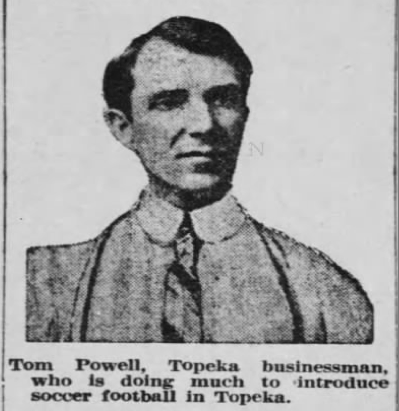
Thomas “Tom” Corden Powell’s contemporaries knew him as an impersonator of Scottish singer Harry Lauder and the owner of Topeka’s Scotch Woolen Mills. But above all, Powell was known as a soccer organizer—or as The Topeka State Journal put it, “the round football promoter of Topeka” and “the daddy and guardian angel of soccer football here.”[1]
When I first read about Powell in 2016, he was a footnote in my research about early soccer in Oklahoma, but he has evolved into a focal point of his own. From 1912 to 1916, he introduced and organized soccer teams and games for men in Topeka, Kansas. Despite his efforts, adult amateur soccer never achieved the same level of popularity as baseball and gridiron football in Topeka before the First World War. This was partially due to factors outside of his control such as the weather and the war. Powell nevertheless successfully advocated for soccer’s addition to the Topeka Public Schools’ sport offerings for adolescent males and also constructed the first open-to-all regulation soccer field in Kansas’ capital city. Powell’s efforts reflected Progressive Era values of physical activity, education, and health and the lingering competitiveness of the Gilded Age, demonstrated by his desire to have a winning soccer team in Topeka.
From Shropshire to Topeka
Thomas Corden Powell was born May 26, 1868, and baptized on July 5 in Baschurch, Shropshire, England.[2] At some point, he moved to Southport where he lived with his sister and brother-in-law. On March 29, 1902, the three family members departed Liverpool on the Red Star Line’s S. S. Rhynland, arriving in Philadelphia on April 7, 1902. The trio then left for Manhattan, Kansas, residing there for a year or two “in the hopes of improving their health” after the month-long trip from England to the American midwest.[3]
After a short stint working for a florist in Manhattan, Powell moved to Topeka and started working in the freight receipts office of the Santa Fe Railroad’s Auditing Department.[4] No records exist for the next five years of Powell’s life, but he must have enjoyed living in Topeka because he boasted about the city and encouraged other Brits to immigrate there during a five month visit back to Southport in 1908.[5] After returning to the US aboard the S. S. Saxonia, Powell filed immigration papers in Topeka to become a permanent U.S. citizen, which he gained in 1916, and declared his occupation as a railroad clerk.[6] A Topeka Daily Capital reporter quoted Powell as saying upon his return, “I am an Englishman by birth, but after crossing the Atlantic I became an American. I don’t believe in singing ‘God Save the Queen’ every time the word ‘England’ is mentioned.”[7]
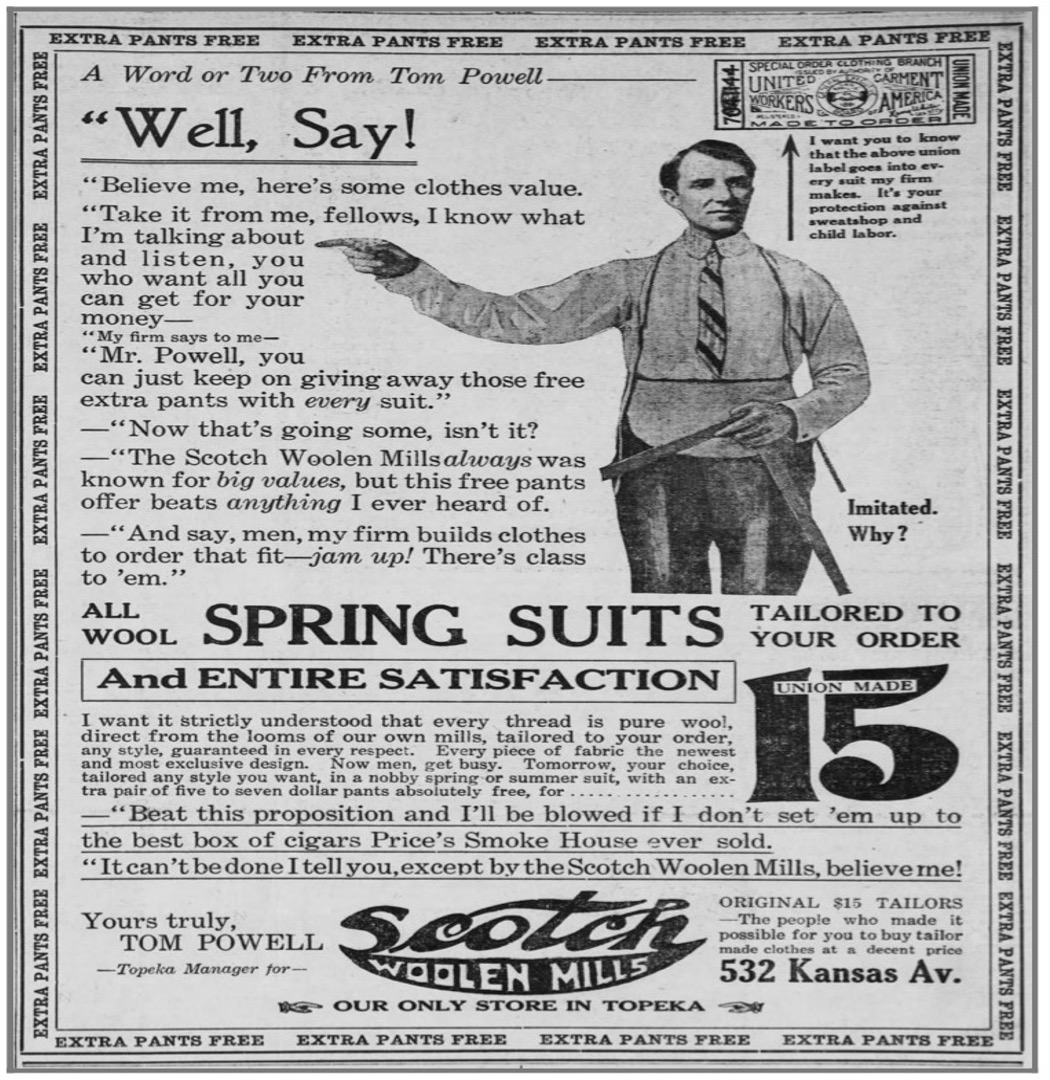
In 1910, Powell married Ella Isabel Stockham and became the store manager of Scotch Woolen Mills, Topeka’s woolen suits and tailoring firm. Four years later Powell bought the company.[8] Newspapers regularly praised both his and the store’s success. Operating the unionized Scotch Woolen Mills gave Powell connections to laborers of English, Scottish, and Irish descent, who like him enjoyed soccer, and also a location to hold team meetings.
“The soccer season proper begins when the football season closes and continues until Christmas time”
In October 1911, Powell, along with his brothers and other soccer enthusiasts, formed the Topeka Soccer Football Club. Fielding a side called the Topeka Specials, a Thanksgiving Day soccer game against the Maple Hill-based Tod Ranch Ramblers, also called the Tod Ranch Rangers depending on the newspaper report.[9] The game was played after a rugby match between Maple Hill High School and the “Topeka High School second elevens.”[10] Topeka newspapers only reported about the high school contest, but The Alma Signal and The Alma Enterprise published information about the soccer game a week later. The Alma Signal mentioned the Maple Hill teams won both games, noting that local photographer L. E. Wehe took “one [picture] of both of the foot ball teams” which were sold “at the Post Office at 25¢ each.”[11] The Alma Enterprise reported that the Tod Ranch team “outclassed” Powell’s team from the start and the game ended 6-0.[12]
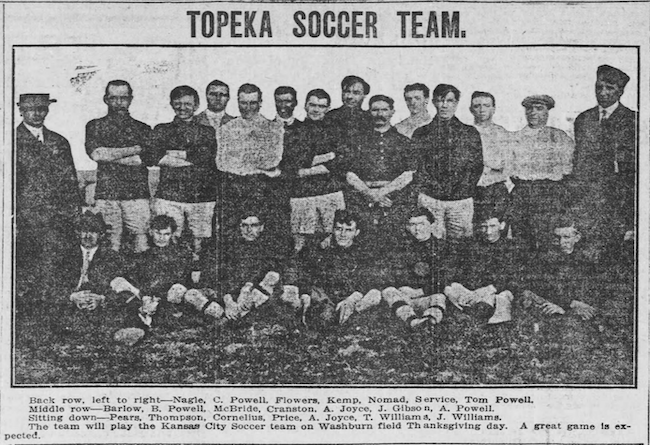
The lopsided loss appears to have left a mark on Topekan soccer enthusiasts; an August 1912 article in The Topeka State Journal observed efforts by Powell to organize a team beyond pickup games failed from a lack of players.[13] Nevertheless, in October 1912, Powell called for a meeting to organize a side to play against teams from Lawrence, Maple Hill, and Kansas City.[14] Twenty men answered the call and elected Powell the team’s captain at a meeting in the Scotch Woolen Mills store.[15] Called the Regulars, the team held its first practice at Skene’s Park four days after the organizing meeting.[16] A week later the Regulars kicked off their season with a 7-2 victory against local team the Colts at Topeka’s League Park.[17] After the victory, newspapers refer to the team as Tom Powell’s soccer team, the Topeka soccer football team or simply the Topeka team.
Local collegiate and amateur teams were already at play when Kansas City cricket clubs helped establish in 1912 the Inter-city Soccer Foot Ball League, the first organizational soccer body in Kansas and western Missouri.[18] Among the college soccer teams were sides representing Friends University in Wichita, the University of Kansas in Lawrence, Kansas State Normal School (now Emporia State University) in Emporia, and Baker University in Baldwin.[19] Kansas State Normal School and Friends University played Kansas’ first inter-collegiate soccer game in 1909.[20] The University of Kansas also allowed soccer to be taught to women as part of “a course in advanced work for those who are preparing to teach gymnasium work” as did KSNS which “also constructed a soccer field and began forming women’s teams.”[21]
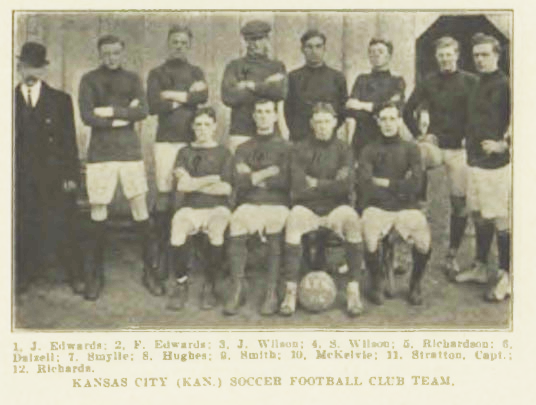
Amateur club teams including the Fort Leavenworth team, Kansas City (MO) Football Club, Kansas City (KS) Football Club, Schmelzer, British-Americans, and Kansas City Tigers were all approved as members of the new Inter-city Soccer Foot Ball League.[22] Powell’s team was not a member of the ISFBL but is mentioned in the 1913-1914 Spalding’s Guide, which referred to it as the Topeka team. This did not prevent Powell from arranging friendlies against ISFBL member teams.[23]
Thanksgiving and American gridiron football are inseparable today. But in 1912, an association football game excited Topekans more than gridiron. Powell had arranged a match with the Kansas City (KS) Football Club, the reigning ISFBL champions and one of two prospective opponents to contact him in early November about a holiday game.[24] Most newspapers advertised the soccer match between the Topekans and the Kansas City Football Club as the main Thanksgiving Day attraction with no other sports scheduled. One exception was a report in The Topeka Daily Capital of a game between African American gridiron football teams representing Topeka and Lawrence scheduled to be played at League Park in Topeka.[25]
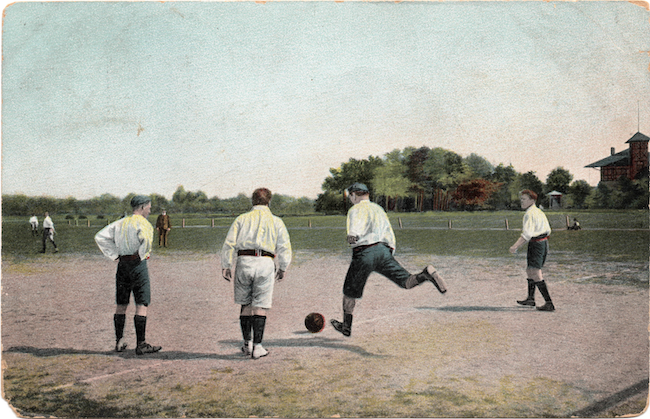
Before the Thanksgiving Day game Powell invited the public to an open practice on November 24 at Western League Park, a minor league baseball field.[26] The Topeka State Journal reported that Powell had received many phone calls from people wanting to know more about Topeka’s first chance “to see a real English soccer football game between inter-city teams.”[27] Newspapers emphasized how Powell’s roster featured immigrant players who reportedly played for prominent teams in England, Scotland, Isle of Man, and South Africa.[28]
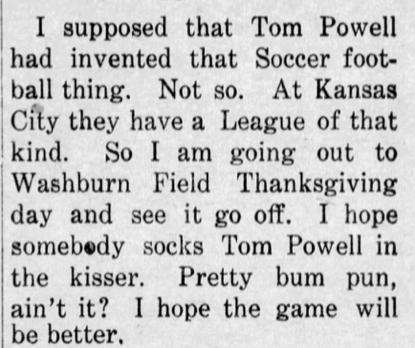
With interest in the Thanksgiving soccer game growing, Powell and the Kansas City Football Club coach arranged to play the contest on the Washburn College gridiron football field because it featured sideline.[29] For most Topekans, it would be their first soccer game. This included The Pink Rag’s editor, who hoped to see “somebody [sock] Tom Powell in the kisser.”[30]
Topeka defeated the Kansas City Football Club 3-1 in front of what The Topeka State Journal reported was “a good sized crowd.” The newspaper’s match reporter observed spectators were pleased by what they saw and declared, “the game is here to stay.”[31] Confident of soccer’s potential to bring large crowds, Powell offered to help organize “college or high school teams,” giving assurances that soccer would not interfere with gridiron football or baseball because it could be played in winter after the football season and early spring before the baseball season began.[32]
The 1912-1913 season would be the last complete season for adult soccer in Topeka prior to the First World War. Winter weather made it difficult to schedule games. By the time the weather cooperated, the baseball season was about to start. Powell, who also loved baseball, refused to arrange any soccer games with baseball’s opening day so close. Despite playing few games in the fall of 1913, Powell’s team supposedly joined the Missouri Soccer Football Association—the governing body for soccer in Missouri, southern Illinois, and eastern Kansas and affiliated with the United States Soccer Football Association—after being contacted by the association’s secretary following formation in February 1914. If the team was a member, little came of it and adult soccer growth faltered in Topeka. Meanwhile, public school soccer boomed.[33]
“The only way to develop good soccer material is to start in the schools”
The rise in public school soccer was connected to the efforts of social reformers after the excesses of the Gilded Age. One focus for addressing the consequent social ills was the promotion of sports for children, particularly children of immigrant descent in urban areas. Reformers had two goals: promoting children’s physical health and controlling their extracurricular activities through school sports leagues. By 1914, “almost every grade school in Topeka” had organized a soccer football team, and enthusiasts claimed soccer was on the rise in the town because of the number of boys learning the sport.[34]
In 1915, the Topeka Public School System reorganized its sports league into the Topeka Grade School Athletic Association.[35] Pressured by Powell, soccer was added to the sports available for sixth, seventh, and eighth grade boys, for whom gridiron football and its “forward passball” variant was already offered.[36] Powell observed, “It is hard to teach the old fellows who have been used to the American style of football the game. The only way to develop good soccer material is to start in the schools.”[37] The Topeka State Journal noticed the gender disparity in Powell’s unspoken assertion and commented, “Isn’t it funny how every kind of worth while [sic] sport has to begin with the boys?”[38] There is no mention of women or girls playing soccer in Topeka during this period, but sixth, seventh, and eighth grade girls competed in the Topeka Grade School Athletic Association’s forward pass competition.[39] Powell donated a trophy, the Tom C. Powell Cup, to be awarded to the champion of the eighth-grade soccer tournament while local businesses Fullerton Brothers and H. B. Howard & Company donated cups to the sixth and seventh grades competitions, respectively.[40]
In September 1915, Powell named his team the Santa Fe Soccer Football Team after the team’s official field for practices and games, the Santa Fe Shops Baseball Park.[41] Upon learning about the struggles the recently organized University of Kansas soccer team was having in finding opponents in the Midwest, Powell wrote two letters offering to play them.[42] Santa Fe players could only play on Sundays or holidays due to their full-time jobs, which at the time meant also working on Saturdays, so Powell suggested a Thanksgiving Day game with the Jayhawks.[43] Three weeks passed before the match was confirmed. It would be the first game between the Jayhawks and Powell’s team as “heretofore the authorities would not let the students play on Sundays or Thanksgiving, but as a football game will be played this year on Turkey day, there is no reason why a soccer game cannot be arranged.”[44] The game was free to watch to give young players an opportunity to watch and to learn.
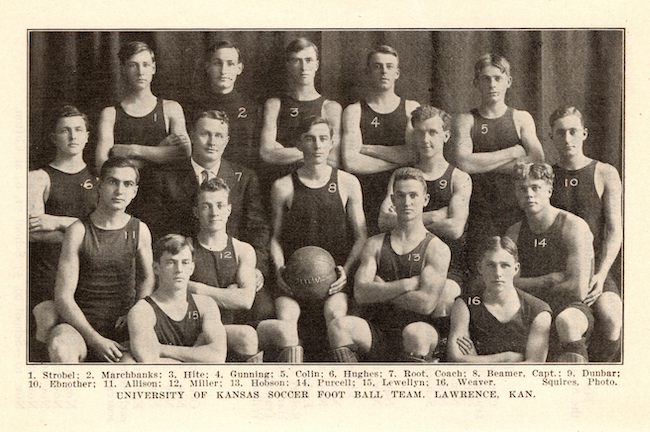
Even though it had only been formed in 1915, The Topeka State Journal reported before the game that “K.U. is said to have one of the best soccer teams in this part of the country.” After the game, which ended in a 1-1 draw, The Topeka Daily Capital called the Jayhawks an “inexperienced” team that “relied on their youthfulness and greater stamina.”[45] Powell complimented the Jayhawks’ speed and said, “if they had been a little more experienced they would have walloped us.”[46] Despite the underwhelming opponents, the “twenty-mile wind” and “the thermometer just a little above freezing,” the stands were filled with “several hundred people who shivered and shook and then yelled with delight every time a player, teetering uncertainly on one foot, drove the other viciously into the wind-blown spheroid and thus kept his goal from danger.”[47]
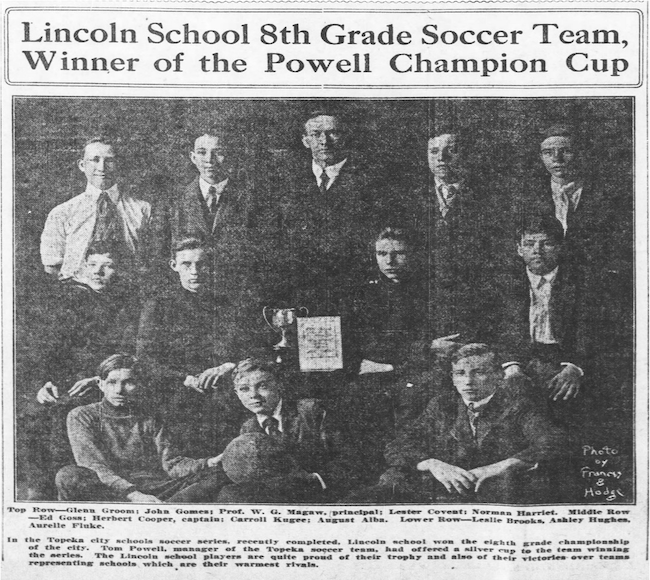
On November 30, 1915, five hundred children attended the slate of football, forward pass, and soccer school championship games organized by the Topeka Grade School Athletic Association. In soccer, Polk School defeated State Street School in the sixth-grade competition, but because of draws, the seventh and eighth grade championships had to be played again. Quincy School defeated Lowman Hill for the seventh grade Fullerton Cup, and Lincoln, which had lost none of its nine regular season games, defeated State to win the Tom C. Powell Cup. Both teams only scored one goal to decide their championships. All-Star teams for each sport and grade were also named to honor “those players who were the most loyal and played the best.” The Topeka Daily Capital published a photo of the Lincoln team with the principal and championship trophy. Fifty teams across the school grades competed in the Topeka Grade School Athletic Association soccer tournaments, playing a total of 250 games, while “thousands of children played the games on their own school grounds.”[48]
In early December 1915, Powell partnered with City Commissioner of Parks W. L. Porter to lay out Topeka’s “only regulation soccer football field” at Klines Grove, “the new East Side city park,” Kline’s Grove, also spelled as Klein’s Grove in newspaper reports. Bleachers would be constructed later.[49] The new field, open to everyone in the city, became the new home grounds for Powell’s Santa Fe team. Newspapers claimed soccer was getting “a larger hold on Kansans” and discussions about a “western soccer league” possibly between teams in “Chicago, Cleveland, Detroit, St. Louis, and Kansas City” were reported.[50] Yet, active work organizing adult amateur soccer matches declined in Topeka despite “the fact a great many adults are displaying a keen interest in the game.”[51]
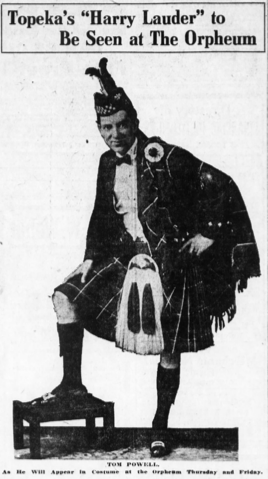
On August 25, 1916, The Pink Rag commented, “Something is wrong: Tom Powell has not been in on an item about soccor [sic] football in more than six months.”[52] A month later, Powell and City Commissioner Porter created a second soccer field at Ripley Park. Despite this construction and enlisting Kansas City Shamrocks manager David McBride to help form a team in December 1916, Powell organized no further soccer teams or games or in Topeka.[53] Powell denied that soccer was dead in the city but failed to prove it. In February 1917, The Topeka State Journal reported that Powell was spending more time performing bagpipe stunts as a Harry Lauder impersonator than organizing soccer and asked, “Is this an indication that Sir Thomas is not so virile as he once was, or was he driven to it by the lack of interest in soccer here?”[54]
Two months later, the United States entered the First World War. As Topekans directed their attention towards the global conflict, Powell helped recruit British and Canadian immigrants living in Kansas to enlist in those armies. One of his players and the Scotch Woolen Mills head tailor John “Jock” Alexander McBride was killed in combat in September 1918 while fighting in Europe with the Canadian Army. In his obituary, he was called “one of the best soccer players of the middle west.”[55]
Though scheduling conflicts and finally the First World War brought Thomas Corden Powell’s efforts to popularize adult soccer in Topeka to an unceremonious end, his story is representative of United States soccer history. As an immigrant, he promoted soccer in his adopted hometown, helping to strengthen the local working-class immigrant community’s bond in Topeka. His soccer fanaticism was palpable with one newspaper describing it as, “Nothing in eternity would make Tom so happy as to see all the angels, good and bad, spending their time playing the blooming old British game.”[56] Despite perpetuating Gilded Age and Progressive Era mindsets of prioritizing “native American sports” such as baseball and gridiron football by only scheduling soccer during their offseason, Powell understood that schoolchildren must be introduced to soccer to establish and grow for future generations of native born and immigrant players alike. Yet, when he died in 1946, his obituary in The Topeka State Journal made no mention of his passion and contribution to the sport much like how soccer has often been a footnote or left out of United States history.[57]
Endnotes
[1] The Topeka State Journal, November 6, 1915, 8; “Revive Soccer,” The Topeka State Journal, December 14, 1916, 9.
[2] England, Births and Christenings, 1538-1975. Salt Lake City, Utah: FamilySearch, 2013.
[3] Thomas C Powell, 1901 England Census; “Ships,” Red Star Line, http://www.redstarline.eu/ships.html; Thomas Corden Powell, Kansas, Naturalization Abstracts, 1864-1972, Ancestry; Thomas Corden Powell, Missouri, Western District Naturalization Index, 1840-1990, Ancestry; The Manhattan Republic, May 1, 1902, 1.
[4] The Topeka Daily Herald, October 3, 1903, 8.
[5] “Who They Are,” The Topeka State Journal, June 24, 1911, 11.
[6] Thomas Corden Powell, Massachusetts Passenger and Crew Lists, 1820-1963, Ancestry; Thomas Corden Powell, Kansas, Naturalization Abstracts, 1864-1972, Ancestry; “Can’t Get Rid of the Czar: Morduch Gurwitz is Again Opposed by U.S. in His Effort to Become a Citizen,” The Topeka Daily Capital, January 15, 1916, 20; Thomas Corden Powell, Missouri, Western District Naturalization Index, 1840-1990, Ancestry.
[7] “Half-Minute Interviews: Comments Heard in Passing by the Capital’s Reporters,” The Topeka Daily Capital, August 22, 1909, 17.
[8] Thomas Corden Powell to Ella Isabelle Stockham, Missouri, Jackson County, Marriage Records, 1840-1985; “Short Stories of Topeka Happenings,” The Topeka Daily Capital, January 26, 1910, 6; The Topeka State Journal, October 4, 1910, 9; The Pink Rag, August 7, 1914, 2.
[9] The Topeka State Journal, October 17, 1911, 10; “First Soccer Practice,” The Topeka State Journal, November 4, 1911, 19; The Topeka Capital-Journal, November 16, 1911, 14; The Alma Signal, December 7, 1911, 8; “Topekans Play at Maple Hill: Double Bill of Football Promised Sports There,” The Topeka Capital-Journal, November 28, 1911, 14; “In Double Header Against Topeka,” The Topeka Daily Capital, November 28, 1911, 2.
[10] The Alama Enterprise, December 8, 1911, 1; “Topekans Play at Maple Hill,” 14; “In Double Header Against Topeka,” 2; The Alma Signal, December 7, 1911, 8.
[11] The Alma Signal, December 7, 1911, 8.
[12] The Alama Enterprise, December 8, 1911, 1
[13] “Soccer Football,” 11.
[14] The Topeka State Journal, October 16, 1912, 5.
[15] The Topeka State Journal, October 18, 1912, 12.
[16] The Topeka State Journal, October 18, 1912, 12; “Was the First Soccer Game of the Season,” The Topeka Daily Capital, October 28, 1912, 2, 6.
[17] “Was the First Soccer Game of the Season,” 6.
[18] Edward Cartmell, Secretary, “Soccer Foot Ball in Kansas City, Mo.” in Spalding’s Official Association “Soccer” Foot Ball Guide edited by Thomas W. Cahill (New York: American Sports Publishing Company, 1913), 271
[19] Cartmell, “Soccer Foot Ball in Kansas City, Mo.,” 271; David Wangerin, Distant Corners: American Soccer’s History of Missed Opportunities and Lost Causes (Philadelphia: Temple University Press, 2011), 105.
[20] “First Soccer Game in Kansas: Played at Wichita Between Normal and Friends,” The Topeka State Journal, November 6, 1909, 2.
[21] “Women Play Soccer,” University Daily Kansan, January 16, 1912, 3; Brian D. Bunk, From Football to Soccer: The Early History of the Beautiful Game in the United States (Urbana: University of Illinois Press, 2021), 149.
[22] “Women Play Soccer,” 3.
[23] Cartmell, “Soccer Foot Ball in Kansas City, Mo.,” 271.
[24] The Topeka State Journal, November 2, 1912, 6; “Topeka Soccer Team Plays at Park Today,” The Topeka Daily Capital, December 29, 1912, 12; “Soccer Game Here on Thanksgiving: Tom Powell Strengthens Team for Turkey Day Contest,” The Topeka Daily Capital, November 24, 1912, 16.
[25] “Amusements Today,” The Topeka Daily Capital, November 28, 1912, 2.
[26] The Topeka State Journal, November 22, 1912, 6; “Ballpark in Topeka, Kansas,” postcard, Kansas State Historical Society, https://www.kansasmemory.org/item/228596.
[27] The Topeka State Journal, November 22, 1912, 6; The Topeka State Journal, November 25, 1912; The Topeka State Journal, December 28, 1912, 17.
[28] “Soccer Football to be Local Attraction Today: Topeka and Kansas City Teams Will Clash on Washburn Field,” The Topeka Daily Capital, November 28, 1912, 2; “Play Soccer Here: Topeka and Kansas City Meet on Washburn Field, Veterans of Game in Old World Will Play Here,” The Topeka State Journal, November 27, 1912, 5.
[29] “Soccer Game Here on Thanksgiving,” 16.
[30] The Pink Rag, November 22, 1912, 3.
[31] “The Soccer Game: Topeka Won from the Kansas City Team, 3 to 0, A Good Sized Crowd Placed O.K. on the New Local Sport,” The Topeka State Journal, November 29, 1912, 8.
[32] “The Soccer Game,” 8; “Off for Kansas City,” The Topeka State Journal, December 31, 1912, 7; Muskogee Times-Democrat, December 26, 1912, 7.
[33] David Frances Barrett, “Soccer Foot Ball in Missouri: Missouri Soccer Foot Ball Association” in Spalding’s Official Association “Soccer” Foot Ball Guide edited by Thomas W. Cahill (New York: American Sports Publishing Company, 1914-1915), 127; “Soccer in Topeka: New Rival of Football ‘Catching On’ With Local Athletes, Tom Powell Expects to Have a Winning Team Here,” The Topeka State Journal, October 1, 1914, 3.
[34] The Topeka State Journal, November 6, 1914, 3; The Topeka State Journal, January 14, 1915, 9.
[35] The Topeka Daily Capital, July 13, 1915, 7.
[36] “Quincy Breaks Tie, Wins Soccer Championship, Lincoln Beats State Street—Coach MacLean Chooses All-Star Grade School Teams,” The Topeka Daily Capital, December 12, 1915, 26
[37] “Soccer in Schools,” 7.
[38] The Topeka State Journal, January 14, 1915, 9.
[39] Quincy Breaks Tie,” 26.
[40] “Gives Out Schedule for Grade School Athletics: W. P. MacLean, Director, Announces Week’s Program, Seventy-Five Teams, 1,200 Children, in Four Divisions, Enter Contest Which Closes Thanksgiving,” The Topeka Daily Capital, October 11, 1915, 2.
[41] “To Use Santa Fe Park: Soccer Football Practice Will Begin Here Sunday Week,” The Topeka State Journal, September 25, 1915, 3.
[42] “May Bring K. U. Soccer Team Here: Tom Powell Feels Sorry for Collegians Who Can’t Find Team to Play Against,” The Topeka Daily Capital, October 24, 1915, 21; “May Arrange Soccer Game: Tom Powell Says K. U. Team Doesn’t Want to Play—Meeting for Those Interested Tonight,” The Topeka Daily Capital, November 13, 1915, 10.
[43] “Will Play Soccer Game: University Team Will Go To Topeka Thanksgiving Day,” Lawrence Daily Journal-World, November 17, 1915, 2.
[44] “Soccer Game Turkey Day? Tom Powell’s Team Wants to Meet the Jayhawkers Here,” The Topeka State Journal, October 29, 1915, 18.
[45] “Soccer Game Cinched, K.U. Will Play Powell’s Santa Fe Team Here Thursday Afternoon,” The Topeka State Journal, November 20, 1915, 6; “Soccer Game Was a Tie: University Boys Played Santa Fe Team at Topeka, High Wind Bothered Game and Chilled Bare Knees of Players at the Park,” Lawrence Daily Journal-World, November 26, 1915, 2.
[46] “Soccer Game a Draw: Santa Fe and K. U. Teams Played a 1 and 1 Tie Thursday,” The Topeka Capital-Journal, November 26, 1915, 12.
[47] “Soccer Game Was a Tie,” 2.
[48] The Topeka Daily Capital, December 1, 1915, 10; “Quincy Breaks Tie,” 26; “Soccer Cup to Lincoln: Eighth Grade Team Played Nine Games Without a Single Defeat,” The Topeka State Journal, December 13, 1915, 10; “Lincoln School 8th Grade Soccer Team, Winner of the Powell Champion Cup,” The Topeka Daily Capital, January 9, 1916, 2.
[49] “A Soccer Field: Topeka Teams will have Grounds at Kline’s Grove, Tom Powell and W. L. Porter Boost for Sport,” The Topeka State Journal, December 4, 1915, 4; “Soccer at Klein’s Grove Park: Tom Powell’s Team and Other Soccer Organizations to Use New City Park,” The Topeka Daily Capital, December 5, 1915, 28.
[50] The Manhattan Weekly Mercury, December 2, 1915, 4; Clug, “Sport Wheezes,” The Topeka State Journal, January 25, 1916, 3.
[51] “A Soccer Field,” 4.
[52] The Pink Rag, August 25, 1916, 3.
[53] “Revive Soccer,” 9.
[54] The Topeka State Journal, February 3, 1917, 7.
[55] “Killed in Action: “Jock” McBride of Topeka Makes Supreme Sacrifice. He Was a Volunteer in the Canadian Army,” Topeka State Journal, October 10, 1918, 1; “John A. M’Bride Falls in Action in France: Topeka Tailor Was a Favorite With His Friends,” The Topeka Daily Capital, October 11, 1918, 5.
[56] The Topeka State Journal, April 10, 1915, 3.
[57] “Tom Powell, Long Time Resident and Singer, Dead at 79,” The Topeka State Journal, February 2, 1946, no page.