
Originally published in issue number 4 “Politique(s): Le sport est-il de droite ?” in Les Sports Modernes – Association pour la valorisation des archives et de l’Histoire des sports (2026): 139-47. Printed in Neuchâtel: Éditions Alphil-Presses universitaires suisses.
Well before social media could capture and hold a public persona hostage to their own words, the United States government maintained the practice of written transcripts of the debates on the Congress floor. This political forum was rarely focused on sport and even less on soccer.[1] Yet a handful of words said in passing have become etched in collective memory. Such a view has been often bandied about by sports journalists, writers, and commentators of various decades as well as historians, to the point of shaping a political narrative about the nature of soccer in America. Was that sport politically weighted? More specifically, has soccer been a sport with a particular penchant for one political viewpoint? A short foray, this article explores the political leaning (or not) of soccer in America specifically around the iconic words of one 1980s Republican delegate from New York. Part historical exercise, part myth-busting, the following essay is not exhaustive of the wider topic but rather an examination of specific sources and narratives which have never been critically revisited.
Congressman Jack Kemp’s 1983 speech was unknown beyond the anecdotal memory of contemporary congressional representatives and undoubtedly forgotten until the archives were dusted off decades later. In the wake of September 11, 2001, critically-acclaimed author, Franklin Foer, used the lens of football to opine about the American political culture wars. In his 2004 book, How Soccer Explains the World, one of his key examples was the claim that Republican Congressman Jack Kemp took the floor in 1986 “to orate against a resolution in support of an American bid to host the [1986] World Cup”.[2] Kemp, we are told, embarked on a tirade against soccer as un-American, and qualified the sport as “European socialist.” Those were strong words from the influential conservative and former American football star. When Foer commented on Kemp’s politicization of soccer two decades later, the author was capitalizing on Andrei Markovits’s line of questioning about socialism and soccer’s shared failure to mark the American political and sporting landscapes, an argument presented in his acclaimed 2001 book, Offside: Soccer and American Exceptionalism.[3] While Foer nuanced some, he still concluded that there was a powerful anti-soccer lobby in the United States, one aligned with American exceptionalism and opposed to a progressive left-leaning globalist view. This was supposed to be embodied in Kemp’s notorious comments.
This lobby had deep roots going back through the Cold War and the 1970s. When upcoming Daily News journalist David Hirshey preferred to cover Pelé and a New York Cosmos game instead of baseball’s legendary Yankees, veteran sportswriter Dick Young told his younger colleague “Don’t waste your time on soccer” because “it’s a game for commie-pansies.”[4] Such rhetoric was regularly trotted out in the following decades. On the eve of the 1994 World Cup Draw in Las Vegas, veteran sportswriter Tom Weir asserted that “hating soccer is more American than mom’s apple pie.”[5] Notwithstanding a successful men’s World Cup in 1994, the launch of a new men’s professional league, Olympic and world titles for the US women, the sentiment continued. After Foer’s book had brought the “European socialist” quote to public attention, the anti-soccer lobby continued into the 2000s. In the midst of the 2010 World Cup, Marc Thiessen of the conservative American Enterprise Institute published an essay in the AEIdeas public commentary section that was entitled “Soccer is a Socialist Sport.”[6] But the most emblematic example was said to be conservative political pundit, Anne Coulter, who wrote a widely decried 2014 article entitled “America’s Favorite National Pastime: Hating Soccer.”[7] Her assessment of the sport solicited vivid reactions in Sports Illustrated but also across a full spectrum of media including the Guardian and Forbes.
Thus, in an exercise of reductive reasoning, we are to believe that the sport of football—soccer in America—is more associated to the progressive left (or un-American globalism for some) and in opposition to a right-leaning conservatism (grounded in nationalism and American exceptionalism for others). Things are, of course, more complex. This article will explore several aspects of this sporting-cultural-political debate with particular attention to this often-cited case which has been elevated to almost mythical status. Our examination of the 1986 “socialist” quote will cover what was being debated, who was involved, the timing, how the surrounding events unfolded, and ultimately contextualize Kemp’s now infamous words.
–0–
Let us begin with what was at stake. What caught Kemp’s attention and prompted his diatribe was a congressional resolution to be passed as law regarding the national government’s official support for the 1986 World Cup. Foer was correct on the specifics about the resolution, except that the congressman’s supposed anti-soccer harangue took place not in 1986 but actually three years before the competition in the spring of 1983. The world championship was supposed to have been held in Colombia after having been attributed to the South American country in 1974.[8] However, with the expansion of the tournament in 1982 (from 16 to 24 teams) and the more onerous requirements for the host country, the newly elected Colombian federation president, León Londoño Tamayo, was unable to obtain sufficient guarantees from the Betancur government. In addition, the creation of a private entity to manage the event took its organization out of the hands of the federation or government, something which did not reassure FIFA leadership.[9] This led to rumors confirmed by the press in October 1982 that “Colombia possibly would not be able to have the World Cup” and drew interest from Brazil (ultimately withdrawing), Canada, Mexico, and the USA.[10] Ensued over the early months of 1983 a rapidly pieced together bid from the United States Soccer Federation (USSF). We will not address the bid process, the “limits of football diplomacy” or the final result which has been well described by George Kioussis.[11] It is sufficient here to explain that the hosting for 1986 was thrown open with only three years before kick-off and support of the host country government would be a necessary requirement.
In the spring of 1983 the American governmental guarantee was prepared in the form of a joint resolution. Such a legal instrument meant that, to become law, it required passage in both chambers of the US Congress before signature by the president. The proposed text stated that the American Government would declare its “support for the efforts of the United States Soccer Federation to bring the World Cup to the United States in 1986.”[12] The resolution originated in March with two parallel measures introduced, one in the Senate by Larry Pressler on March 22 (Senate Joint Resolution – SJR69) and another in the House of Representatives by James Florio two days later (House Joint Resolution – HJR219). Senator Pressler’s speech was well-informed and highlighted the financial success of the 1982 World Cup. As chairman of the Senate Subcommittee on Business, Trade and Tourism, he underscored the important economic opportunity presented by such “a major tourist attraction for the host country.”[13] Just forty-eight hours later, Representative Florio, in his capacity as House chairman of the Subcommittee on Commerce, Transportation and Tourism, stressed the “positive effect on our trade balance.”[14] The emphasis was on concrete benefits. What was being asked of the national government was somewhat symbolic, somewhat practical. The resolutions underlined that the USSF was not asking for any direct financial support from the government; rather it was guarantees for visas, customs and international exchange rates.
As for the resolutions’ two sponsors, they were the faces of the parallel congressional subcommittees related to commerce and tourism but politically quite different. If Florio was a Democratic representative from one of the most reliably left-leaning districts in New Jersey, senator Pressler was a long-time Republican representative from South Dakota.[15] As the resolutions were discussed in their respective congressional committees through April, Democratic senator Daniel Patrick Moynihan reached across the political isle and joined the Republican Pressler to co-sponsor the resolution.[16] Testimony in support for HJR219 came from former Secretary of State Henry Kissinger, who underlined how in tourism terms “the World Cup may well be the world’s most lucrative event.”[17] However valuable the bipartisan support, the cause faced serious challenges.
By the time the resolutions were debated on the floor of Congress in the month of May, FIFA had already announced that it would not visit the United States. The USSF was in an uproar that Mexico’s hosting of the 1986 World Cup now appeared an almost foregone conclusion. In stepped Kissinger in an effort to turn the tide. Working to backtrack on the “public airing of grievances” in late March in which the USSF had lambasted FIFA, Kissinger adopted a “delicate tone” in an attempt to save any chance of hosting the event in America.[18] Quoted in the New York Times in early May, his optimism underlined how the movement was “getting broad-based public and political support now” with “a number of leading business executives joining our organizing committee.”[19] Notwithstanding public enthusiasm and a hopeful tone, the dice, yet to be cast, still appeared weighted against the US bid.
This was the context in which the resolution arrived before the congressional members for full debate on May 3. In the early afternoon, Florio presented his committee’s proposal to the House of Representatives who had just concluded lengthy discussions of the Federal Deposit Insurance Act and postponed the vote on legislation in support of tribally-controlled community colleges. The debate on Florio’s resolution lasted no more than approximately twenty minutes. Only a handful of individuals spoke in response: Donald Lawrence Ritter, Abraham Chick Kazen Jr., Jack French Kemp, Norman Frederick Lent, Gerry Eastman Studds, and William Marshall Thomas. Ritter, a Republican from western/central Pennsylvania was the co-sponsor in support of Florio. Kazen was a long-serving Democrat from Texas. Like Kemp, Lent was also a Republican from New York state. Studds was a Democratic representative from Massachusetts, while Republican Thomas represented California’s 21st congressional district. In all, of the six congressmen who spoke, four were Republican and two Democrat. What did they say on May 3, and particularly what was said about soccer being socialist?
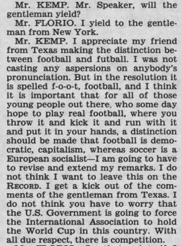
Shortly after 1:15pm, Kemp asked for the floor with the first questions for Florio. He wished clarification on the use of the word “football” to which Florio answered “it has not anything to do with football, as we know it,” in other words American football. Kemp thanked Florio for making the distinction because “with due respect for soccer, it is important that the American people know that this is not football, that it is soccer” and proceeded to ask how much it would cost.[20] Florio responded that, similar to the Olympic Games, no investment from the taxpayer was asked; rather, it was only a question of governmental support in the form of visas and customs arrangements. The Republican from New York spoke again and rather unequivocally in favor:
Before I make my 11-year-old son mad at me for giving the impression that I may be against it, let me announce that I am for holding the cup in the United States… I think the benefits would be quite extensive. But I want to make sure, as a very, very old football player, that we do nothing that would show support by the Government for one sport as opposed to another.
Notwithstanding his support, Kemp underlined a semantic problem about the use of the word football which, in the United States, most commonly referred to the American collegiate (and professional) game. He wished that “[FIFA] would change their name and stop confusing all of those young boys and maybe some young girls who think of football as football.” In stepped Democratic representative from Texas, Abraham Chick Kazen who reminded his congressional colleagues that the football being discussed was “spelled ‘fut,’ futball [sic] and that is the name in all Latin America.” Despite some hopeful words from Florio who was trying to win over support for the resolution, Kazen felt otherwise. The Texas Democrat went on to note how “we are newcomers” to the sport and that he did not believe “we as a government and as a Congress ought to come in and…bring that tournament to the United States. I think it rightfully belongs in Mexico.”[21] So, after the opening minutes of debate, the right-leaning Kemp had expressed initial support for a US-hosted World Cup all while highlighting definitional problems around the word “football.” In opposition was the south Texan Democrat Kazen, who argued unabashedly against supporting the US bid.
It was in response to Kazen’s comments that Kemp uttered his famous words, words that have not only been taken out context but twisted towards a different conclusion. As the subsequent lines in the archival record reveal, the New York Republican—and former star American footballer himself—was in fact supporting Florio’s resolution about the World Cup. What Kemp took issue with was the use of the word football instead of soccer. Football in his mind was the American sport, his American sport. It was in making this point, that he articulated his famous words: “football is democratic, capitalism, whereas soccer is a European socialist—I am going to have to revise and extend my remarks.” The congressional transcript indicates that even Florio was confused as to whether Kemp was in fact in support. But Kemp’s final words were unmistakable: “So I am going to support it [the resolution]. But I want to do so with the full understanding that someday I hope to see a full distinction in this country between football and soccer.” So, Kemp ultimately affirmed that he could welcome the world’s game to America, but he did not want to encourage the use of its internationally recognized name.
With Kemp’s support now explicit, two more Republicans rose to speak. William Marshall Thomas from California was well aware of the competing bids from Mexico for the originally planned Colombian World Cup. He argued that the Mexicans had already hosted the event in the prior decade and he believed it “entirely appropriate that the United States offer itself, based upon the surge that soccer or football has had in this country.” Thomas’s confidence emboldened him to even proclaim that the rest of the world should know that “not only are we going to be able to host a World Cup soccer, but we may very well be in the finals.”[22] Indeed, the support for the resolution appeared to be building across the congressional floor and the political spectrum. Long-time New York politician Norman Frederick Lent, who had served in the Senate for eight years before now representing the 5th District covering Long Island, also spoke in support of the resolution. The Republican talked at length, noting the surge of popularity with “more youngsters playing organized soccer in this country than baseball.” By the early 1980s, this fact was common knowledge regularly appearing in the news.[23] Commending Florio’s leadership, the Republican Lent urged his colleagues in support “because soccer is a sport which knows no politics.”[24] The adoption of Florio’s resolution began to look more promising.
The final contributions in the debate came from one Democrat and one more Republican. Gerry Eastman Studds, Democratic Congressman from Massachusetts, had asked previously about Kissinger’s involvement in the resolution. Subsequently, Studds expressed his disbelief in Kemp’s characterization of American football being capitalist and soccer being socialist calling it “a challenging intellectual concept.”[25] Ritter, the Republican from Pennsylvania and Florio’s co-sponsor, once again underlined the tourism and commercial benefits of hosting the World Cup and urged support. With that, the debate was closed, the vote was taken orally, and the resolution passed successfully in the House; three days later and with almost no discussion the Senate followed suit. Senator Pressler’s version was squeezed in between a long emotional reflection on the creation and importance of the Mother’s Day holiday as well as a newly proposed “Family Reunion Month.”[26] The joint resolution was then presented to President Reagan. It should be noted that the White House’s office did not consider this to be much more than a symbolic show of support. The internal memo to Fred Fielding, the President’s legal counsel, noted that the resolution “simply expresses support for the efforts of the USSF” in language that was “somewhat vague and in any event does not commit the government to any specific action.”[27] By the time the resolution was officially signed into law on May 20 in Washington, it could have no impact on the decision being made that same day across the Atlantic in Stockholm where FIFA voted to give the 1986 World Cup to Mexico. The deal was already done.
It was undoubtedly not the most significant piece of legislation proposed by Florio in what was his most active session as a congressman yet. But for the Democrat from New Jersey, known to argue “for a strong activist government,” the relief must have been palpable even for something hardly considered essential congressional business.[28] No further mention was made to the capitalist-socialist paradigm and Congress moved on. With Kemp remaining silent, the record offers little else for a deeper understanding of what the Republican had prefaced with the words “I say this with some tongue-in-cheek—football is football; soccer is soccer. Soccer does not have a quarterback; only football has a quarterback.”[29] Was it all just tongue-in-cheek? What did Kemp truly think about the sport? The only biography about Kemp implies that soccer was evidently not a sport he championed, nor watched even when his son Jimmy played.[30] The reason this semantic football-soccer distinction was important to him—enough to make a statement about it—was undoubtedly due to his own experience as a professional football player in the early days of the American Football League (AFL), before its merger with the National Football League (NFL). Over Kemp’s record-setting career which included two championships, he captained two professional teams (the San Diego Chargers and the Buffalo Bills), appeared in the league All-Star game seven times, and earned the 1965 AFL Most Valuable Player award. Kemp was known for his solidarity with the marginalized in sport, including black players, and also co-founded the AFL Players Association in an era that saw the rise of unionization in professional sports.[31] But the former star quarterback was not opposed to the World Cup coming to his country in the oppositional way his words have been reimagined to mean. Somehow, he could both hold a view disliking soccer personally while still supporting the government resolution in favour of hosting soccer’s championship event. Years later Kemp did go on record to clarify his words. The congressman admitted that while he had enjoyed “making fun of soccer” over the years because he could find it “boring,” his words were in jest. He spoke on the Congress floor “with my ‘tongue firmly planted in my cheek’…[and it] was based on one of [George] Carlin’s great comedic routines of the differences between baseball and football.”[32]
To close, let us return to Franklin Foer and his characterization of Kemp being among the “xenophobes and reactionaries intoxicated with a sense of cultural superiority, the sporting wing of Pat Buchanan’s America First conservatism.”[33] As mentioned at the start of this article, Foer’s overall analysis did seek to nuance and observed that there are “many conservatives who hate relativism, consider the French wussy, and still adore soccer.”[34] Yet Foer still mistook Kemp’s quote as evidence for opposition to hosting the World Cup in the USA. Certainly, the congressman had no love for the sport. But the quote was an ever-so-convenient fit to a narrative of the pro-soccer progressive versus anti-soccer conservative. Foer’s select use of the Congressional record is both incomplete and inaccurate, whether in factual regard to dates (1983 not 1986) or actual substance. As the archive demonstrates, the origin of the resolution and its support was entirely bipartisan. The sole voice in opposition to hosting the World Cup was not a Republican, but rather Kazen, the Texas Democrat. Instead, the resolution was supported by Republicans including the ambitious Thomas who envisaged (probably naïvely) a US team making the final. Foer’s use of the quote ignores the largely contextual insignificance of the resolution (because of its timing and process underway for deciding the 1986 host county). Perhaps most importantly, Foer’s approach conveniently conflates love/dislike of a particular sport for love/dislike of a particular political view.
Were Kemp’s words truly about soccer’s nature as a socialist sport or a conflation of his dislike for a sport that many socialist countries happened to play? The congressional transcript does appear to indicate that Kemp interrupted himself midway through his thoughts and stated his wish to “revise and extend his remarks.” But was it anything more than the congressman articulating, “tongue-in-cheek.” his preference for his own—and known—national tradition? In the same way that some outspoken pundits have made their distaste obvious for both soccer and progressive politics, conflating such sporting preferences with political leanings is a convenient shortcut. Perhaps it could be considered a heuristic foul on the field of a more fundamental and contextual issue. In Kemp’s 1983, soccer simply had not yet constructed a place in the collective national imagination in the way that baseball and American football had created their legitimate recognized histories at the start of the twentieth century.[35] In the minds of congressional representatives navigating the escalating Cold War tensions of 1983, soccer was just a new game associated to Pelé and the glitzy New York Cosmos. No published historiography did not mean no history, but it did mean no national narrative.[36] Anything anterior to Pelé was associated with immigrants and ethnic clubs, some of whom came from communist or socialist countries.
Without an American origin story, Kemp and any others who did not personally like (or know) soccer could sustain the view that the sport was a recent foreign import and unrepresentative of national values, the same ones threatened by what President Reagan had only just named the “Evil Empire” in early March. The same Florio who initiated the governmental resolution to host the World Cup, authored another proposal in September targeting the USSR following the Soviet attack on Korean Air Lines Flight 007 and only days before the nuclear false alarm and the subsequent Able Archer War Scare that autumn.[37] Tensions were high and anything with a possible socialist flavour was anathema in 1983 America. If soccer was indeed a socialist sport in 1983, then how could Henry Kissinger—probably one of the period’s most anti-socialist and anti-communist figures—still proclaim to be a soccer-phile? Indeed, if Kemp really believed that soccer was socialist by nature, then why would he ever let his own son play such a game, at home in the USA, to say nothing of supporting hosting the World Cup? However important the debate about the use of the word football appeared, the whole thing was not even important enough for Kemp to “get his remarks expunged” from the record.[38] Indeed, he was living through a paradigm change in which the sport he may have subconsciously associated to foreign socialist cultures was already becoming the game of American youth, including his own son. Ultimately, the whole matter of an old quarterback’s semantic offence to soccer being called football by his government may be little more than an embarrassing yet funny anecdote. The political pendulum swings back and forth. Irony would have it that Republican president Donald Trump—hardly considered a socialist politician—joked in July 2025 about issuing an executive order officially renaming “soccer” as “football” in the US for the 2026 World Cup.[39] What would Kemp think of that?
The author is grateful to George Kioussis for his constructive critique and pointing to additional sources.
Notes
[1] In the Congressional Record archives covering the period 1873 to 2025, the word “soccer” appears 4,435 times. Never more than a handful of times until the turn of the 1960s, “soccer ” begins appear regularly (between 20 and 70 times per year) during the 1970s, rising to close to 100 at the turn of the 1990s. For comparison, the word “football,” referring to American football, appears 19,744 over the same period, “baseball” 15,369 times, “basketball” 12,256. Only “hockey” is behind “soccer” at 2,990 times between 1873 and 2025. Statistics consolidated from Congress.gov.
[2] Franklin Foer, How Soccer Explains the World: An Unlikely Theory of Globalization (New York: Harper Collins, 2004), 241.
[3] Markovits first articulated his ideas in a 1988 article entitled “The Other ‘American Exceptionalism’–Why is there no soccer in the United States?” Praxis International 8 (2) (1988): 125-50. His thesis was later developed into a book with Steven L. Hellerman, Offside: Soccer and American Exceptionalism (Princeton: Princeton University Press, 2001).
[4] Correspondence with David Hirshey, 3 September 2025. Hirshey speaks about this in an interview with sports journalist Bill Simmons. See “B.S Report – Steve Nash (2010.06.03),” https://youtu.be/ipF9_igo_IE?feature=shared&t=2785.
[5] Tom Weir, “Soccer always on the wrong foot in USA,” USA Today, 18 December 1993, 2B.
[6] Marc A. Thiessen, “Soccer is a Socialist Sport,” American Enterprise Institute, 30 June 2010, https://www.aei.org/society-and-culture/soccer-is-a-socialist-sport.
[7] Ann Coulter, “America’s Favorite National Pastime: Hating Soccer,” The Clarion-Ledger, 25 June 2014.
[8] Letter, Helmut Käser to Federacion de Colombia de Futbol, 18 June 1974, reprinted in FIFA News, 133/134 (Juin/Juillet 1974), 290. The initial Colombian bid was as early as 1970, submitted two days before the quarterfinals of the World Cup. The document printed on embassy letterhead was sent to FIFA by the Colombian Ambassador to Mexico, Cesar Augusto Pantoja. See FIFA Archives, Box 35.9.1 – 1986 World Cup Colombia.
[9] See Folder “Correspondence with the local Org. Committee and withdrawal,” FIFA Archives, Box 35.9.1 – 1986 World Cup Colombia.
[10] Soccer Week, 14 October 1982.
[11] George N. Kioussis, “A bid denied: the U.S. application to host the 1986 World Cup,” Soccer & Society 21 (8) (2020): 946-959.
[12] Congressional Record—Senate, 22 March 1983, 6652; Congressional Record—House, 24 March 1983, 7424.
[13] Congressional Record—Senate, 22 March 1983, 6653.
[14] Congressional Record—House, 24 March 1983, 7496.
[15] All biographical information comes from Charles B. Brownson, 1984 Congressional Staff Directory (Mount Vernon: 1984).
[16] Congressional Record—Senate, 6 April 1983, p. 7678.
[17] Testimony on soccer World Cup, Subcommittee on Commerce, Transportation and Tourism of the House Committee on Energy and Commerce, Apr 7, 1983, MS 1981: The Henry A. Kissinger Papers, Part II, Series III, Box 698, folder 5, Manuscripts and Archives, Yale University Library, 2.
[18] Kioussis, “A bid denied… ,” 950-951.
[19] Lawrie Mifflin, “KISSINGER AND VANCE UNITE FOR SAKE OF SOCCER,” New York Times, 2 May 1983, Section A, 1.
[20] Congressional Record—House, 3 May 1983, 10763-64.
[21] Congressional Record—House, 3 May 1983, 10764.
[22] Congressional Record—House, 3 May 1983, 10764.
[23] See for example, Nancy Scannell, “Soccer Making Inroads on Baseball,” Washington Post, 2 May 1979, D1.
[24] Congressional Record—House, 3 May 1983, 10765.
[25] Congressional Record—House, 3 May 1983, 10765.
[26] Congressional Record—Senate, 6 May 1983, 11389.
[27] Memorandum from John G. Roberts to Fred F. Fielding, 17 May 1983, Roberts, John G.: Files; JGR/Resolutions, 1983, (2 of 2), Box 47, Ronald Reagan Presidential Library.
[28] In Florio’s eight congresses between 1975 and 1990, he sponsored 273 pieces of legislation, 70 of them between 1983-84. For more about Florio, see Michael J. Birkner, Donald Linky, Peter Mickulas, The Governors of New Jersey: Biographical Essays (Rutgers: Rutgers University Press, 2nd edition, 2014): 328. See Congress.gov “Member Activity by James J. Florio,” https://www.congress.gov/member/james-florio/F000215.
[29] Congressional Record—House, 3 May 1983, 10764.
[30] On the occasion of his funeral, Kemp’s son Jimmy explained his father’s enduring love for football above all sports and he “missed every soccer game I ever played, but if I was playing football, he was there.” Morton Kondracke, Jack Kemp: the bleeding-heart conservative who changed America (New York: Sentinel, 2015), 317.
[31] Larry Felser, Birth of the New NFL: How the 1966 NFL/AFL Merger Transformed Pro Football (Guidlford: The Lyons Press, 2008), 74-5 and chapters 3 and 4 in Ed Garvey, Never Ask “Why”: Football Players’ Fight for Freedom in the NFL (Philadelphia: Temple University Press, 2023).
[32] Jack Kemp, “What I really think about soccer,” 20 June 2006, https://humanevents.com/2006/06/20/what-i-really-think-about-soccer.
[33] Foer, How Soccer Explains the World, 241.
[34] Foer, How Soccer Explains the World, 245.
[35] For the construction of the national origin stories of baseball, American football and soccer, see Kevin Tallec Marston and Mike Cronin, Inventing the Boston Game: Football, Soccer, and the Origins of a National Myth (Amherst and Boston: University of Massachusetts Press, 2024).
[36] The sport has a long history but that has only begun to interest the academy since the turn of the millennium. See Roger Allawy, Rangers, Rovers and Spindles: Soccer, Immigration, and Textiles in New England and New Jersey (Haworth: St. Johann Press, 2005); David Wangerin, Distant Corners: American Soccer’s History of Missed Opportunities and Lost Causes (Philadelphia: Temple University Press, 2011); Chris Bolsmann and George Kioussis (eds.), Soccer Frontiers: The Global Game in the United States, 1863–1913 (Knoxville: University of Tennessee Press, 2021); and Brian Bunk, From Football to Soccer: The Early History of the Beautiful Game in the United States (Urbana: University of Illinois, 2021).
[37] As a direct response to the attack, Florio initiated H.Con.Res.162 – A concurrent resolution urging the President to prohibit grain shipments to the Soviet Union unless certain actions are taken by the Soviet Government.
[38] Kemp’s biographer notes that congressmen would often have transcripts edited in order to remove undesirable statements. After the discussion and his famous words, Kemp apparently told his aides he would get his remarks edited. But the record stands and he did not have the statement removed. Kondracke, Jack Kemp, 103.
[39] Interviewed by DAZN during the FIFA Club World Cup, a journalist suggested penning a new executive order officially renaming soccer as football, to which Trump replied “I think we could do that”. Caitlin McCormack, “Trump quips about signing executive order mandating soccer be called ‘football’ in America: ‘I think we could do that’,” New York Post, 13 July 2025.