Does SASH build tifo?
No. But SASH helped inspired one at a Minnesota United game in early August.
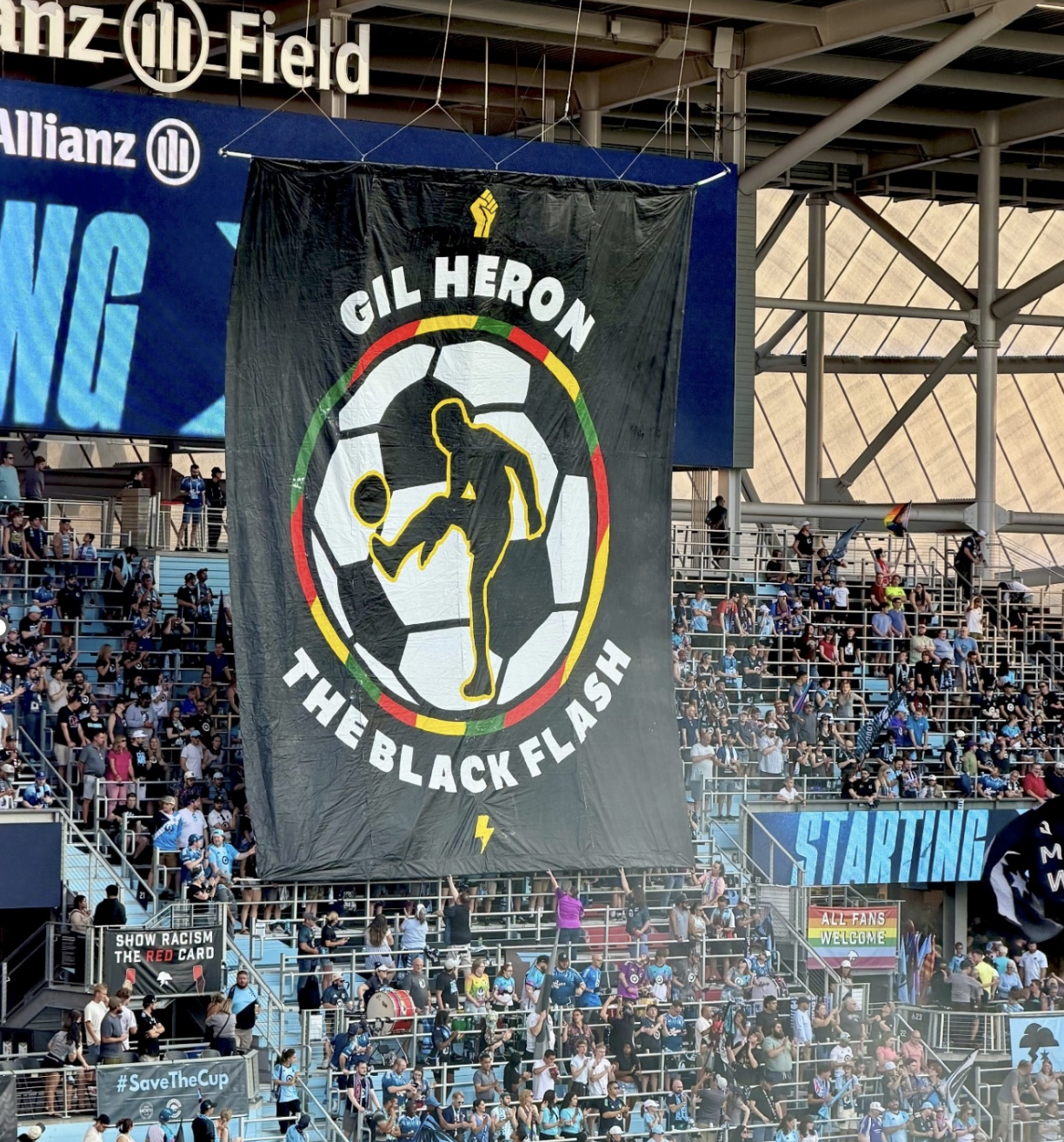
Wonderwall—the collective of Minnesota United supporters groups that includes Dark Clouds, Red Loons, and True North Elite—hoisted a large TIFO featuring Gil Heron over the crowd in celebration of Black Excellence Night on August 1 at Allianz Field.
SASH didn’t create the tifo. But Kalalyna Murphy, the senior art director at the branding studio Knock who designed it, says SASH played a role.
A coworker of Murphy’s who was on the Wonderwall TIFO committee reached out to her to see if she would be willing to create something that celebrated both soccer and black excellence. She had previously done pro bono work centered around the African American community, so she was all in.
Murphy’s first thought was to seek out black pioneers in soccer in the United States, people whose stories might connect the history of the game with the history of black achievement. Although Gil Heron’s impact on soccer in the US was centered on his time in Detroit, particularly with the professional North American Soccer Football League and later with Glasgow Celtic, his name came up early in her research. It was a familiar name, but she was confused. She knew of the musician, poet, and hip-hop pioneer Gil Scott–Heron, but who was Gil Heron? Murphy quickly realized Gil Heron was the father of the musician.
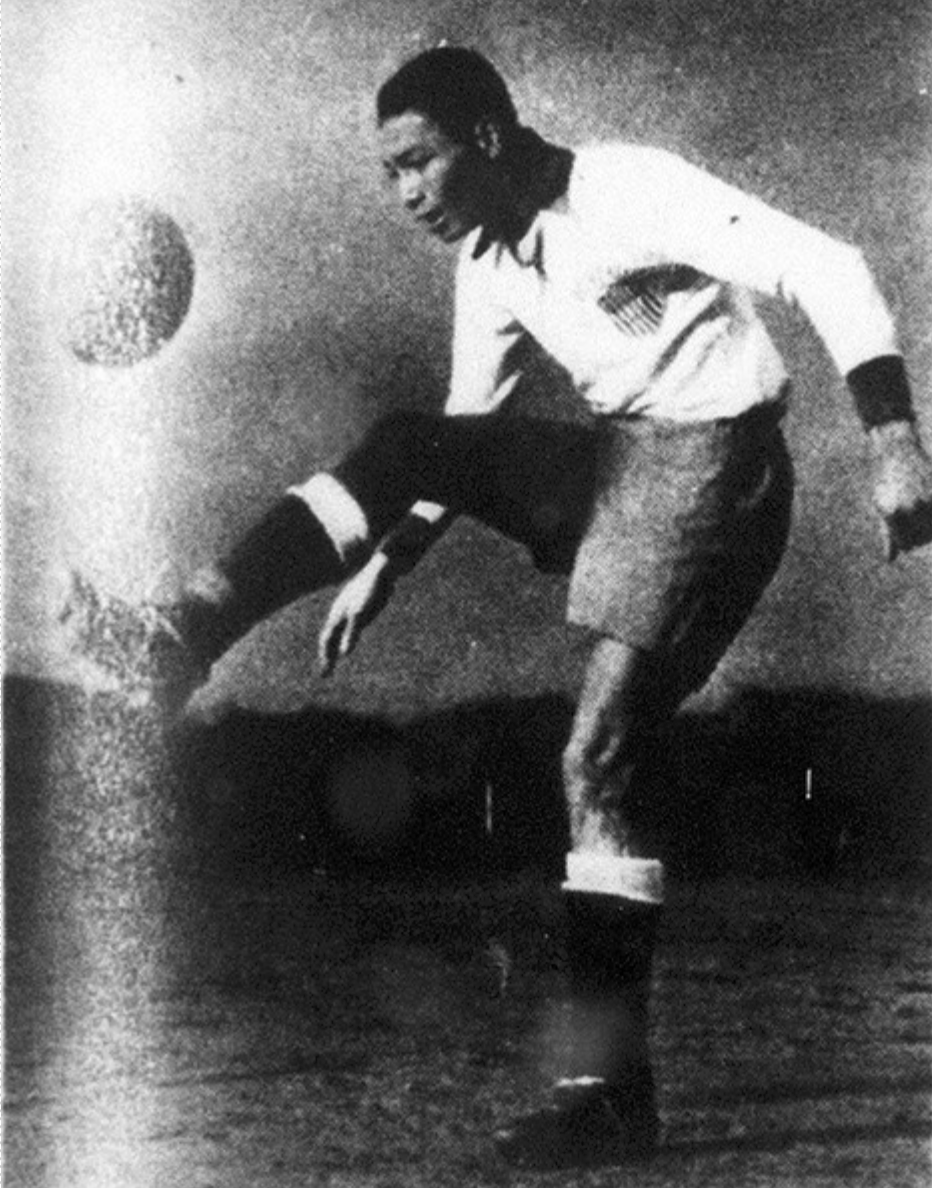
SASH was one of the first places Murphy found information about Heron the soccer player. Brian D. Bunk wrote two pieces in 2020 for the SASH site on the Jamaican-born player, a profile titled “Gil Heron,” and another looking at Heron’s playing style that includes photos of him published in the July 1947 issue of the magazine Ebony. In February 2026, Jermaine Scott, Maxwell Murray, and Chuck Carlson presented a SASH Session titled “Gil Heron and ‘Pito’ Villalon: Black Players Breaking Barriers in US Soccer.” Roger Allaway has written about the North American Soccer Football League.
The silhouette of Heron from one of the Ebony Magazine photos can be seen in Murphy’s tifo. He gained the nickname “The Black Flash” while playing for Celtic.
SASH doesn’t build tifo but it does work to tell the story of US soccer history. The Heron tifo is an example of how the story of one player uncovered through articles on the SASH website can find a new audience’s trying to make connections to the past.
Why does the USA keep doing this? As with many things, multi-racial progress in football existed long before the States got round to it, very late as ever. Scotland’s captain in 1881 was Andrew Watson. Look him up. Look up Arthur Friedenreich in Brazil in 1910, Isabelino Gradin and others in Uruguay from 1912. And youse want to make a big deal about 1947? A modicum of shame might be more apt.
Iain Campbell Whittle
Yes, isn’t it horrible that some supporters groups in a city still affected by the murder of George Floyd and recently was subjected to an “immigration enforcement surge” by racial profiling ICE came together to produce a tifo designed by a black graphic designer about a black player on a night celebrating Black Excellence.
Since you’re so interested in pontificating, maybe you should look up Oliver and Fred Watson, two African American brothers born in Pawtucket, Rhode Island who played in the 1890s and early 1900s. Just so you don’t have to put yourself out, here’s a link to the essay I wrote about them with my colleague Brian Bunk in 2020: https://www.ussoccerhistory.org/gentlemen-of-color-oliver-and-fred-watson-the-earliest-known-african-american-soccer-players-in-the-united-states/. Or maybe you can read the chapter we wrote about them in the book “Race and Resistance in Boston: A Contested Sports History” that was published in 2025.
Did you know Oliver and Fred Watson are the first documented black players in the world after Robert Walker, Andrew Watson, Arthur Wharton? I’m guessing not.
Did you know they were playing before Willie Clarke and John Walker? That they they were playing before Arthur Friedenreich, Isabelino Gradin, and your unnamed others. Clearly not. Did you know that the city of Pawtucket is now placing a historical marker on the Watson brothers’ home and giving the street the house is on the honorary name “Watson Brothers Way”? No, you did not because you’ve never heard of them. But that’s okay, they were forgotten for 120 years until Brian and I wrote about them. Unfortunately, the Watsons aren’t very tifo friendly because no pictures of them are known to have survived.
Brian and I also made presentation about the Watson Brothers that’s been available on the SASH YouTube channel for six years at https://youtu.be/qHPl-4K_CVY. In case you can’t be bothered to spend an hour watching the presentation, here’s a link to the slideshow we used: https://docs.google.com/presentation/d/1yWVbVbLlzfEJKfY7vzAqJa6mvwCLVX2GDCN3yFeIzSs/edit?usp=sharing. Just go to slide 15, titled, “The Watson’s Black Contemporaries.”
While you’re at it, maybe you can take the time to look at Brian Bunk’s piece on the multi-racial Barrow School team that won Springfield, Massachusetts’ Junior League Championship in 1908 at https://www.ussoccerhistory.org/the-barrow-school-socker-foot-ball-team/. Or Brian’s piece examining a possible image of black players in a game in New York City’s Central Park from 1915. In it he notes that the earliest documented Black soccer club in the city, the Spartan Athletic Club, was formed in 1908. So you don’t have to look that up, here’s the link: https://www.ussoccerhistory.org/an-early-image-of-black-soccer-in-new-york-city/. After that you can check out the presentation Jermaine Scott made three years ago titled, “Black Soccer Radicalism in New York City, 1928-1949” at https://youtu.be/XJtKJCJQaKU.
When you’re done looking at all of those sources, come back and tell us more about the need for a modicum of shame.