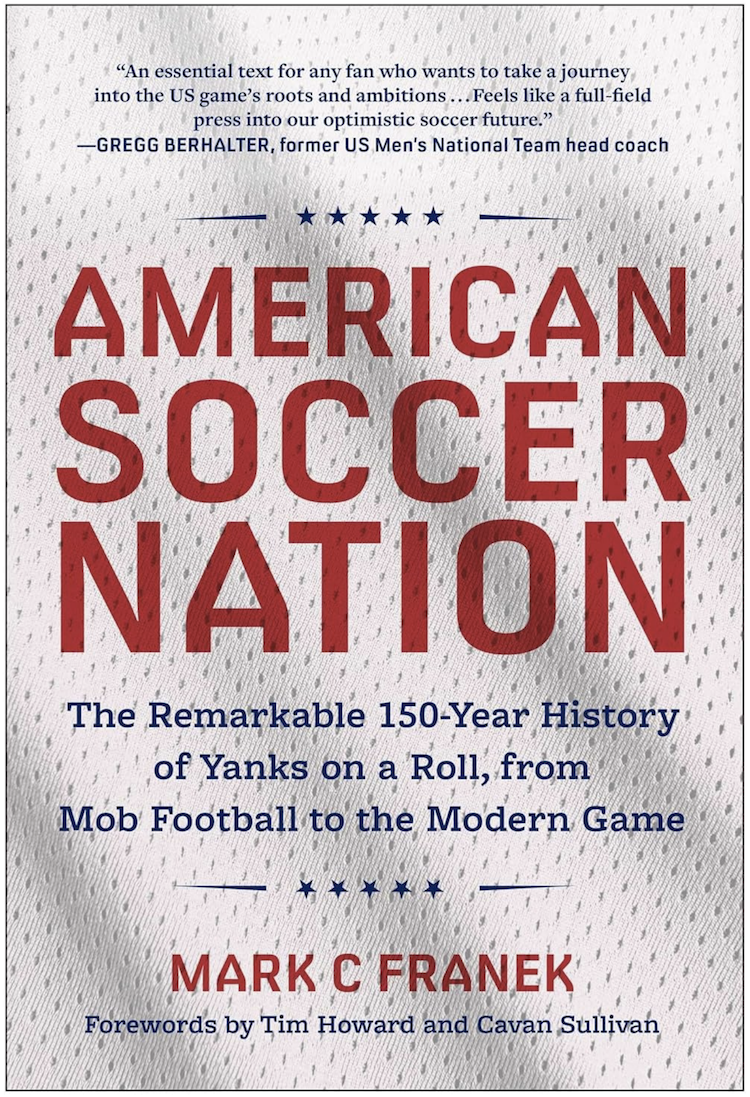
SASH member Mark C Franek has a new book out called American Soccer Nation: The Remarkable 150-Year History of Yanks on a Roll, from Mob Football to the Modern Game.
Franek teaches English at YSC Academy, the independent, college-preparatory school founded by Union minority owner Richie Graham in 2013 embedded within the Philadelphia Union’s academy system. Combining rigorous academics with professional-level soccer training, YSC Academy’s 15,000-square-foot campus is located next to the Union’s stadium in Chester, Pennsylvania. Part of the academic program includes a yearlong course Franek teaches on the history of American soccer.
 Franek has long experience with soccer and as an educator. After playing varsity soccer for a stint at Duke University, he played semipro club soccer for six seasons in Iceland and captained the Philadelphia Ukrainian Nationals. He has coached varsity boys soccer at the Montgomery Academy in Alabama and William Penn Charter School in Philadelphia, where he was also Dean of Students. Following a BA in English and Masters in Teaching from Duke, Franek received a Doctorate in Educational Leadership from the University of Pennsylvania. He’s been a visiting professor at Philadelphia University (now Thomas Jefferson University) and Cabrini College, and was also an instructor at the University of Pennsylvania’s Graduate School of Education. Following two decades in education, Franek received a degree in law from Temple University and worked for six years as a litigator before returning to teaching at YSC Academy.
American Soccer Nation recounts the history of elite men’s soccer in the United States. It is popular history, entertaining and intentionally optimistic in its point of view. Franek strikingly connects history with what he identifies as the essential elements needed to move American men’s soccer to its highest level.
I’m a Philadelphia guy. Much of my focus as a historian has been on Philadelphia soccer. My earliest soccer memories involve Philadelphia teams like the Atoms, the Fury, and the Fever (and, of course, Soccer Made in Germany on our local public television station!). I’ve had Philadelphia Union season tickets since the team’s first season in 2010. As managing editor of the Philly Soccer Page I wrote over three thousand articles and edited hundreds more before stepping down from the site in 2017. A former colleague from the Philly Soccer Page connected me with Franek in 2024. While we haven’t met yet in person, I’ve been delighted to learn that work I and other SASH members have done is part of Franek’s curriculum at YSC Academy. After Franek invited me to read a prepress copy of American Soccer Nation, I described the book as “an engaging introduction” to soccer’s long history in the United States, one that is a “timely and entertaining starting point for deeper discussion,” concluding that the book “is sure to become a classroom staple.” It’s a fun read, one aimed not so much at those who have already been bitten by the US soccer history bug as it is aimed at sparking wider interest in the deep history of the game in the US most Americans don’t know. Gratifyingly, Franek repeatedly points readers to SASH to learn more.
As historians do, Franek and I disagree on some aspects of American soccer history, and we’ve had some lively email exchanges related to those disagreements. But we agree far more than we disagree and those disagreements don’t take away from American Soccer Nation’s optimism and easy reading. And as a historian of American soccer, it is fundamentally encouraging to see awareness and appreciation of American soccer history coming from within the elite men’s soccer ecosystem and promoted as one of the essentials needed for American soccer to continue its advance both at home and abroad. As a Philadelphia soccer guy, I’m proud American Soccer Nation was written by someone with so many connections to the Philly region, including the Philadelphia Union.
Franek kindly answered by email eleven questions about American Soccer Nation. He’ll be doing a SASH Session Book Talk on American Soccer Nation on Friday, July 17 at 12 PM ET.
The genesis of your book is the classroom. Tell us more about the year-long course you teach YSC Academy students about American soccer history.
I teach a year-long course that blends the history of elite men’s American soccer with stories and essays from soccer writers around the globe. In a given week, students might read a chapter from my book, excerpts from others, and first-person accounts from current and former pros published in the free online magazine The Players’ Tribune. I ask students to make connections between themes in these texts and their own lives. Their written responses become part of a self-published book that grows in volume and vibrancy throughout the year. The books become a part of a classroom library. I try not to bore students. Teaching bored students well, week after week, is about as hard to do as scoring a Panenka on a professional goalie.
You’ve described your students find much of the reading list for your class “overwhelmingly negative, defeatist, and uninspiring.” Tell us more about that.
Many of the books written about American soccer over the past twenty-five years are remarkably negative and pessimistic. Respectfully, what teenager—what American soccer fan—wants to read a book titled Why the US Men Will Never Win the World Cup, or What Happened to the USMNT: The Ugly Truth about the Beautiful Game? Too many American soccer books—even the well-written ones—are filled with stories of woe and disappointment about our game. I choose a different approach. I kept students and fans in mind and focused on the most distinctive and powerful moments of the American journey. I tried to deliver those moments like hopeful crosses into the box, in chapters that are easy to read and engaging, without ignoring our missteps or downplaying the global game.
You’ve described how your book is a “fundamentally optimistic account” of American soccer history. What has changed over the past twenty-five years to allow such optimism?
I view our soccer journey (and potential future) with optimism. Much has changed over the past twenty-five years. MLS and USL are expanding nationwide, powered by deep-pocketed investors supporting clubs, leagues, new stadiums, and media deals. In his foreword to my book, Tim Howard notes that today’s American fans are more passionate and knowledgeable than ever: “the standards are just higher for everybody.” Player development is improving across the country—from thriving MLS NEXT academies and independent superclubs to college programs to professional teams. Fans, too, are sharper and more engaged, eager to support their local teams as well as the USMNT. There is still a lot of work to do, which involves (among other things) building consistently strong and inspiring professional leagues nationwide, and earning sustained respect on the international stage. We may not out-sing anyone in the stands, but we’re on a collective march toward excellence on and off the pitch. The run-up to and glow of the 2026 World Cup may prove that America really is the land of soccer opportunity. And I wouldn’t bet against the Yanks.
In your introduction to the book, you mention an opinion piece you wrote in 2008 that appeared in the Philadelphia Daily News that was skeptical of MLS. But you also expressed hope that the Union would be able to capture the energy and enthusiasm for soccer already evident through the game’s existing historical foundation in the Philadelphia region. You now support the Union project through your work at YSC Academy. Tell us about the evolution of your thinking about MLS.
My thinking tracks MLS’s evolution, and has been positively influenced by the league’s successes over the past decade. In 2008, the year I wrote my crusty op-ed piece, the league had only 14 teams, and only six franchises were playing in soccer-specific stadiums. No club—not one—had a fully functioning youth academy system. Many of the owners were losing money. Beckham had yet to join LA Galaxy. The Beckham Experiment—the name of the spectacular book by the late great Grant Wahl—hadn’t been published yet, and no one really knew where the league was headed and whether the whole MLS experiment would work. Today, the league is up to 30 teams. Twenty-five franchises are playing in soccer-specific stadiums—including intimate soccer venues, such as those in St. Louis and San Diego, that rival the best in the world. MLS NEXT has completely replaced the USSF’s Development Academy (DA), and now includes all 30 teams in the MLS, plus over a thousand independent teams around the country. Some academies, like the Union, are regularly producing pros. Many are earning six-figure salaries to play soccer on American pitches in front of adoring fans. And all MLS games are viewable in HD via a modest Apple TV package. These days, even without factoring in the expected World Cup bump, MLS has plenty going for it. I stand by my original op-ed. But I’m glad it’s a relic of the past.
What are some of the aspects of American soccer history that excite or inspire your students?
Young soccer stars come to appreciate they are part of a gritty national story stretching back over 150 years—that they are a part of an international sport that is nearly as old as baseball on American soil. Students learn about how mob football was played by Native Americans long before Europeans arrived; how organized soccer in America predates gridiron football, and even took a few tentative breaths on American colleges before being sustained by immigrants within working-class communities; and why the sport has long been more inclusive and immigrant-friendly than all the other North American professional team sports. As the academic year moves along, my students examine the good, the bad, and the ugly of the original American Soccer League (ASL), the North American Soccer League (NASL), and the early growing pains of MLS. There are many more things to admire than to despise about our remarkable soccer journey.

How does the study of American soccer history help the development of academy players?
This book offers academy players—and those already in or on the edges of the soccer tent—touch points and stories from the American journey, not as referees assigned to judge every misstep, but as fans, to discover and to celebrate. This book attempts to teach academy players that finding inspiration from our collective history matters. And so does developing a positive mindset about who we are as American soccer players. Both are paramount for accelerating growth within the sport. No one wants to talk—or pass the ball—to a soccer curmudgeon. We’ve all met these kinds of players, parents, and fans. They are the ones who are always complaining about American soccer, who are not willing to work hard for the team, and who are not interested in learning from past mistakes in a sustained collective effort to make our sport better. Yanks need to lean into our soccer history (warts and all) and exude optimism, confidence, and passion about our future. This book attempts to harness and double-down on that energy.
Do you have a sense that the benefits of student athletes learning about American soccer history is growing in other academies? Has your course inspired or influenced courses at other MLS academies?
Such things are hard to judge. And it’s too early to tell if other MLS academies and independent superclubs will follow in YSC Academy’s footsteps. Late in the book, I outline a concept called “Total Immersion,” which details how to create and maintain a wholistic learning / coaching environment that supercharges the soccer dream for America’s elite athletes. Of course: I’d love it if every major club in America would buy the book at a deep discount (reach out to me at AmericanSoccerNation.com) and give it to their academy players and parents! A rising tide of professionalism, knowledge, and coordination will lift all boats in the vast U.S. soccer ecosystem.
What kind of resources are needed by educators to help better teach American soccer history?
The best starting point for teachers, coaches, and fans is the Society for American Soccer History (SASH) website, which offers extensive content from leading American soccer writers, along with links to their work. For weekly reading, my students turn to traditional outlets like The Athletic, ESPN FC, GOAL, and Soccer America, as well as newer platforms such as The Players’ Tribune. They also listen to a variety of soccer-focused podcasts. What makes these sources so valuable is that many of the content creators are passionate, opinionated, and often present varied viewpoints. Discussions range from thoughtful analysis to heated debate—from brain food to headbutts. And that’s a wonderful thing: it shows that the American soccer nation is already vibrant, open to diverse perspectives, and growing rapidly.
What role does the teaching of American soccer history play as one of the “essential elements needed to move the soccer needle at its highest level” in the US?
A deeper knowledge of elite men’s American soccer benefits players, organizations, and fans alike. Young players learn from past stars and professionals, gaining insight into player development and career trajectories. Governing bodies such as the USSF can draw on history to build more sustainable systems and, ideally, avoid repeating past mistakes. Fans, in turn, gain a richer appreciation for milestones like the 1994 FIFA World Cup, the rise of MLS and USL, and other “victories” along the American journey—deepening their connection to the sport and its growth in the United States. Ultimately, the long-term success of all these groups—players, organizations, teams, and fans—depends on a genuine understanding that we are all connected. That idea must evolve into a set of beliefs backed by action. The USSF and MLS need to recognize that they are on the same team, and should make decisions based on what best serves youth development in America rather than on narrow interests or short-term financial gains. Players and parents can do more by developing a broader awareness of the full spectrum of soccer competencies and fostering a sincere appreciation for elite-level soccer, from academies through the professional ranks. Fans, too, play a role by showing up in greater numbers whenever the USMNT plays on home soil. Some readers may see all this as ridiculously ambitious—or even unrealistic. I don’t. The final chapter of my book offers a practical roadmap for reaching the summit.
Do you have a sense that an appreciation of the importance of American soccer history exists among the powers that be in US Soccer and MLS? What can historians do to encourage soccer associations, leagues, and academies to embrace American soccer history?
I don’t know whether the powers within the USSF and MLS appreciate the importance of American soccer history. The novelist and social critic James Baldwin reminds us to “Know from whence you came. If you know whence you came, there are absolutely no limitations to where you can go.” YSC Academy and its Board, and the larger Philadelphia Union universe, have given this book project tremendous support. They realize we are all connected, and a victory for any single member of the community is a victory for all of us—at least as far as soccer is concerned. As to soccer historians, I urge them to appreciate they are keepers of the flame. But to realize that today’s young people learn very differently than any generation before them. Today’s students have immediate access to powerful electronic communication devices and a host of artificial intelligence platforms that make it very difficult for teachers (let alone historians!) to capture and maintain their interest. I think historians need to keep plugging away at it and embrace social media and be open to new ways to tell a story. My best advice almost always boils down to a soccer analogy: Appreciate the value of teamwork, pass the ball to the next guy, enjoy the journey (even if it has now migrated almost entirely online, to the choppy waters of the social media world), and support the Show!
What have you been surprised to learn in researching American soccer history?
One thing I discovered during the writing was how the game of soccer is really a metaphor for living and developing winning habits of mind. I’m sure others have written about it: How wonderful it is that nothing really ambitious and big happens without teamwork, and yet—and yet!—sometimes it is the individual playmaker that creates the spark that makes a material difference to the final outcome.
American Soccer Nation: The Remarkable 150-Year History of Yanks on a Roll, from Mob Football to the Modern Game. By Mark C Franek. Dallas: BenBella Books, 2026. 320 pp. 978-1637748640 (Softcover) $21.95. 978-1637748657 (e-Book) $14.95.
American Soccer Nation is available now for purchase from its publisher BenBella Books as well as Amazon, Barnes & Noble, Books-A-Million, Bookshop, and Walmart