Readers of the Boston Globe in the 1920s had little reason to think of faraway Worcestershire. If American readers were familiar with the county at all, it was probably on account of Lea & Perrins whose most famous product was advertised extensively, helping to explain why Globe journalists referred to Worcester as ‘The Saucey City’ (sic). Given this context, the strident headlines ‘SOCCER STARS OF WORCESTER COUNTY WELL PRIMED ON EVE OF ENGLISH INVASION’ (2 October 1926) and ‘WORCESTERSHIRE, ENG, SOCCER TEAM TO START BAY STATE INVASION NEXT WEEK’ (14 September 1927) are particularly striking
What were the events that led to football teams from Worcester, Mass, about 40 miles from Boston, visiting ‘Worcestershire, Eng’ in 1926 and 1929, with teams from Worcestershire crossing the Atlantic in the other direction in 1927 and 1930?
The story begins during the First World War when the Mayor of Worcester, Arthur Carlton, established the British-American Fellowship with the aim of ensuring that US servicemen passing through on their way to the front would receive a warm welcome. The scheme was based on the premise that towns and cities in Britain would ‘adopt’ towns and cities in the USA in a version of what later became known as ‘twinning’. Providing hospitality in the cathedral city for soldiers from its Massachusetts namesake was one of the most obvious ways to develop the connection. After the war the Fellowship found other ways to continue its goodwill mission, principally through ‘a school-linking scheme’ and Carlton ‘devoted an enormous amount of time to the carrying out of this work’ (The Times, 4 July 1919).
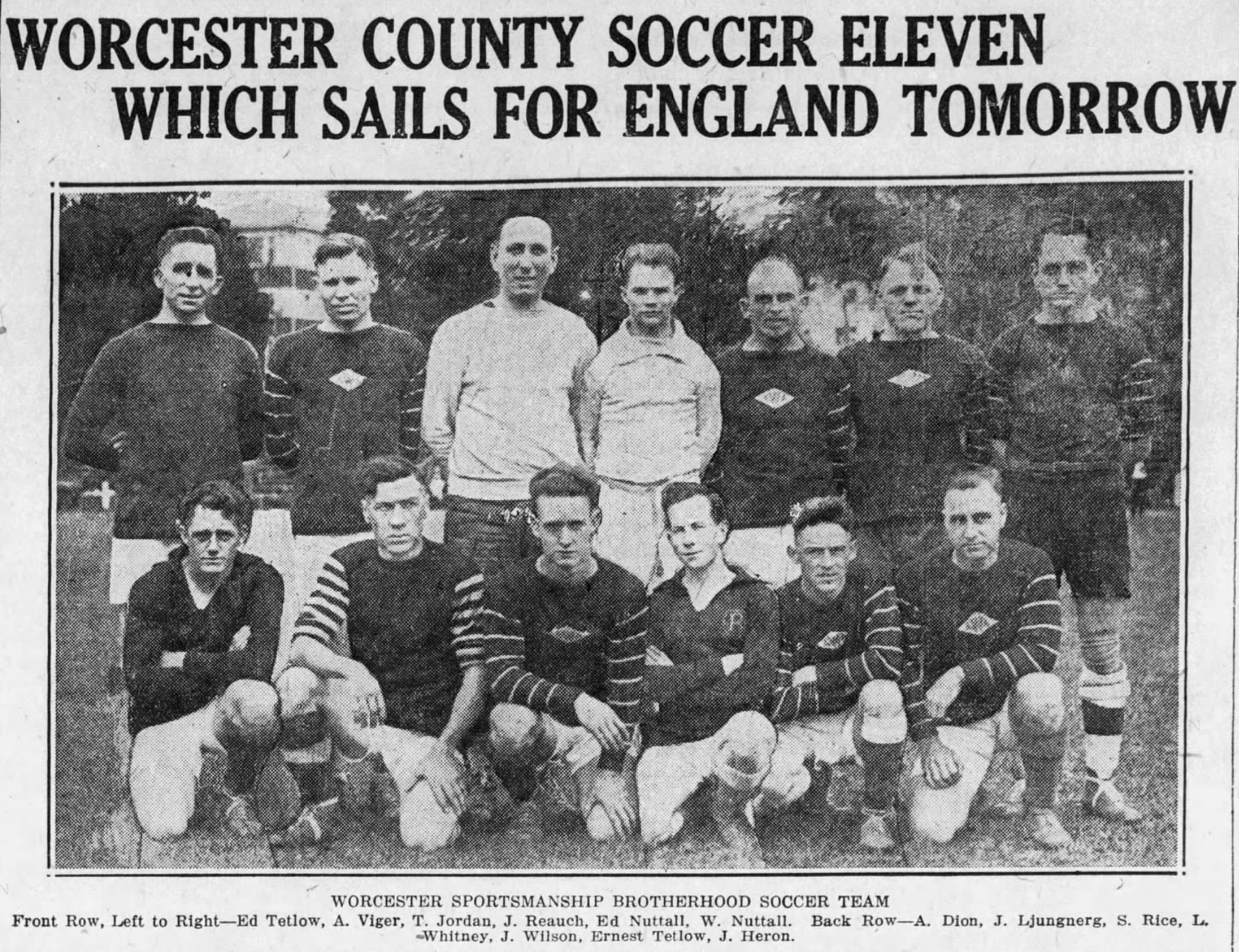
Carlton’s British-American Fellowship was one of a number of organisations that emerged to promote Anglo-American goodwill after the US entered the war in 1917. The wartime alliance created opportunities for those who could see advantages in fostering links between two communities which spoke the same language, despite the geographical distance between them. Sport – popular on both sides of the Atlantic – offered possibilities of building personal connections and prominent businessmen in Worcester County, Mass, were persuaded to sponsor the Worcester County Sportsmanship Brotherhood (WCSB) with a view to issuing a challenge to the sportsmen of Worcestershire.
The Americans took the initiative in proposing football – or, as they preferred, ‘soccer’ – exchange visits. Though less popular in the US than American football, soccer was firmly established there in the 1920s and the ‘Bay State’ was one of its strongholds. There was concern that the USA should not become isolated from what was an increasingly a global phenomenon and George M. Collins, the Globe’s soccer correspondent, who had managed the US national team that competed in the Olympic tournament at Paris in 1924, was keen to stay connected. The Brotherhood proposed a visit in 1925 but Worcestershire was not quite ready for an American invasion and it was only in August 1926 that the formation of a British-American Sports Fellowship based in Worcestershire was announced, just in time to welcome the WCSB’s first soccer ambassadors.
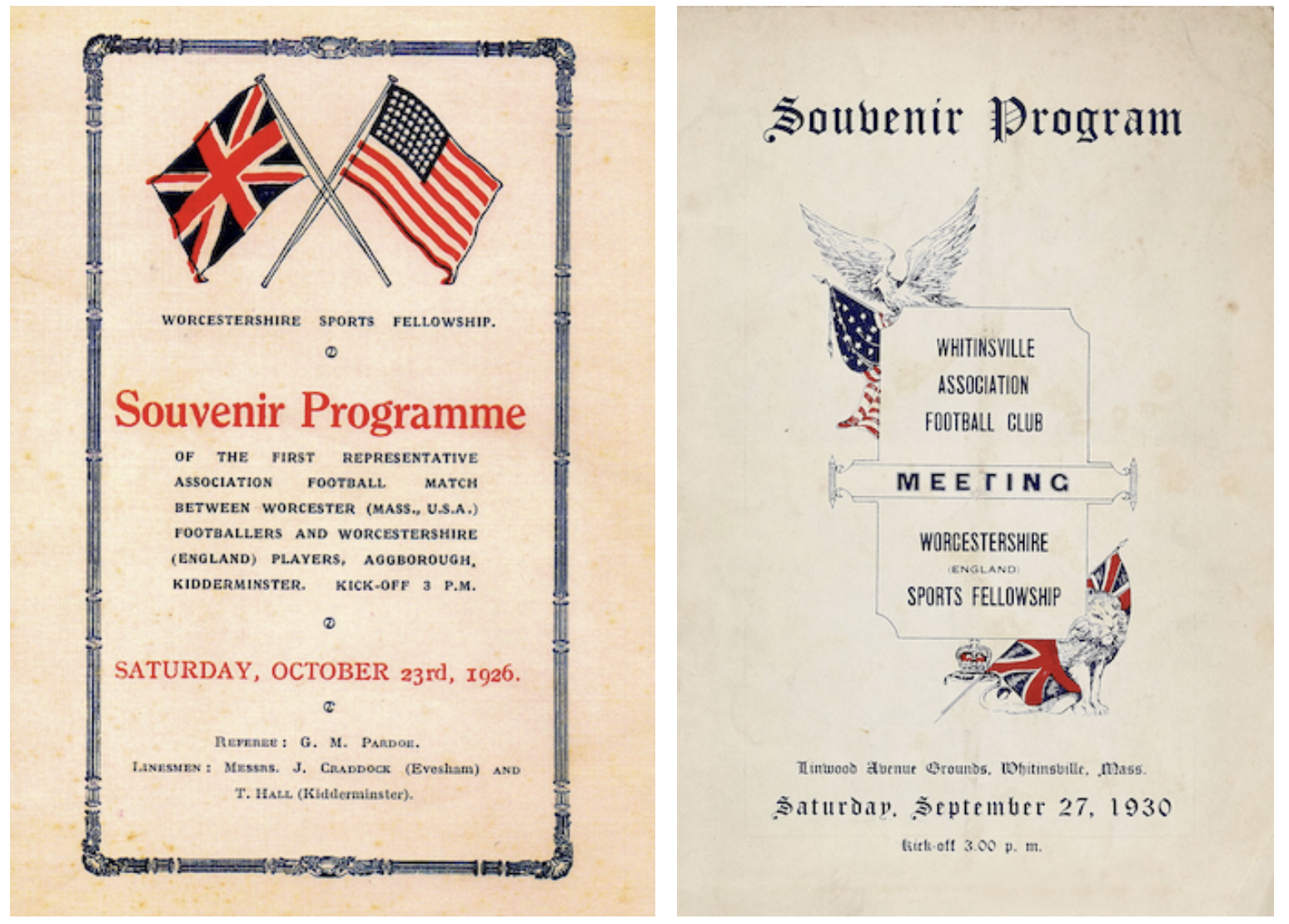
Two deposits at University of Worcester’s The Hive Library supply details of this ambitious scheme to promote transatlantic goodwill through sport. Percy Harper of Stourbridge, a famous referee and the secretary of the Worcestershire County Football Association, kept a scrapbook of correspondence and press cuttings, along with match programmes, menus and other memorabilia relating to the 1926 and 1927 tours (899:195/1786/1b). The great and the good of the county were heavily involved. Harper and the WCFA were drawn in to the arrangements from 1925 after he had been approached by the Lord Lieutenant, Viscount Cobham, president of the new Sports Fellowship. Sources relating to Worcestershire’s 1930 trip are to be found in papers preserved by Alderman Percy Jones of Stourbridge who accompanied the county’s representatives on their visit to Worcester County (705:1144/10539/ii).
It was not unusual for English teams to play overseas in the 1920s though tours were usually undertaken by professional clubs cashing in on their fame or by so-called ‘Middle-Class Wanderers’, often public-school Old Boys taking an Easter break in continental Europe. The Worcester tours were different in that the players on both sides were drawn from clubs playing in local leagues. Biographical notes in match programmes indicate that the Americans were mainly from works teams in and around Worcester. The Worcestershire party that crossed the Atlantic in 1930 comprised men working in a variety of occupations from agriculture and market gardening to car manufacturing, carpet weaving, engineering and plumbing; there was also a GWR clerk and an Oxford undergraduate. An expenses-paid trip to the USA was more than they could possibly have anticipated when they took the field in local parks and recreation grounds in the 1920s.
There were occasional misunderstandings. Percy Harper, who refereed the first match of the 1926 tour at Stourbridge refused to allow the visitors to replace their goalkeeper when he was injured, much to their dismay. It is doubtful that they were consoled by reports suggesting that losing 5-2 with ten players ‘has a better moral aspect than a defeat by a lesser margin with eleven players’ (Berrow’s Worcester Journal, 16 October 1926). Despite this incident it is clear that the American party returned home with a positive view of their time here. Collins, writing to Harper in 1927, recalled ‘our visit to Worcester and District’ with affection; he continued, ‘… every time I run up against one of the players the first thing we say is “How about that trip to Worcester”’(!)
Football, it seems, was almost incidental, a means to an end. The exchanges were intended to educate and to generate goodwill. When the tourists were not training or playing, they were subject to a relentless schedule of dinners, receptions, factory visits and sightseeing. As E.S. (‘Bill’) Irwin of the Worcester News-Telegram explained to Harper before the 1927 tour: ‘You gave us a wonderful time last fall in England and, if possible, we are going to give you one this fall’. He reminded his friend that they would be coming to a ‘dry country’ – this was the era of prohibition – ‘but we will do our best, and that really is not too bad’.
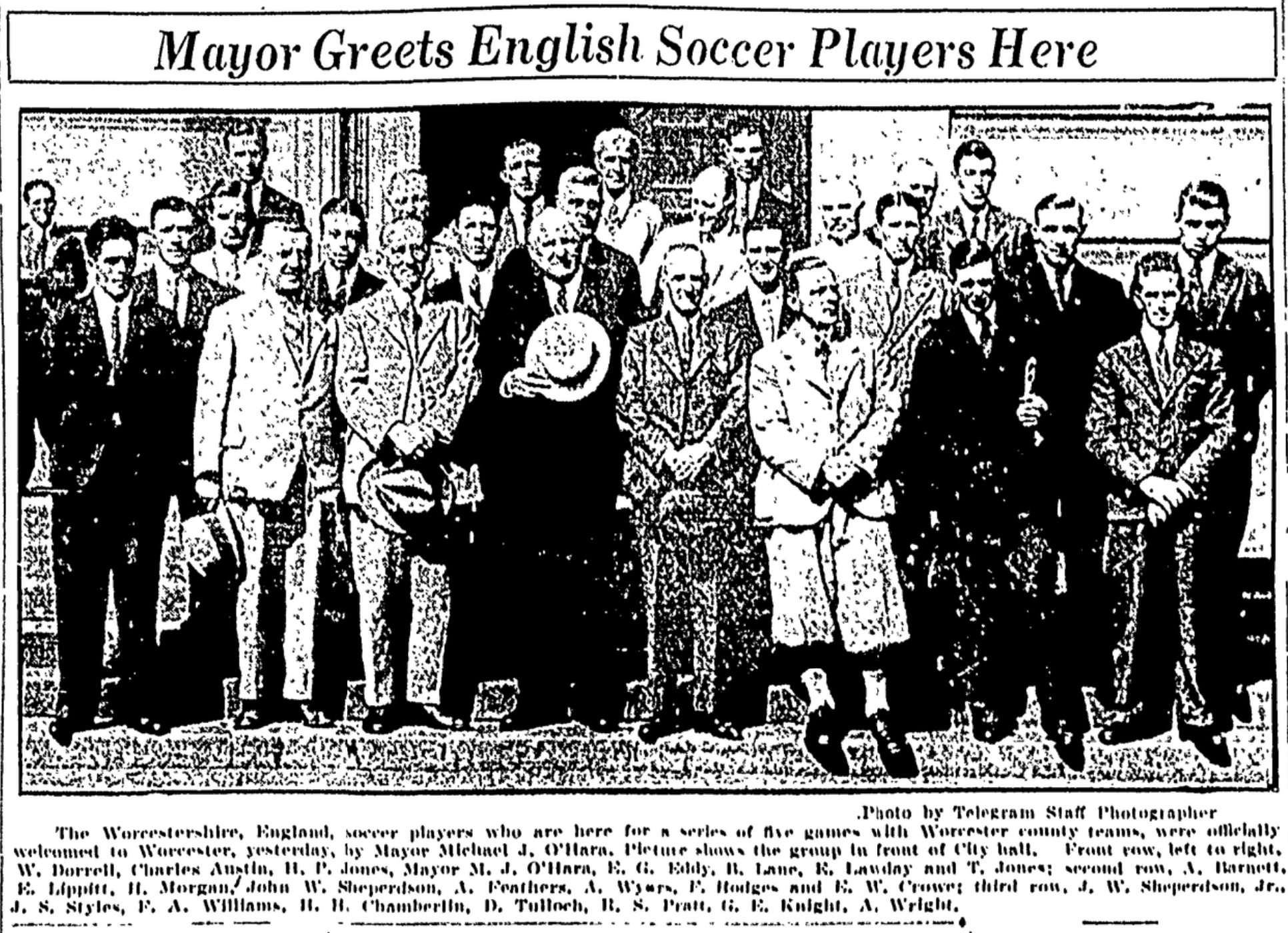
It is possible to discern something of how the Worcestershire players responded to their American experiences via interviews given to the local press on their return. In general, they were impressed by American modernity. A Worcester police constable on the 1927 tour recalled a multi-story car park seen in Boston, ‘a gigantic helter-skelter’, as a thing of wonder, ‘a marvellous arrangement’ (Berrow’s Worcester Journal, 22 October 1927). They also recalled a land of plenty. Bernard Lane, trainer on the visit to the USA in 1930, was impressed by the gigantic steaks served in the dining car on a rail journey from New York to Boston: ‘This meal will live long in our memories’ (Berrow’s Worcester Journal, 25 October 1930). The Americans seemed to be impressed largely by Worcestershire’s antiquity; I have yet to find any comments on the food.
A version of this essay first appeared in the Friends of Worcestershire Archives Newsletter, No. 104, Summer 2021
Pingback: SASH Session, Friday, May 8 at 12 PM ET: “‘How about that trip to Worcester!’ Transatlantic Soccer and the Anglo-Saxons in the 1920s” – Society for American Soccer History
Picking one for TCP/UDP tasks – it is not the price, but latency and geo. Overall dedicated SOCKS5 worked best – unmetered traffic. Free test – ran my load and stayed.