
“Don’t call it ‘soccer’!” – countless condescending English drunkards.
“Language is a virus” – William S. Burroughs.
Any lover of the Beautiful Game who has made pilgrimage to Britain for the sport is familiar with dismissive “don’t call it soccer” rhetoric. As Stefan Szymanski and Silke-Maria Weineck have shown, the football/soccer linguistic debate continues to grow increasingly bitter.[1] English phobia over adopting Americanisms provoked the Economic Officer at the U.S. Embassy in London, Partha Mazumdar, to insist in 2006:
Soccer’s etymology is not American but British […]. It comes from an abbreviation for Association Football, the official name of the sport. For obvious reasons, in the 1880s and 1890s, English newspapers couldn’t use the first three letters of Association as an abbreviation in their pages, so they took the next syllable, S-O-C. With the British penchant for adding “-er” at the end of words: punter, footballer, copper, and, of course, nicknaming rugby, “rugger,” the word “soccer” was soon born, over a hundred years ago, here in England, the home of soccer. We adopted it and kept using it because we have our own indigenous sport that we call football.[2]
The United States and United Kingdom have long been regarded as two nations divided by a common language. “Words have been crisscrossing the ocean for more than four centuries,” observes Allen Walker Read, “and their journeys in both directions can be documented in greater and greater detail. Such lexical journeys are best described […] by the word transit,” which “avoids the invidious overtones of borrowing, migration, and others.”[3]
American soccer historians have often speculated that the term “soccer,” an abbreviation for “association football,” was a linguistic or lexical import from the 1905 Pilgrims’ tour.[4] Established as the United States Football Association in 1913 (incorporating the American Football Association, formed in 1884), the entity was rebranded as the United States Soccer Football Association in 1945 before becoming the United States Soccer Federation in 1974. The governing body’s official centennial book notes the sport “was not called ’soccer’ in America until about 1905.”[5]
Weeks after the Pilgrims’ tour of September and October 1905, in a letter to The New York Times, Francis H. Tabor admonishes the editor for the paper’s use of the word “socker,” noting the Oxbridge “fad” for hypocorism with an “-er.”[6] Seeking to preserve use of the term “association football,” Tabor implores the editor to stop the spread of this lexical “heresy.” Two days later, the Old Gray Lady published a response from Lawrence Boyd asking Tabor “how he expects his word ‘soccer’ to be pronounced.”[7] But use of the term quickly gained traction. Spalding’s Association Foot Ball Guide of 1905 was rebranded as Spalding’s “Soccer” Football Guide by 1907, the same year The New York Times dropped quotation marks for its use of the term. A headline from 8 December 1909 notes that “Soccer is Dawning in American Sports: Less Dangerous and More Open Football Becoming More Popular”.[8]
So, the adoption of the term to disambiguate from the gridiron, carrying, tackle form of football that evolved from rugger on these shores has a traceable history in the lexicon of American sport. Digitization continues to shed light on the lost history of the global game on these shores, and a recent search finds the term used a full decade earlier than previously considered.
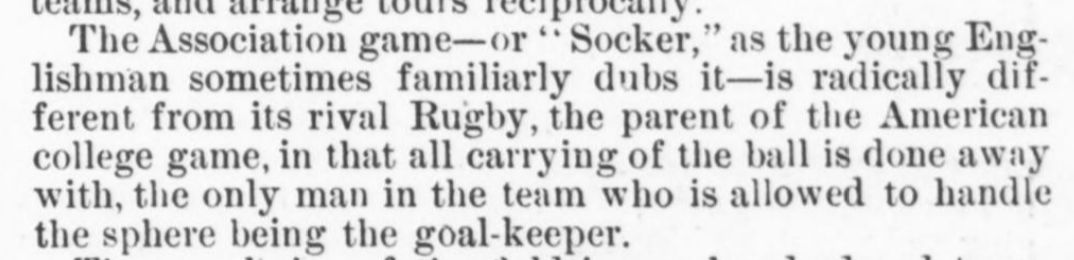
Harper’s Weekly ran a feature article by Hermann Montague Donner on March 2, 1895 promoting association football, complete with diagrams of positions at kick-off, throw-ins, corner kicks, and a goal. Donner notes that “The Association game – or “Socker,” as the young Englishman sometimes familiarly dubs it – is radically different from its rival Rugby, the parent of the American college game, in that all carrying of the ball is done away with, the only man in the team who is allowed to handle the sphere being the goal-keeper.”[9] This, a full decade prior to the Pilgrims’ arrival in 1905, extends use of the word west of the pond considerably while reinforcing its English etymology.
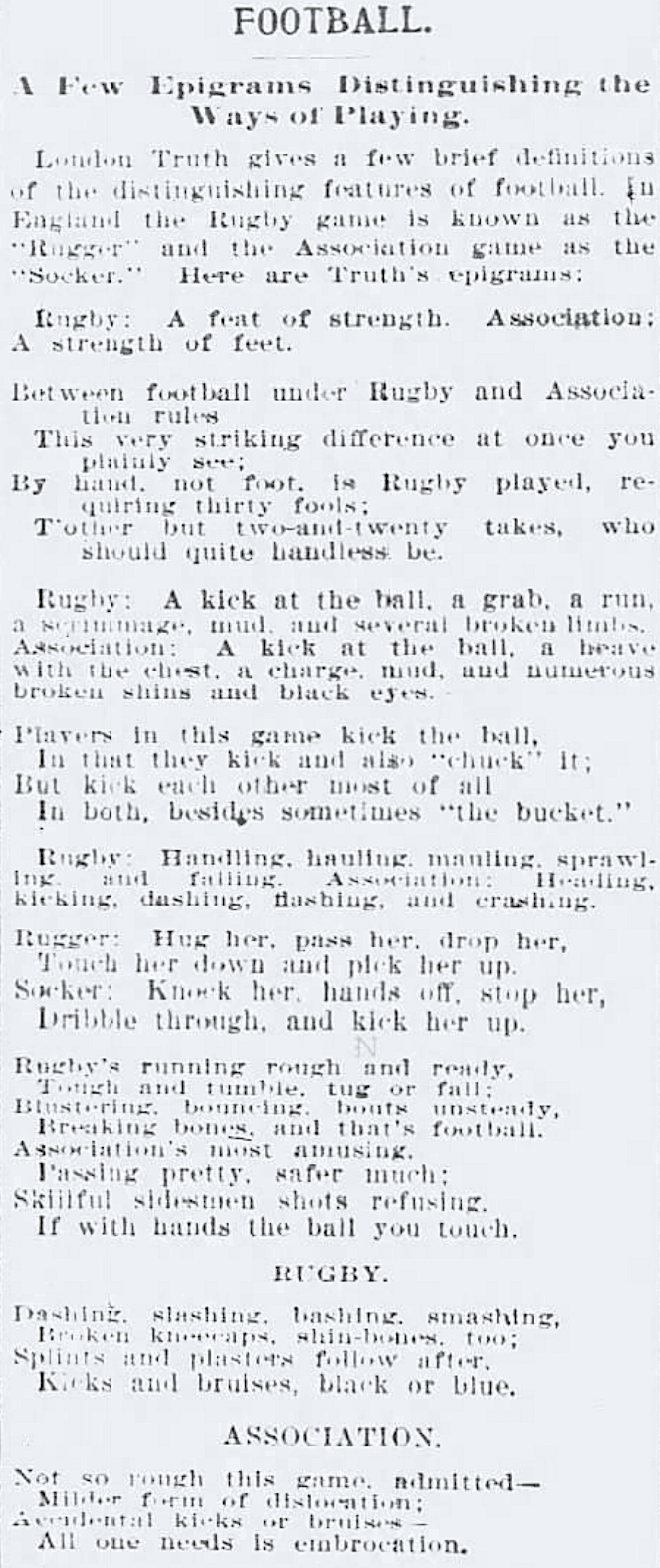
However, the earliest use of the word in an American publication is found (to date) in a local newspaper, the Buffalo Courier on December 1, 1893 reprinting epigrams from the Truth of London explaining differences between the rival footballing codes: “Rugger: Hug her, pass her, drop her,/Touch her down and pick her up./ Socker: Knock her, hands off, stop her,/Dribble through, kick her up.”[10]
So while it took a while for socker/soccer to catch on and enter the American sporting lexicon, new research into the game’s origins on these shores reinforces the conviction that anyone irritated by the word’s usage should not blame (the) US and that the game has a deeper and richer history here than often acknowledged.
Given that Charles Goodyear sold the first modern footballs (with a vulcanized rubber bladder, allowing for precise passing and controlled dribbling) at his brother-in-law’s store in Manhattan as early as April 1845,[11] American soccer fans might feel confident to claim as we co-host this summer’s FIFA World Cup that soccer is coming home – even if the term was not invented here.
Notes
[1] Stefan Szymanski and Silke-Maria Weineck. It’s Football, Not Soccer (And Vice Versa): On the History, Emotion, and Ideology Behind One of the Internet’s Most Ferocious Debates. Independently published, 2018.
[2] Embassy of the United States: London, UK. Podcast transcript. 5 June 2006. http://www.usembassy.org.uk/rss/transcripts/worldcup2006a.html
[3] Allen Walker Read. “Words Crisscrossing the Sea: How Words Have Been Borrowed between England and America.” American Speech: A Quarterly of Linguistic Usage, 2005 Summer, pp. 116-117.
[4] Roger Allaway. “These Pilgrims Brought Soccer.” Society for American Soccer History. 16 October 2024. https://www.ussoccerhistory.org/these-pilgrims-brought-soccer/
[5] United States Soccer Federation. 100 Years of Soccer in America: The Official Book of the U.S. Soccer Federation. Universe, 2013, p. 16.
[6] Francis H. Tabor. “Origin of the Word ‘Socker’.” The New York Times, 4 December 1905.
[7] Lawrence Boyd. “Soccer or Socker?” The New York Times, 6 December 1905.
[8] “Soccer is Dawning in American Sports.” The New York Times, 8 December 1909.
[9] Hermann Montague Donner. “Association Football.” Harper’s Weekly, 2 March 1895, p. 213.
[10] “Football. A Few Epigrams Distinguishing the Ways of Playing.” Buffalo Courier, 1 December 1893, p. 8.
[11] David Kilpatrick. “New York Soccer Pioneers.” Soccer Frontiers: The Global Game in the United States 1863-1913. Chris Bolsmann and Geroge N. Kioussis, eds. University of Tennessee Press, 2021, pp. 68.
Interesting research! Big thanks!