I am grateful to Brian D. Bunk, Gabe Logan, Tom McCabe, and Kurt Rausch for sharing sources with me and for their comments on earlier drafts of this essay. Thanks also to Les Jones and Neal Morrison for working with me on “Representative matches of the Western FA (Canada) and the American FA (United States),” published in 2021 on the Rec.Sport.Soccer Statistics Foundation website. Any errors below are my own.
The first official international soccer match was a scoreless draw between Scotland and England played at the West of Scotland Cricket club in Glasgow on November 30, 1872. The match was organized in response to a challenge by Charles Alcock, secretary of England’s Football Association (FA). Scotland’s Football Association (SFA) wouldn’t be formed until March 13, 1873, so the Glasgow club Queens Park Rangers took up Alcock’s challenge. Before then, teams playing as “England” and “Scotland” with players selected from the London area met in five unofficial international matches between March 1870 and February 1872, all of which were played at The Oval Cricket Ground in London. Wales played its first official international, a 4-0 loss against Scotland, in March 1876, with Ireland, now Northern Ireland, following in February 1882 with a 13-0 loss to England. The next first official international wasn’t played until Argentina and Uruguay met in July 1902, with Argentina the 6-0 winner.
The first official United States international was a 3-2 win over Sweden at Rasunda Stadium in Stockholm on August 20, 1916, three years after the founding of the United States Football Association (USFA), now known as the United States Soccer Federation or US Soccer. The first official Canadian international was a 0-1 loss to Australia at the Brisbane Cricket Ground in Queensland on June 7, 1924. The Canadian Soccer Association, also known as Canada Soccer, was originally founded as the Dominion of Canada Football Association in July 1912. But a series of international matches between Canada and the US were played thirty years before the founding of Canada Soccer and US Soccer featuring representative sides selected by the Newark, New Jersey-based American Football Association (AFA) and the Western Football Association of Ontario (WFA), headquartered in Berlin, now Kitchener, Ontario.
International matches accompanied the creation of the first organized soccer associations in the US in the mid 1880s. These matches included club sides and select teams representing US and Canadian soccer associations and were the first internationals in global soccer history to occur outside of the United Kingdom.
Inspired by a vision of intercontinental soccer articulated in a story published in the Scottish Football Association Annual, 1884-85, the series of representative matches between AFA and WFA select teams were played between November 1885 and May 1888. These matches directly informed the selection of the representative Canada team that embarked on the first ever intercontinental soccer tour when it visited the United Kingdom in 1888 and also influenced the selection of the combined Canadian-US team that toured the UK in 1891.
This essay reviews the 1885-1888 AFA-WFA games and examines their status as “unofficial” USA-Canada internationals while placing them within the context of the larger series of representative matches featuring select US-based sides against select WFA sides played between 1884 and 1893.
Ned Duncan’s Dream
In his report in the Scottish Football Association Annual, 1885-86 on the American Football Association’s first year after its founding, the US-born AFA secretary P.J. O’Toole described the association’s “exceedingly bright” prospects, announcing, “We will almost certainly play an international with Canada before the season ends.” O’Toole added with a wink to his Scottish readers, “I think it almost certain that ‘Ned Duncan’s Dream’ will be realized.”[1]
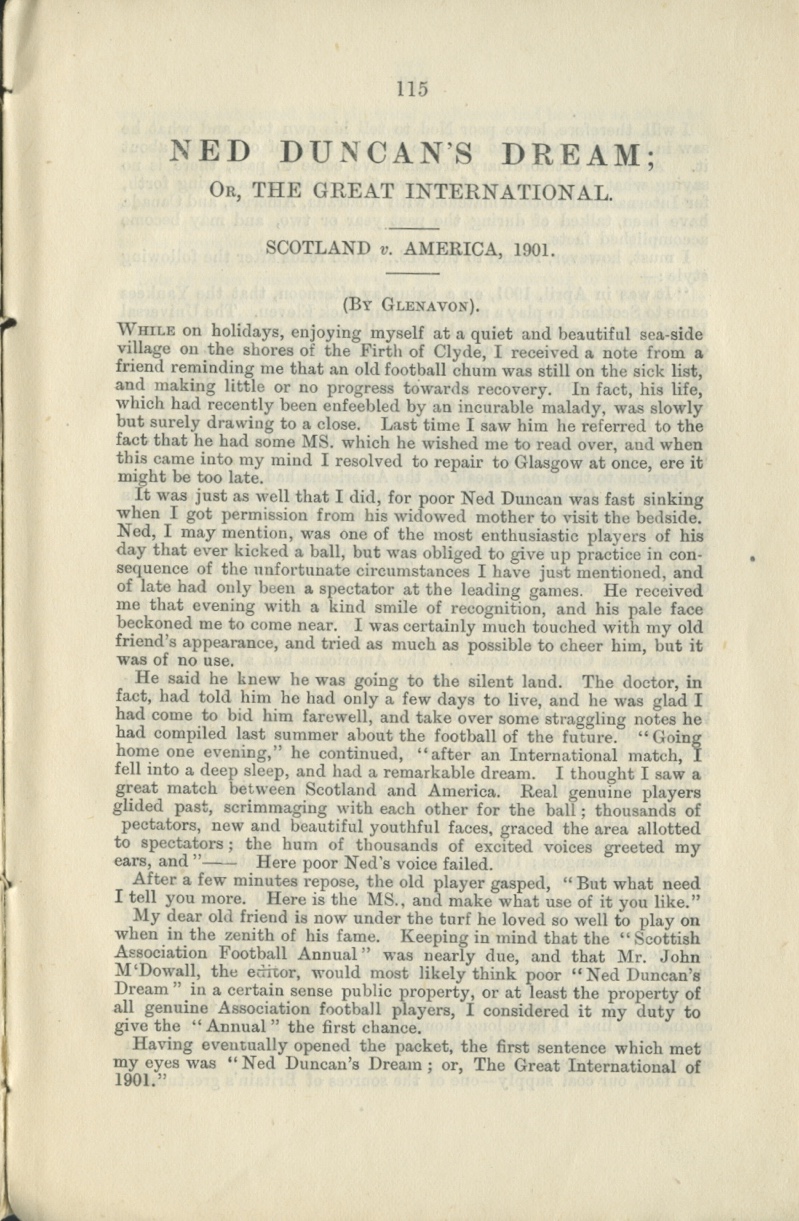
O’Toole was referring to the short story “Ned Duncan’s Dream; or, the Great International of 1901,” published in the Scottish Football Association Annual, 1884-85.[2] Written by D.D. Bone, “Ned Duncan’s Dream” reads like soccer-themed utopian science fiction. Advances in electric powered transportation compelled by diminishing coal reserves “had annihilated space and bridged the Atlantic in earnest,” with electric-powered steamships traveling at “120 knots per hour, no vibrations” between New York City and Glasgow “in a little over twenty-four hours.”
All the bugbears of soccer in 1880s Scotland had also been vanquished. Social change meant betting on games was outlawed as “low and unmanly,” with “all needy souls and black-legs” banished so that everyone could “enjoy themselves in an honest way” at a game. Because “coarse language” had disappeared from the playing field “one could now take sweetheart or wife to enjoy themselves,” even if “of course, they did not understand” what was happening on the field. As for professional soccer players, “no such thing had been heard of for years” because “no club would have anything to do with them.”
How the game was played had also changed. Instead of a coin toss, now the visiting team was allowed “in the most chivalrous way” to pick which end of the ground to defend first. Match time had been reduced to sixty minutes with thirty-minute halves. Throw ins were no more, replaced by a kick from the touch line to return the ball back into play.
Technological change meant that a “new order of things” had arisen “all over the world.” International soccer was no longer just cross-border, it was now intercontinental. The main event of “Duncan’s Dream” is “The Great International” between Scotland and the USA. It’s unlikely the story’s focus on international soccer was influenced by Scotland’s recent victory in what became known as the British Home Championship. While formalizing a regular calendar of matches between England, Ireland, Scotland, and Wales, the “home nations” of the United Kingdom, the series of games was yet to be embraced as a championship tournament. In the same edition of the SFA annual in which “Ned Duncan’s Dream” was published, Scotland’s deciding victory over England is just one in a list of internationals played and not accorded distinction.
Indeed, the soccer world in “Ned Duncan’s Dream” consists only of England, Scotland, Australia, Canada, and the USA, and the “Yanks” fantastically were ascendant. Having already defeated England, Canada, and Australia, the US team now had Scotland in their sights and had “come over to crow in the Land o’ Cakes.” The team arrived with traveling support: “Crowds of partisans and friends who had come over with the strangers.” If the US players were speedy and full of pluck, the Scots were accomplished dribblers and passers. After the visitors scored the opening goal in the first half, the undaunted Scots finally leveled the score with only ten minutes left to play in the match. Making “the grandest run” ever seen since soccer “became a scientific sport,” the Scots “literally dribbled the ball clean through” the befuddled US defense to equalize. Another “run” by the Scots saw them take the lead with four minutes remaining. With the “Yanks” now “fairly cowed,” the home team made it 3-1. The US players “heartily joined” the rapturous crowd in cheering the Scotland team for the final goal “in the most gentlemanly way.” After the referee whistled the end of the game, “the vanquished Americans” themselves received a “hearty round of cheers” from the appreciative crowd.[3]
Back in the real world, despite an international match against Canada still being nothing more than “most likely,” O’Toole enthusiastically asserted in his report that “it is almost certain” a match between the USA and Scotland would happen before the technological change described in “Ned Duncan’s Dream.” He even warned his Scottish readers to be on the alert for a Scotland defeat. O’Toole’s enthusiasm was contagious. Writing in the same edition of the Scottish Football Association Annual, David Forsyth, secretary of the WFA, asserted the Berlin Rangers, the Canadian champion team he founded, developed, and captained “would give some of the crack Scotch teams a very hard game.”[4]
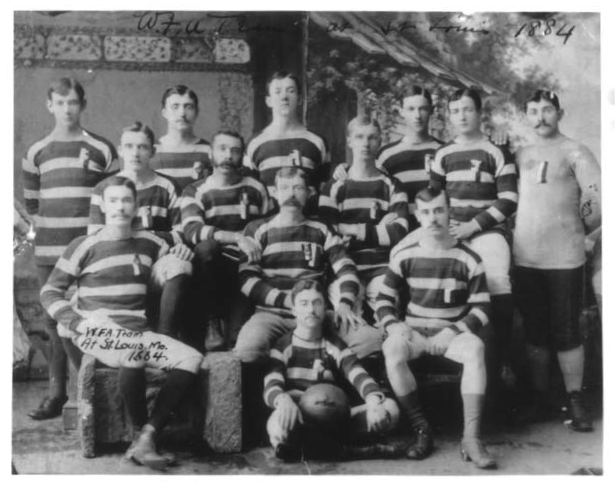
Forsyth was more reserved in the Scottish Football Association Annual, 1886-87. Reviewing the WFA’s “International Events,” Forsyth reported the results of a match in St. Louis in December 1884 against a team selected from the Western Football Association of America (WFAA) by a representative WFA team, the first ever visit by a Canadian soccer team to the United States. Without naming them, he also described the AFA’s American Cup champion ONT team’s five-game tour to Canada in the spring of 1885, the first visit by an US-based soccer team; one report ambitiously suggested ONT would also visit St. Louis as part of the tour but that did not happen. Sponsored by the Clark Thread Company, the team was named after the company’s Our New Thread product line. Finally, Forsyth recounted the tour by a representative WFA team to Newark, New Jersey in November 1885. “The leading match was, of course, the one with the Association team” –the representative AFA team–which the WFA won 1-0 after “a stubborn fight.” The WFA tour was composed of seven matches, including one regulation game and three indoor games against ONT for the “American Challenge Cup” played at the Newark Rink. After winning the silver-plated trophy, the WFA repurposed it and began awarding it to the champion of the association’s annual Junior Cup tournament.[5]
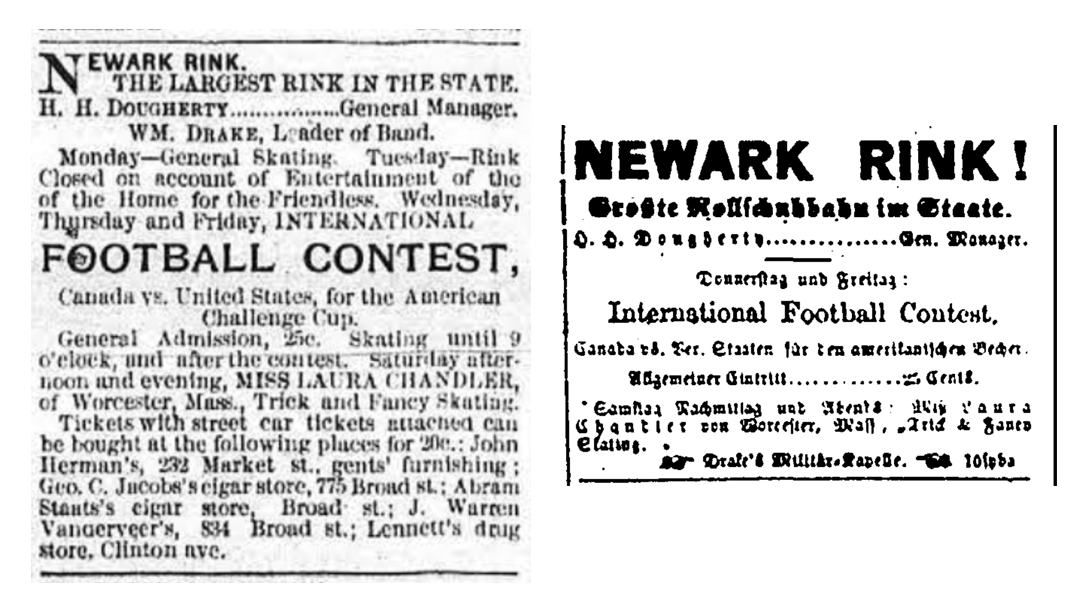
The trio of tours Forsyth described was a triumph for the WFA with eleven wins, two draws, and one loss. Despite this, Forsyth also noted with disappointment that “our American cousins” the AFA had backed out of a return visit to Canada “arranged” for May 1886 “for reasons not as yet explained.” Three weeks after ONT won the second edition of the American Cup the first match in the US between two state associations, New Jersey and New York, was played. The New York State Football Association was founded only weeks before on March 25, 1886; when the New Jersey State Football Association was formed is unclear but one report indicates it was “about the same time.” Played at Prospect Park in Brooklyn, the representative interstate match was meant to be a warmup for the unaccountably abandoned May 1886 tour to Canada. But what Forsyth described as a return visit by the AFA actually was something else. Instead of a representative AFA side, it was to be “an eleven of the New Jersey State Association, which has been formed for the purpose of a tour through Canada.” This foreshadowed later touring teams from New England that were not explicitly named as representative AFA sides but were composed of players selected from AFA-affiliated clubs in Fall River, Pawtucket, and Providence. In the event, the New Jersey State Association “won easily” against the New York team, 6-1.[6]
While neither an AFA nor a New Jersey team visited Canada that May, a US club team not affiliated with the AFA did. In January, Buffalo FC had issued a challenge to clubs in Western New York “or inside a radius of fifteen miles in Canada, for the amateur championship.” On Queen Victoria’s birthday, the self-described champions of Western New York extended their challenge radius by twenty-five miles and travelled to Dunnville, Ontario, to face the home team, losing by the same score the AFA did to the WFA in November 1885, 1-0.[7]
Describing a “proposed British trip” by a “representative Canadian team” in his 1886-87 Scottish Football Association Annual report, Forsyth noted his preference for a visit to Canada by an English or Scottish team first, perhaps recalling a proposed visit by a Scotland team to Canada and the United States in 1878 that had come to naught. If “Canadians must first begin the attack,” Forsyth said that British clubs “may expect to hear from us in the fall of ’87.” Attempting a trans-Atlantic tour sooner than 1887 would be “folly on our part.”[8]
Forsyth’s prediction was off by only one year. When a representative WFA team he organized visited Ireland, Scotland and England for a twenty-three-game tour in September and October 1888, it was a team of international veterans honed by four years of contests against American based sides, including nine unofficial USA-Canada internationals.
Internationals, official and unofficial
Surveying online newspaper archives and other sources, I have documented nearly eight hundred and fifty intercity, interstate, interregional, and international matches between 1884 and 1905 involving US-based teams. 1884 is the starting point for the survey because that is when the AFA and the St. Louis-based WFAA were formed and the first interstate and international matches were played in the US. One week after the AFA was organized in May 1884, founding AFA clubs met on Decoration Day, now Memorial Day, for a program of matches at the Manhattan Grounds in New York City at Eighty-Sixth Street and Eighth Avenue. There a regulation match between the New York Caledonians and “the Caledonians of Paterson and Newark” of New Jersey was followed by a mini four-a-side tournament that included teams from New York City, Kearny, Paterson, and Newark in New Jersey, and Providence, Rhode Island. A few months later in October 1884, interstate play began in New England with the Fall River East Ends of Massachusetts defeating the Providence team. International play in the US began over the 1884 Christmas holiday when a WFA team traveled from Ontario to St. Louis for two games, including a match against a select WFAA team.[9] 1905 is the survey’s endpoint because that was the year the English amateur team the Pilgrims toured Canada and the United States, helping to spark a new soccer boom in both countries. Online newspaper archives and other archival resources regularly add new titles to their collections so it is likely that more cross-border matches will continue to be documented.
As local soccer scenes developed, teams looked to test themselves against sides from other communities. Such contests conferred legitimacy to emerging soccer locales through their association with more established clubs and soccer scenes. Positive press coverage resulted in more exposure for the sport and could lead to the formation of new clubs while attracting new players and fans. Much needed funds could also be raised from the larger attendance that typically resulted from such high-profile visits. Relationships with local sponsors who themselves were interested in benefiting from the publicity that accompanied these marquee matches might also be developed. The experience gained from planning such visits also added to the logistical knowledge necessary for organizing regional and, eventually, national competitions.
International matches created even greater attention than intercity, interstate, and interregional matches. Some kinds of international matches are not immediately obvious. For example, more than one hundred fifty international matches featuring US-based club sides against teams composed of crewman from British-flagged steamships are among the eight hundred forty-nine matches documented through the survey. These matches were played in New York, New Jersey, Rhode Island, Massachusetts, Oregon, California, Hawaii, and Texas beginning in 1890 through 1905.[10]
The impressive number of international steamship games is dwarfed by matches between US and Canadian sides. Two hundred fifty-one international soccer matches played between 1884 and 1905 have been documented involving teams from thirteen US states and four Canadian provinces. This includes sixty-one international club friendlies between US and Canadian clubs. Detroit clubs played an additional eighty-five cross-border international league matches in Canadian cup and league competitions, including matches in the WFA’s Challenge Cup series beginning in 1890—winning the de facto Canadian championship in 1891 and 1892—and in the Peninsular League between 1895 and 1905. Fifty-eight international tour matches were played in Scotland, Ireland, England, and Wales by a combined Canadian and American team in 1891. Eight international tournament matches were played between the 1901 Pan American Games in Buffalo, the 1904 Olympics in St. Louis, and the 1905 Lewis and Clark Exposition in Portland, Oregon. [Download list of US and Canadian matches, 1884-1905 (Excel)]
Among the matches played between US and Canadian teams are fifteen international association friendlies played between 1884 and 1893 featuring representative sides. For this essay, a representative match is defined as one between teams selected by the AFA, the WFA, the WFAA, or the Chicago Football Association. A representative match may also be one between an all-city or New England Football Association (NEFA) team selected from AFA-affiliated clubs and a representative WFA side. Among these fifteen matches are two sometimes referred to as unofficial USA-Canada internationals, which themselves are part of the series of nine matches between representative AFA and WFA sides.
The fifteen representative international friendlies were generally played during multi-game tours that included an additional sixteen mixed international friendlies featuring representative sides against club teams. ONT’s five-game 1885 Canadian tour also included two matches against representative WFA sides, Buffalo FC played a representative side picked from WFA-affiliated teams in Berlin and Galt, Ontario, in 1890, and the Braidwood team played the WFA side that visited Chicago in 1893, making for a total of thirty-four international matches involving representative teams in Canada and the United States during the period surveyed. [See Appendix A]
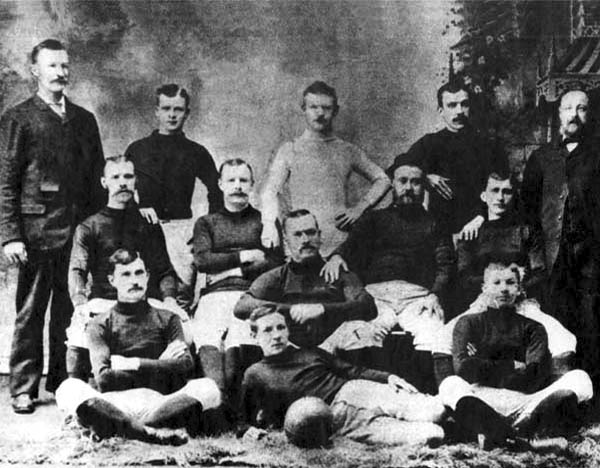
These international soccer contests had a profound effect on soccer’s early development in the United States, helping to establish the game as it began to be organized in the mid-1880s. Among these matches are some of the highest attendance numbers reported in North America at the time, including eight thousand spectators for a match between a representative WFA team and ONT in Galt in June 1885. As many as four thousand saw the sides meet again during the WFA’s visit to Newark in November 1885. In June 1893 an incredible ten thousand attended a night match “under electric lights” in Pawtucket between Pawtucket Free Wanderers and Toronto Varsity.[11] Matches at the turn of the century between US and Canadian club sides later played a part in soccer’s revitalization after its decline following the economic depression in the mid-1890s.
International soccer matches between US and Canadian teams followed a well-beaten path of cross-border team sports competition between the two North American countries. A match between Canadian and US cricket club sides was played in Toronto in 1840. Four years later, the first representative international cricket match—the first representative international match in any sport—was played between US and Canadian sides in New York City with a return match played in Montreal the next year. Canadian and US curling clubs met in Buffalo in 1865 for an international bonspiel, with US clubs from New York, New Jersey, Pennsylvania, and Ohio competing. The May 1874 visit by Montreal’s rugby playing McGill University football team to face the Boston Rules playing Harvard football team, and the return match in Montreal in October 1874, are the starting point for rugby-style intercollegiate football’s eventual evolution into American gridiron football. In its first season, the International Association for Professional Base Ball Players (1877-1880) included two Ontario-based teams, along with teams from Massachusetts, New Hampshire, New York, Ohio, and Pennsylvania.[12]
Background to the AFA-WFA “unofficial” internationals
Canada had an eight-year head start over organized soccer developments in US soccer. The first soccer association outside of Britain, the Toronto Football Association (TFA), was founded in 1876. The following year, the Dominion Football Association (DFA), “essentially an expansion of the TFA,” was organized in Toronto. While open to any club in Canada playing Association football rules, participation in the DFA’s Challenge Cup was effectively limited to teams from Ontario province. Short lived, the DFA was superseded in 1880 by the formation of the Western Football Association of Ontario (WFA), with member clubs located west of Toronto. The WFA was joined by the Central Football Association (CFA) in 1883, which included clubs from Toronto and as far east as Kingston, Ontario. The Manitoba Football Association followed in 1884. Contrary to soccer’s development in the US, which was largely driven by ethnic Scottish, English, and Irish social, athletic, and workplace-based clubs, early developments in Canada were powered by high schools and colleges alongside ethnic clubs.[13]
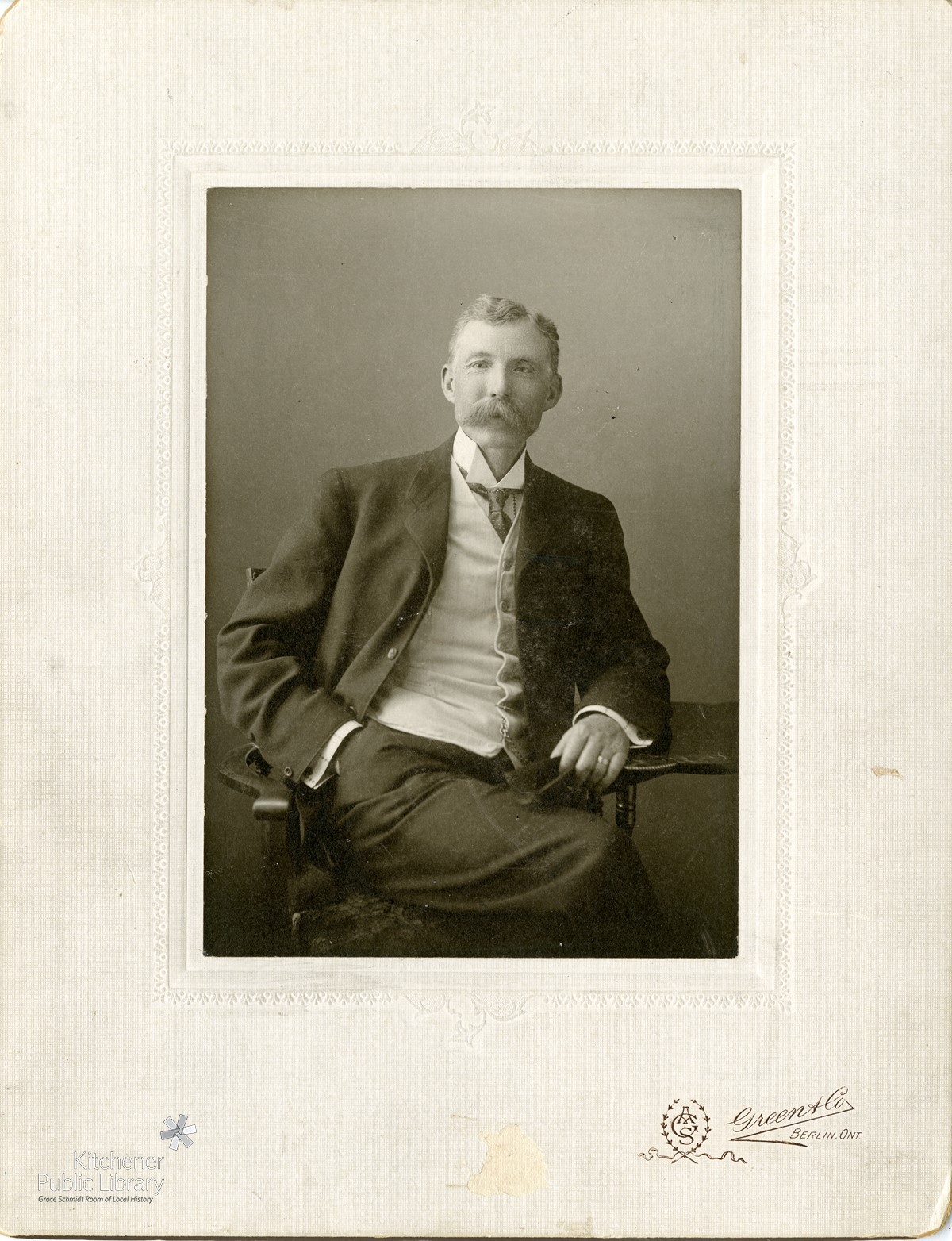
Leading developments in Canada was David Forsyth. Born in Perthshire, Scotland, in 1852, Forsyth’s family emigrated to Canada before his first birthday. After graduating from the University of Toronto where he had played “university rules” football, Forsyth began his career as an educator, teaching math and science at Berlin High School (later known as the Kitchener and Waterloo Collegiate Institute) in 1876. There he added soccer to the school’s sports program and was a founding member of the DFA. Under his management, the Berlin High School team was the runner-up in the first two editions of the DFA’s Challenge Cup and soon dominated play in the WFA. That domination continued when the team became the Berlin Rangers in 1884, which Forsyth also managed and was made up of graduates of the high school team. Berlin High School graduates were also influential in making the University of Toronto’s Varsity team the dominant side in the CFA.
Forsyth’s accomplishments are astounding. In addition to being a founding member of the DFA in 1877, he was behind the formation of the WFA in 1880, going on to serve five years as the WFA president and 26 years as its secretary-treasurer. In 1901 he was a founding member of the Ontario Association Football Association (OAFA), where he served as secretary-treasurer for five years. He edited the WFA and OAFA annuals. Forsyth was also an accomplished player, appearing in eight WFA Challenge Cup finals with Berlin High School and Berlin Rangers. He was the captain of the WFA teams that visited the US in 1884, 1885, 1886, and 1887. After introducing international soccer to the US, Forsyth organized and played on the world’s first intercontinental soccer team, the Canada team that toured Ireland, Scotland, and England in 1888. Along the way he also found time to run D. Forsyth and Co., an importer of soccer equipment. It’s little wonder Forsyth was called the father of Canadian soccer as early as 1887. Colin Jose described him as “one of the most influential men in the history of Canadian sport.”[14] No figure in the early history of soccer in the US comes close to the sum of Forsyth’s accomplishments as a soccer player, organizer, administrator, and businessperson.
In the United States, newspaper reports of clearly identified soccer matches began to appear by 1879. But compared to Canada, organized soccer was slow to follow. By 1884, challenge matches and cup tournaments were organized in the New York metropolitan area, Fall River, and St. Louis. The first soccer association in the United States, the American Football Association (AFA), was founded in May 1884 at Caledonian Hall in New York City. Like the WFA, the AFA’s footprint was limited to one region in a vast country. From a handful of clubs in northern New Jersey and New York City plus Trenton, New Jersey, the AFA gradually grew until its initial demise in 1898 to include teams from New England–principally Fall River, Massachusetts and Pawtucket/Providence, Rhode Island but also Ansonia, Connecticut and Barre, Vermont–and eventually Philadelphia. Membership in the AFA meant one thing: participating in its challenge cup tournament, popularly known as the American Cup.
The entrance of New England teams into the American Cup tournament resulted in its reorganization into two districts to save travel costs, with the Eastern District comprised of teams from Massachusetts and Rhode Island, and clubs from New Jersey and New York forming the Western District. From just six participating teams in its inaugural 1884-85 edition, the tournament grew to fifteen competitors after New England clubs entered the 1887-88 edition, the same number the AFA reported as association members. In comparison, the WFA reported twenty teams had participated in its senior cup tournament’s 1883 edition, and eleven in its junior tournament (the AFA never organized a junior tournament). In 1887, Forsyth wrote that the combined membership of the Western and Central associations stood at “over sixty clubs.”[15]
If the AFA’s limited geographic scope belied any claim of the American Cup being the championship of the United States, winning it was the closest thing in the country to such a title. As the most prestigious US soccer competition of its day, the American Cup’s success helped to lay the groundwork for the country’s first truly national soccer championship, the National Challenge Cup, better known today as the US Open Cup. The AFA’s footprint became the territory occupied by early professional leagues including the American Association of Professional Football and the American League of Professional Football of 1894, and later the National Association Football League, the Eastern Soccer League, and eventually the American Soccer League.
As Forsyth described in the Scottish Football Association Annual, 1886-87, the AFA-WFA series was preceded by a match in St. Louis in December 1884 against a “picked team from the St. Louis Association.” The “St. Louis Association” was the Western Football Association of America (WFAA), founded only weeks before in October 1884. The St. Louis Post-Dispatch reported that at the WFAA’s first organizational meeting, “Letters were read from the Canadian [WFA] and New York [AFA] Football Associations, wishing the new organization every success,” a remarkable example of the national and international networks of communication that existed between soccer organizations at the dawn of the sport in North America.[16] For the WFAA, its match against the Canadians was anything but successful, with the visitors winning 5-0. By the time Forsyth was writing his report for the 1886-87 Annual, the WFAA was already on its last legs.
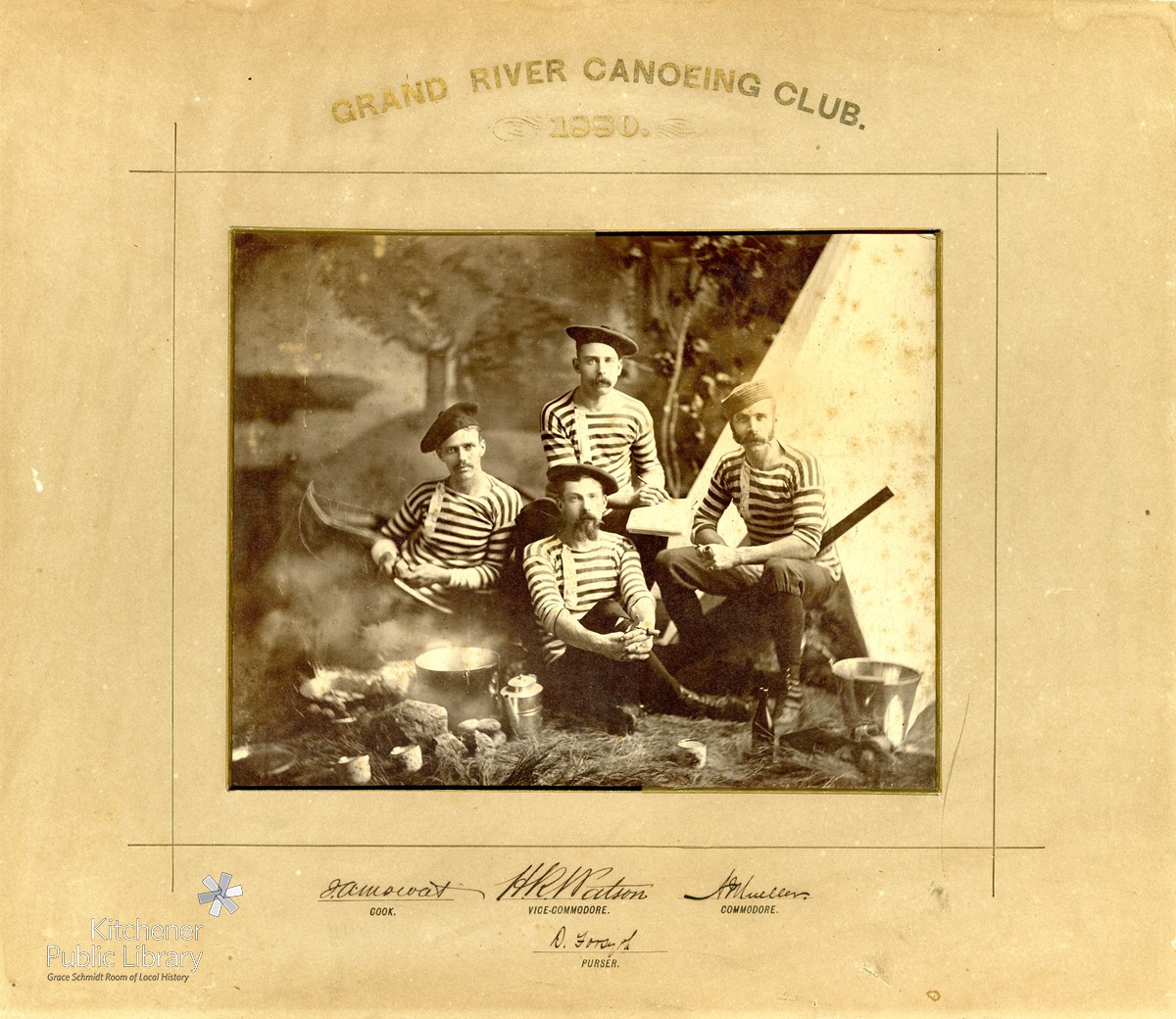
The first two “unofficial” USA-Canada internationals played in East Newark between representative AFA and WFA sides in November 1885 and November 1886 are relatively well known today, beginning with The Story of Soccer in Canada by Colin Jose and William F. Rannie (1982), and Tony Cirino’s U.S. Soccer vs the World (1983). Writing in the Scottish Football Association Annual, 1886-87, AFA secretary Joseph Walden reported the November 1885 match had provided a “great impetus” in creating awareness of soccer. Today, unlike US Soccer, Canada Soccer even lists these games on its website, even if it doesn’t consider them official internationals.[17]
Less known is that the November 1886 visit saw the WFA play against two different representative AFA teams. A further six representative AFA-WFA matches were played in 1887 and 1888. Of the nine total matches, five were played in the US and four in Canada. One of these contests was not explicitly organized by the AFA but featured a representative team selected from newly AFA-affiliated clubs in Fall River. These games were connected to public holidays, with the WFA visiting Newark in November over the Thanksgiving holiday and the AFA visiting Ontario in May around Queen Victoria’s birthday and Decoration Day, now Memorial Day. While ultimately lasting only four years, the regular cycle of these representative AFA-WFA contests, like the British Home Championship, foreshadowed the international calendar we are familiar with today.
After its 1-0 win over the AFA in November 1885, the WFA returned to East Newark in November 1886, playing two representative international matches, a 3-2 loss to an AFA side on Thanksgiving Day, followed by a 2-1 defeat two days later against an all-New Jersey side. Both sides were selected from AFA-affiliated teams, the only difference being that the AFA-named team included two players from the Long Island-based club the Pilgrims; the remaining nine players came from three New Jersey clubs, including six from ONT, two from Alma, and one from Kearny Rangers. No reports connect the team to the New Jersey State Football Association. This was the only time players from a New York-based club were selected for an AFA-WFA match.
The all-New Jersey team was selected from five New Jersey clubs, including five players from ONT, three from Alma, and one each from Kearny Rangers, Paterson, and Tiffany Rovers. One newspaper reported that both the all-AFA squad and all-New Jersey teams were strong, but “if there is any preference it is thought the New Jersey team has it.” While billed as an all-New Jersey team, the Brooklyn Union described it as it was, a representative AFA team: “The American Football Association put its best team on the field at East Newark yesterday, to play the second match against the champion Canadian eleven.” Why the stronger AFA side was billed as an all-New Jersey team is unclear; the first AFA team that was organized for the November 1885 match was made up only of players from New Jersey, as would be the team organized for the WFA’s visit in November 1887. Perhaps the AFA wanted to project an expanded sense of its representation, that it was more than just New Jersey-based teams. Whatever the reason, using today’s language for international soccer, the AFA team that November counterintuitively was the association’s “B” international team, while the all-New Jersey side was its “A” international team. Both matches are the last of the AFA-WFA matches acknowledged on the Canada Soccer website.[18]
Writing in the Scottish Football Association Annual, 1887-88, AFA secretary Thomas B. Hood agreed that the AFA-NJ team was a representative AFA team: “We have now got the length of exchanging visits with the Canadians. They were down last November, and we took both games off them.” The length was not long. Hood acknowledged that after the double victory in November 1886, the first representative AFA tour to Canada in May 1887, which again featured players only from New Jersey-based clubs, was a disappointment, resulting in a 1-1 draw and a 4-1 loss against representative WFA sides. By the time the AFA received the WFA’s final visit to Newark in November 1887, the Newark Sunday Call declared “it was absurd to hope that the Canadians can be beaten.” The WFA players simply had more experience playing together on a select team. When it arrived in Newark, nine of its players had a combined thirty-one appearances against WFAA and AFA teams. [See Appendix B]
In home games, the core of the AFA team to this point had been players from ONT, the AFA’s champion American Cup team; on the road playing in Canada, players from the Kearny Rangers formed the core. Before the November 1887 game, nine ONT players had combined for twenty appearances on representative AFA sides against the WFA. Seven of those players had also appeared for the ONT team that was defeated 2-0 by the WFA during the teams’ June 1885 tour, for a total of twenty-seven appearances. But instead of making its players available for the AFA’s premier home international event, ONT visited Fall River to play East End in a Thanksgiving Day exhibition match. An early North American example of how the priorities of “club and country” can diverge, in placing its interests as a club over those of the association of which it was a member, ONT’s absence was also a glaring example of the limits of the AFA’s authority and Fall River’s rapidly growing influence.
Back in Newark, the AFA logically filled the absence of ONT players with seven players from the Kearny Rangers, runners up to ONT in the two previous American Cup finals. Although the team sheet was complete, the gap in quality remained. Despite four of the Kearny players combining for eleven previous appearances against the WFA, the AFA team was walloped 5-0. Two days after its last victory in Newark, the WFA team visited Fall River to play a scoreless draw against a representative side “picked from” newly affiliated “American Association teams” in Fall River, Pawtucket, and Providence. The WFA had effectively first played a representative AFA Western District team in Newark and then a representative AFA Eastern District team in Fall River.[19]
After the two May 1887 matches in Canada described by Hood, the AFA played two further matches in Ontario in May 1888 against representative WFA teams. The results showed some improvement with a 0-0 draw in Aylmer—another “B” international in terms of roster experience—and a 3-3 draw in Berlin. That AFA team was the first and only explicitly AFA-named representative side to include players from a New England club, with four coming from the newly crowned American Cup champion Fall River Rovers. The May 1888 matches marked the end of the series of nine AFA-WFA representative internationals that began in November 1885. The WFA emerged with a slightly better record in the series, winning three games, drawing four, and losing two, outscoring the AFA seventeen goals to ten. [See Appendix C]
Forsyth wrote in the 1887-88 Annual that “it may not be out of place to state that a Canadian team will be open this fall for another gentlemanly clubbing at the hands of the players of the American Foot-ball Association,” but the series of November games did not continue in 1888. Exhaustion, both physical and financial, on the part of the WFA after the conclusion of its two-month tour of Great Britain only weeks before must have been a factor. Why the series of AFA-WFA internationals did not resume in 1889 is unknown. The shift in competitive, financial, and reputational power within the AFA from Newark to New England is one likely reason. After Newark’s ONT won their third and final American Cup championship in April 1887, the next seven championships using the two-district format were won by teams from Fall River and Pawtucket. Eastern District American Cup matches consistently reported higher attendance—and higher gate receipts—than those in the Western District, and those fans also turned out in numbers for exhibition games against touring sides, be they from the US or Canada. As we shall see, AFA-affiliated New England clubs soon would form the selection pool for representative New England Football Association (NEFA) sides.
Pre WFA 1888 UK Tour Representative Matches
| Date (YMD) | Home Team | Home Score | Visiting Team | Venue | Attendance | City | Country | Tour |
| 1884-12-28 | WFAA | 0-5 | WFA | Sportsman’s Park | 300 | St. Louis, MO | USA | 1884 WFA Tour to St. Louis |
| 1885-11-28 | AFA | 0-1 | WFA | ONT Grounds | 3000-4000 | East Newark, NJ | USA | 1885 WFA Tour to New Jersey |
| 1886-11-25 | AFA | 3-2 | WFA | ONT Grounds | 2000 | East Newark, NJ | USA | 1885 WFA Tour to New Jersey |
| 1886-11-27 | AFA (NJ) | 2-1 | WFA | ONT Grounds | 2000 | East Newark, NJ | USA | 1886 WFA Tour to New Jersey |
| 1887-05-21 | WFA | 1-1 | AFA | Unknown | Unknown | Berlin, ON | CAN | 1887 AFA Tour to Ontario |
| 1887-05-24 | WFA | 4-1 | AFA | Unknown | 2000 | Berlin, ON | CAN | 1887 AFA Tour to Ontario |
| 1887-11-24 | AFA | 0-5 | WFA | Wright Street Grounds | 3000 | Newark, NJ | USA | 1887 WFA Tour to New Jersey and Massachusetts |
| 1887-11-26 | AFA (NE) | 0-0 | WFA | Rovers Grounds | 1000-“over 3,000” | Fall River, MA | USA | 1887 WFA Tour to New Jersey and Massachusetts |
| 1888-05-22 | WFA | 0-0 | AFA | Unknown | 2000 | Aylmer, ON | CAN | 1888 AFA Tour to Ontario |
| 1888-05-24 | WFA | 3-3 | AFA | Unknown | Unknown | Berlin, ON | CAN | 1888 AFA Tour to Ontario |
The AFA-WFA matches and the 1888 Canada tour of the UK
The historian of soccer in Scotland Andy Mitchell has described how the first internationals between England and Scotland —both unofficial and official—were organized to promote the spread of of the game, “to take association football to a wider public.” Forsyth echoed that when he observed with pride in the Scottish Football Association Annual, 1885-86 that five associations now existed in North America: the WFA’s “labour to spread and popularize the dribbling game” by organizing international matches between representative sides “has not been in vain.”[20] After the conclusion of the final May 1888 matches in Berlin and Aylmer against the AFA, that tally of North American associations was down to four, but it was no longer folly for a Canadian team to visit Britain.
First with a one-off game against a WFAA side in St. Louis in December 1884 and then through seasonal matches against the AFA between November 1885 and May 1888, Forsyth had developed a team of international veterans. He did so using a pool of forty-three players selected from thirteen clubs. Players from three clubs, Berlin Rangers, Toronto Varsity, and Galt accounted for eighty percent of the appearances for the WFA. Twelve WFA players had four or more appearances against the AFA and WFAA, including one player with eight appearances, three with seven appearances, two with six appearances, and two with five appearances. In comparison, the AFA used a pool of fifty-four players selected from fourteen clubs. Players from six AFA clubs accounted for seventy-eight percent of the AFA appearances, and only two players played in four or more AFA-WFA games. While the AFA had been fielding representative teams, Forsyth was building one. [See Appendix D, Appendix E]
Part of how Forsyth was able to do so is very likely connected to social class. Reviewing the biographies of the Canadian players who were part of the 1888 and 1891 tours reveals an assemblage of students, educators, businessmen, veterinarians, and doctors, evoking the old boys and club men of independent means behind the amateur teams that dominated play in the early days of soccer in Britain and later were on the rosters of the Pilgrims and Corinthian teams that toured Canada and the US in the early 1900s. These were players who had the means to take time off from their studies or work to participate in matches that involved international travel—and likely possessed the funds to maintain a level of comfort regardless of whatever expenses were reimbursed from the gate receipts of matches and the host’s hospitality, an important social component of international as well as intercity and interregional matches. In contrast, the AFA’s base was in the industrial cities and towns of northern New Jersey, Fall River, and Pawtucket. While some AFA players shared the social and economic background of the leading WFA players, it is reasonable to conclude more did not and needed the forbearance of supportive workplace bosses to take time off work to travel. That’s how the ONT team, supported by the Clark Thread Company, was able to tour Canada and travel to Fall River.[21]
The ability to take off from work was a vital part of selection for these representative teams, especially for touring sides. There were no standing representative teams, no pre-match training camps. Sometimes trial matches were organized to aid selection but not always. These were scratch teams, assembled for purpose, and a player whose work obligations precluded participation, no matter how talented the player, could not be considered for selection. In this Forsyth had the advantage of a pool of players who could travel. Forsyth also selected players who were positional partners for their club team to develop a core group of players who were experienced in playing together, substituting the series of matches against representative AFA sides and club sides for training camps and trial matches to name the Canada team that embarked on the UK tour over September and October 1888.
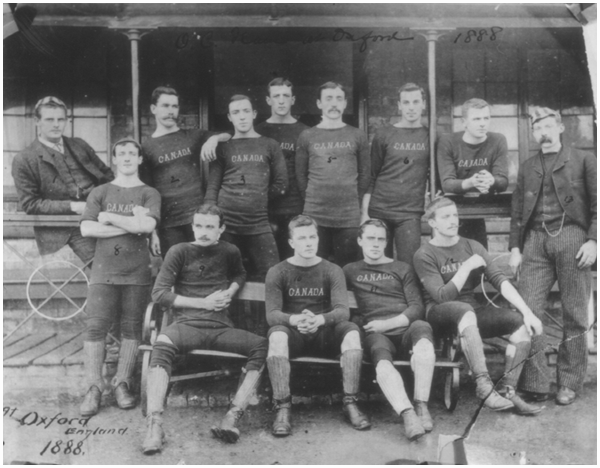
This is clear looking at the roster of the 1888 UK tour team. Of the seventeen players who represented Canada, thirteen were veterans of matches against AFA and WFAA sides, totaling sixty-five appearances in representative international matches between them. Seven of the thirteen WFA veterans came from the Berlin Rangers, four from Galt, and one each from Toronto Varsity and Dundas. All seventeen players were Canadian born save for one, David Forsyth, and he had arrived in Canada from Scotland as a toddler.
If the Canada team wasn’t the most experienced international side in the world in terms of the number of player appearances when they began the 1888 tour, they were when they returned home. With twenty-three games in sixty-two days—an average of a game a little over every two-and-a-half days—the team finished the tour with a respectable record of nine wins, five draws, and nine losses. The grueling nature of the tour is evident in its loss record, with four of the nine losses occurring in the last four games. Only one of the games during the tour was against a representative side, a 4-0 loss to an unofficial Scotland eleven. Had it been an official Scotland team, the match arguably could’ve qualified as Canada’s first official international and the first official intercontinental international in global soccer history.[22]
AFA New England-WFA games and the 1891 Canadian American Tour
After the Canadian 1888 UK tour, Buffalo FC, unaffiliated with the AFA, travelled to WFA territory in Preston, Ontario for the first time in July 1890 to face a team selected from WFA-affiliated sides Galt and Berlin Rangers. It was a humbling experience for the western New York team. Aside from being an example of the WFA’s ongoing interaction with teams not affiliated with the AFA, coverage of the match demonstrates the ambiguity and conflicting information evident in the era’s newspaper reporting of soccer. The Buffalo Evening News reported the match as between “the Buffalo Football Club” and “Canada’s representative team.” The Toronto Daily Mail reported the match as “between teams picked from Galt and Berlin, and Buffalo and vicinity.” Neither paper agreed on the final score, the Buffalo Evening News reporting Buffalo FC at the wrong end of a 6-1 loss, while the Toronto Daily Mail reported the final scoreline as 7-2. The Buffalo newspaper’s box score listed the opponents as Buffalo and Canada, the Toronto newspaper as Canada and the United States. Neither paper listed the same lineup of players for either side.[23]
Where the reports did agree showed four Canadian players with a combined fourteen appearances for the WFA against AFA sides, two of whom were part of the 1888 UK tour, and another who would participate in the 1891 Canadian American UK tour. Both papers agreed a Gibson played in the game for the home team. But two Gibsons—brothers Alex and Thomas–had been selected for matches against the AFA with eleven appearances between them, both of whom were also on the 1888 UK tour team. Unfortunately, neither match report provided Gibson with a first initial. Was this a match between two representative sides? Was it between a WFA representative side and a US based club team? Whatever it was, the Buffalo Evening News reported a return match would be played in Buffalo in September, which is another example of something common in newspaper coverage at the time: matches announced that were never played.
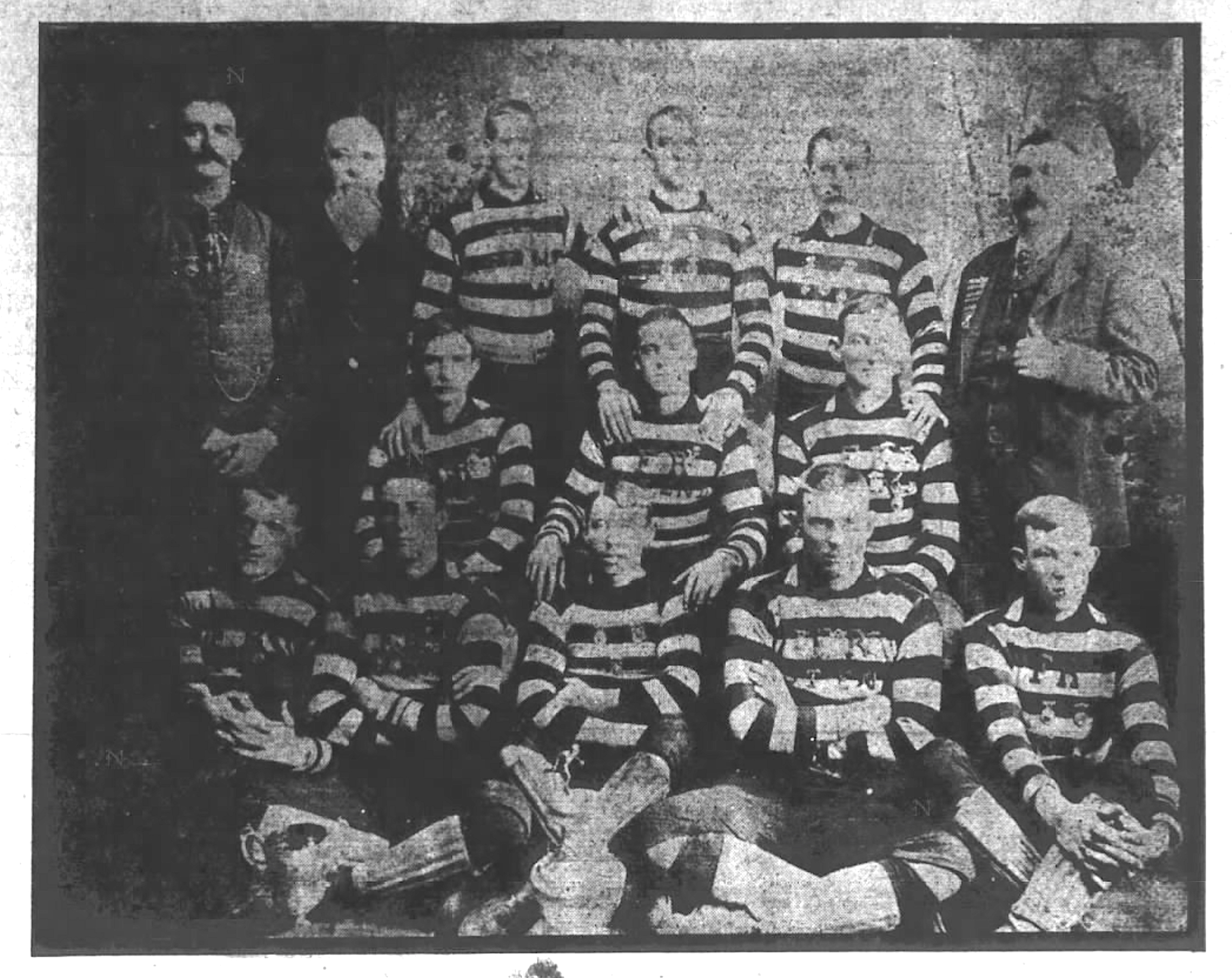
The first visit by a representative WFA side to the United States after its final game in Newark and visit to Fall River in November 1887 came three years later with a trip to Fall River and Pawtucket in November 1890. In Fall River, the WFA lost 3-1 to an all-Fall River team selected from the Rovers, East End, and Olympics, all AFA-affiliated clubs. By this point the Rovers had won the American Cup twice, the Olympics once before winning it again in 1894, and East End was just a few months away from winning the first of its back-to-back championships in April 1891. The match in Fall River followed a visit by Fall River Rovers to Canada in May 1889. There it played three matches against club sides, winning one game and losing two, including a loss to the WFA Challenge Cup champions the Berlin Rangers.
In June 1891, the New England Football Association (NEFA) organized the first visit to Canada by a US-based representative team since the May 1888 AFA tour, downing a representative WFA side 4-1 before defeating an all-Toronto side 2-1. A Fall River Daily Herald report after the tour headlined “Unprofitable” underscored the financial challenges of cross-border play. The “Canadian management” that organized the hosting side of the tour provided expenses of six dollars per player. Three of the six dollars covered transportation costs, leaving only three dollars “to buy ten meals.” Promised gate receipts and money for additional expenses were not paid out. In the end, “Each player [was] out eight or nine dollars on the trip.” Considering that the average yearly wage in Fall River in 1890 was $329.74, or about $6.34 a week, being “eight or nine dollars” out of pocket was a significant loss. It’s no wonder the report said “it is doubtful, very doubtful” that any of the players could be persuaded to embark on another Canadian tour.[24]
If the NEFA as organizer was further evidence of the AFA’s diminished capacity to arrange international events, the players nevertheless were selected from AFA-affiliated teams. More importantly, the NEFA tour proved to be a contributing factor in the transformation of a proposed 1891 tour of the UK by another Canadian team into a tour by a combined Canadian and American team.
As the historian of Irish soccer Michael Kielty has described, plans to repeat the 1888 tour were underway since at least July 1890. Forsyth was originally one of the co-organizers of the 1891 tour but later withdrew, either “put-off by the naked commercial aims of the venture or for personal reasons.” UK papers announced the impending tour in February 1891.[25] But by June, several Canadian players selected for the tour withdrew. Providently, one of the tour’s organizers, James Ellis, saw the NEFA team play in Canada and was impressed. With the approval of the WFA, approaches were made to the NEFA to bolster the touring team’s roster with players from New England clubs. Ellis found a receptive audience. Kielty notes, “In Fall River, as far back as April 1889 there was talk or questions about a tour” by the Rovers to the UK. Ultimately, nine US-based players—five from Fall River Rovers, three from Pawtucket Free Wanderers, and one from Fall River Olympics—became part of the nineteen-player Canadian American team roster. Four of the Canada-based players on the 1891 tour were WFA veterans who between them combined for eighteen appearances against representative AFA and WFAA sides. Three of the American-based players combined for six appearances from the AFA visit to Canada in May 1888. Playing an outrageous fifty-eight matches in one hundred and thirty-six days between August 22, 1891, and January 4, 1892–on average a match just under every two-and-a-half days, or the equivalent of two and a quarter seasons of play in England’s Football League in five months–the team returned to North America with a record of thirteen wins, fourteen draws, and thirty-one losses.[26] Among the games were four unofficial internationals: a 5-2 loss to Ireland, a 5-1 loss to Scotland, a 1-1 draw and a 2-1 loss to Wales, and 6-1 loss to England.
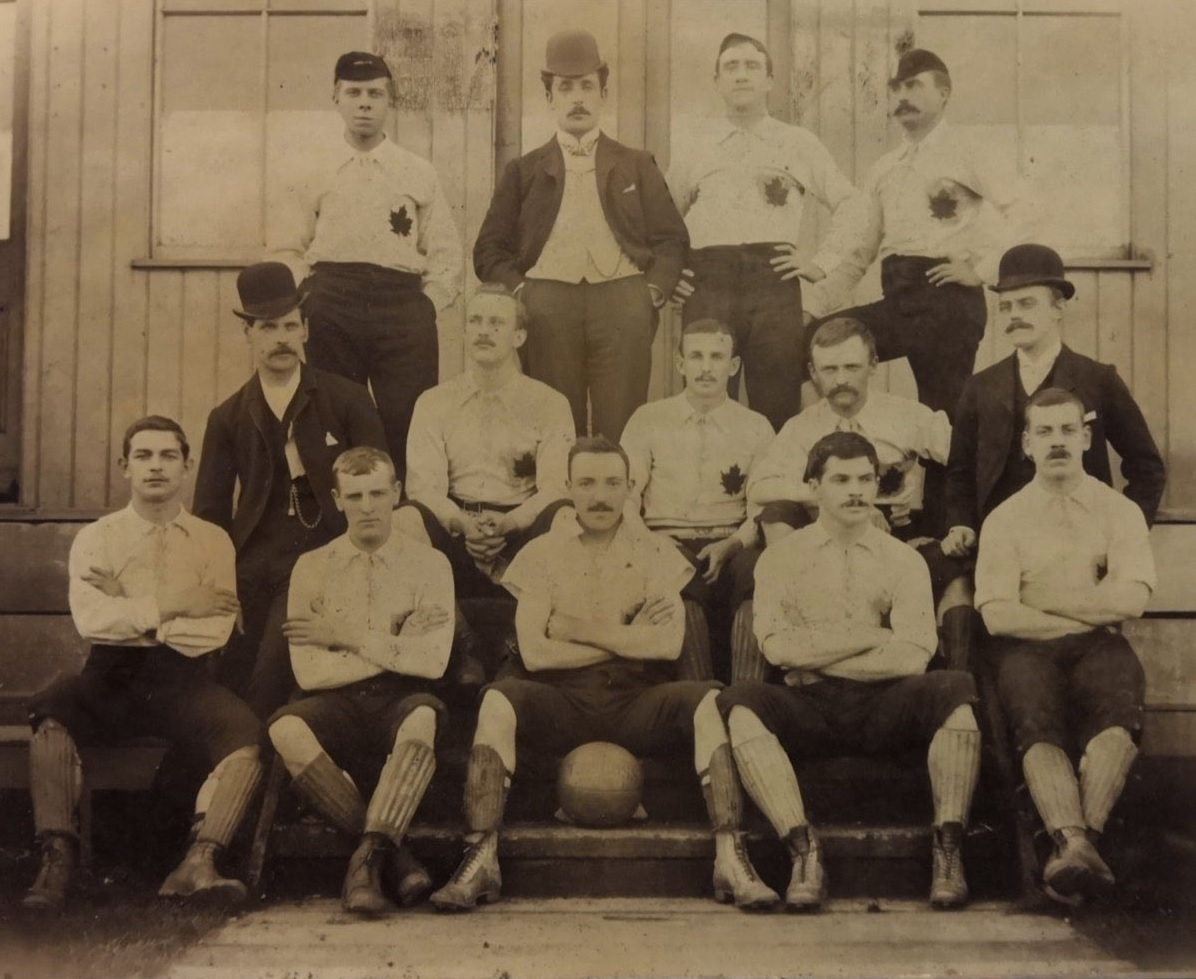
“Duncan’s Dream” it was not. Ellis acknowledged after the tour that “the very best team which can be raised in Canada, or the States or both combined, cannot hope to defeat the strongest old country team at present.” If the lessons learned were used “to make the necessary improvement in football on this side of the Atlantic,” then “the tour will have been of some use, and a benefit to football both in Canada and the States.”[27] Instead, the tour, much like the AFA-WFA matches that proceeded it, faded out of the collective soccer memory of both countries. But it did have an impact on the development of professional soccer in the US.
The 1888 tour coincided with the beginning of the first season of the professional Football League in England. The Scottish Football League followed in 1890 and by the 1891 tour, professional soccer was firmly entrenched in Britain. Back in Fall River and Pawtucket, professional players—more accurately, semiprofessional players– were not uncommon. Some of the New England players who were part of the 1891 tour were semiprofessionals, and their return from the UK coincided with the launch of the New England Football League, which allowed semiprofessional teams. When baseball’s National League backed the ultimately short-lived American League of Professional Football in 1894, the American-born 1891 tour veteran Dennis Shea was tapped to build the roster of the Brooklyn and Boston teams.[28]
After the 1891 Canadian American UK tour
Two years passed after the 1891 UK tour before another international match was played between select teams representing a US-based association and the WFA. A representative WFA team that included players selected from the CFA visited Detroit for games on Thanksgiving Day 1891, the Fourth of July 1892, and Memorial Day 1893, but club sides were the opponent, and none were affiliated with the AFA. In June 1893, the WFA played an all-Chicago side selected from Chicago Football Association member teams unaffiliated with the AFA twice, winning the first game 1-0 and drawing the second 1-1. Playing for Chicago in both matches was Thomas Gibson, the Berlin Ranger who may or may not have been on the team that humbled Buffalo in Preston three years before. After moving to Chicago, Gibson played for the Chicago Cricket Club and served as an administrator in the Chicago Football Association. None of his former WFA teammates were on the team that visited the Windy City.[29]
The CFA-WFA matches were not connected to the abandoned plans for an international soccer tournament to be held in conjunction with the 1893 World’s Fair, but the bold plan of the organizers to stage a club soccer world championship deserves greater recognition. With the amateur English team the Corinthians planned as the tournament’s main attraction, organizers extended invitations to club teams in the US, Canada, Europe, and South America. The idea collapsed when the Corinthians withdrew because of insurmountable transportation costs. But as the historian of soccer in the Midwest Gabe Logan describes, “Although the dreams of a ‘world’ championship proved ethereal, Chicago soccer organizers clearly envisioned an international-soccer-championship, decades before the World Cup and eleven years prior to the first Olympic soccer matches.”[30] Ambitious dreams of international play in the United States were not confined to the AFA. One can only imagine the “great impetus” that might have followed if the Chicago World’s Fair tournament had come off.
Post WFA 1888 UK Tour Representative Matches
| Date (YMD) | Home Team | Score | Visiting Team | Venue | Attendance | City | Country | Tour |
| 1890-11-27 | Fall Rivers | 3-1 | All WFA | Rovers Grounds | 3000-4000 | Fall River, MA | USA | 1890 WFA Tour to Fall River/Pawtucket |
| 1891-06-09 | All WFA | 1-4 | All New England League | Unknown | 700 | Seaforth, ON | CAN | 1891 All New England League Tour to Ontario |
| 1891-06-13 | All Toronto | 1-2 | All New England League | Rosedale Grounds | 1000-3000 | Toronto, ON | CAN | 1891 All New England League Tour to Ontario |
| 1893-06-17 | All Chicago | 0-1 | All WFA | 37th Street and Indiana Avenue Grounds | Unknown | Chicago, IL | USA | 1893 WFA Tour to Chicago |
| 1893-06-21 | All Chicago | 1-1 | All WFA | 37th Street and Indiana Avenue Grounds | Unknown | Chicago, IL | USA | 1893 WFA Tour to Chicago |
By now it was club teams leading engagement in cross-border play, including sides unaffiliated with either the AFA or WFA. Buffalo teams continued to organize matches against Canadian sides after its first cross-border trip in May 1886, doing so mostly against Ontario teams outside of the WFA. Following Fall River Rovers’ 1889 tour, Chicago Cricket Club played two games (with Thomas Gibson on its roster) against WFA-affiliated clubs in Canada in May 1891. A month later, the Rangers of Erie, Pennsylvania hosted Ontario’s Port Dover team on the Fourth of July. In May 1893, just weeks before the WFA’s visit to Chicago, the city’s Pullman club went to Canada for three games against WFA-affiliated clubs. In December 1892, Seattle FC inaugurated cross-border play on the West Coast, with three games against Canadian clubs on Victoria Island in British Columbia.
CFA-affiliated Toronto Varsity emerged as a valued draw for American clubs, playing exhibition matches in Detroit (1890, 1892, 1893), Chicago (1892), Pittsburgh (1892), and Pawtucket (1893). Of the US teams that hosted Toronto Varsity, only Pawtucket Free Wanderers was affiliated with the AFA. Beginning in 1894, the then AFA-affiliated Barre Rangers in Vermont began a series of matches against Montreal-based clubs outside of the WFA’s jurisdiction, including one against a picked Montreal team on July 4, 1894, losing 5-1 despite enjoying a three-player advantage for the first ten minutes of the game because three Montreal players were late to the grounds.[31] Canadian teams finally returned to St. Louis in December 1900 for the first time since 1884 when the WFA-affiliated Gore Vales and Berlin Rangers visited the city. The first AFA (AFA I) had disbanded by this time, but St. Louis teams were never affiliated with the original AFA, nor were they with the reconstituted AFA (AFA II) that returned to the scene in 1906. In 1905, University of Toronto, also not affiliated with the WFA, visited Philadelphia, the first visit by a Canadian team to the East Coast since 1893. Philadelphia Manz was affiliated with the AFA I for one season when it won the 1896-97 American Cup. Philadelphia-area teams began to affiliate with AFA II with the 1907-08 edition of the American Cup and were important participants through the conclusion of the tournament’s final edition in 1924.
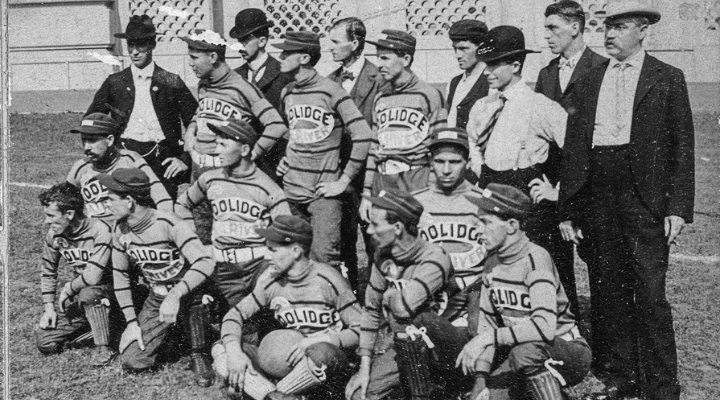
Despite their grand names, the soccer tournaments staged as part of the 1901 Pan American Games in Buffalo, the 1904 Olympics in St. Louis, and the 1905 Lewis and Clark Exposition in Portland were haphazardly organized at best and featured a limited number of competing teams: four in Buffalo, three in St. Louis, and two in Portland, and none were representative national teams as we would expect to see in the Olympics or Pan American Games today. Apart from the Pan American Games, which included matches with reported attendance of six thousand and ten thousand spectators, these soccer tournaments were largely met with indifference by the public. Match reports in St. Louis on the four Olympic games played there (over thirty-minute halves) in which the WFA-affiliated Galt team won the Gold Medal tellingly do not include attendance numbers while attendance at one match at the Lewis and Clark Exposition was reportedly “11 young men and one ’yaller’ dog.”[32] Only one of the handful of teams that participated in the small number of games staged at these tournaments was a representative team, the picked Fall Rivers team, winners of the Pan American championship. The rest of the competitors were club teams.
Historian of soccer in the US Brian D. Bunk has described the challenges that tournament organizers and competing teams faced, the most difficult of which was funding: teams had to pay their own way because organizers could not cover expenses or offer prize money. As Bunk underscores, the cost of transporting, feeding, and lodging a traveling party of fifteen to twenty people quickly becomes a considerable expense on top of providing team equipment and kit. But such investment paid off and the “great impetus” international competition could provide was still evident. The Fall Rivers’ Pan American victory helped power soccer’s resurgence in Fall River after its decline during the troubled economic times of the mid and late 1890s. Four years after the victory, Fall River and St. Louis hosted international club friendlies against the English amateur team the Pilgrims during its 1905 tour. Portland was too far away for the Pilgrims to land there but a league was established in the city within two years of the 1904 games.[33]
Why unofficial?
It’s reasonable to question why the nine matches played between the AFA and the WFA aren’t considered official USA and Canada internationals. One argument that they should be is that the AFA and WFA fielded representative sides. But, as we have seen, Forsyth reported in the Scottish Football Association Annual 1885-86 the existence of five associations in North America. If a match featuring representative sides from two different countries is enough to make it official, then why shouldn’t the WFAA-WFA match in St. Louis be considered an official USA-Canada match? After all, the WFAA was one of the five associations Forsyth described. Why shouldn’t the WFA matches against representative sides from Fall River, the New England Football Association, or the picked Chicago side also be considered official? Clearly, featuring two representative sides isn’t enough to make a match an official international.
Another argument is that the AFA and WFA either claimed to be representative national associations or, at the very least, were the closest thing to representative national associations then existing. That neither the WFA nor the AFA were nationally representative was understood when they existed. Forsyth’s reports on the WFA’s activities in the Scottish Football Association Annuals clearly describe them as for the “game in Ontario,” not for Canada as a whole. (The WFA teams that faced off against the AFA did include players selected from CFA-affiliated sides Toronto Varsity and Toronto Victorias.) AFA reports in the Scottish Football Association Annuals also recognized–without acknowledging the existence of the WFAA –that while there were “many clubs in existence here [in the United States],” the distance between them and the AFA’s center in Newark was “too great (1000 miles in some cases) to admit of their taking part in our contests.” This affirms that “taking part in” the American Cup was the definition of affiliation with the AFA. That is not the basis for a claim of national representation.[34]
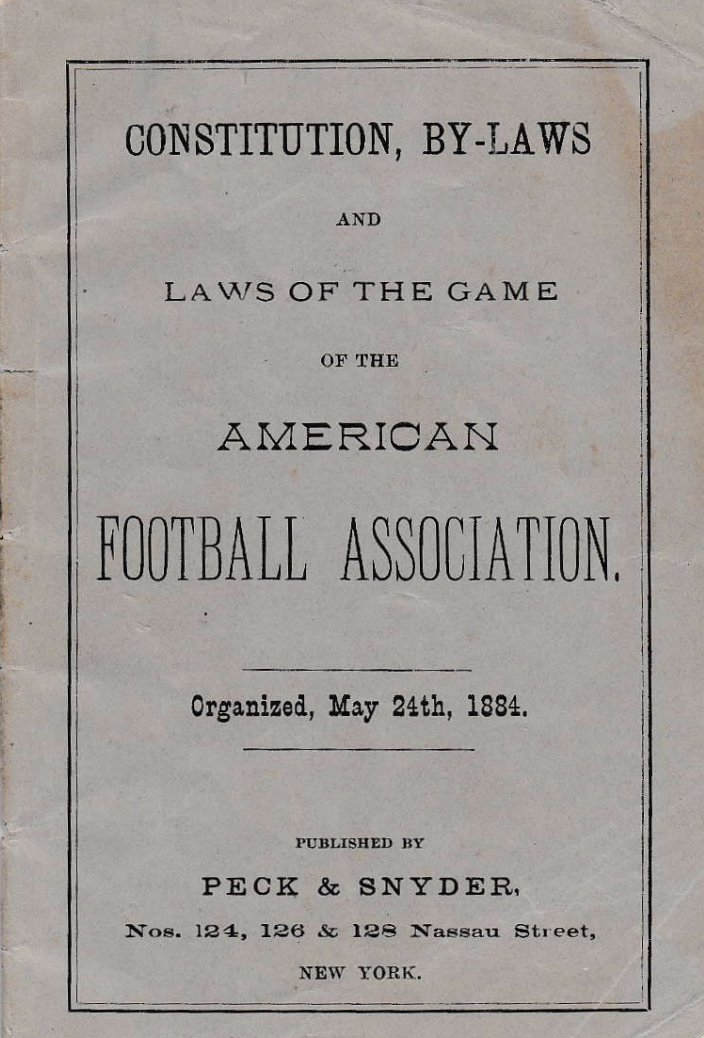
The only extant official AFA publication from this period, miraculously discovered by the historian of Northern New Jersey/New York Metropolitan area soccer Kurt Rausch, The Constitution, By-laws and Laws of the Game of the American Football Association, was published in 1887. While Article II states, “That all clubs in America playing Association Rules be eligible for membership,” the AFA acknowledged that the vast distances between the emerging soccer centers in the US made this an impossibility. The Constitution, By-laws and Laws of the Game reports no efforts by the AFA to link with soccer scenes beyond its Eastern and Western Districts. Nor does it report efforts to organize future international contests; past international matches against the WFA are unmentioned save for an incomplete list of “Men Who Have Played Against Canada” that somehow omits the first AFA-WFA game in November 1885. The only mention of possible future representative international matches is contained in a report by David Forsyth on soccer in Canada.[35]
Interestingly, the AFA later accepted as members teams from two British-flagged White Star Line ocean liners, the Majestics of the RMS Majestic in 1893, and the Teutonics of the RMS Teutonic in 1894. The Teutonics even entered the 1894-95 American Cup only to be eliminated in the first round by the Paterson True Blues. Whether the membership of British teams necessitated a change in the AFA’s bylaws is unknown. Certainly, the AFA never claimed to be an internationally representative association.[36]
That the AFA was not a nationally representative association was also understood outside of official AFA reports. Outing was a national magazine, an example of the evolution of sports reporting to sports journalism; instead of match reports and box scores, it published essays on a variety of sports and outdoor activities. A March 1891 Outing article by S.H. Roberts called “Association Football” begins with a review of the history of pre-code football and then a detailed explanation of how soccer is played before reviewing the state of the game in North America. Observing that soccer on the continent began in Canada, Roberts notes that before New England clubs affiliated, early AFA member clubs were “all clustered about the metropolis [the New York metropolitan area] and within the radius of a few miles.” He mentions the final AFA-WFA match in Newark in November 1887 but, despite writing only four years after it was played, incorrectly describes it as “the first international match played with Canada,” and makes no reference to the eight other matches played by the two associations. Roberts then underscores the limits of the AFA’s authority: “There are leagues in every State along the Atlantic coast from Maine to New Jersey,” adding, “The great obstacle that is presenting itself is the difficulty of governing the different clubs. Those that are members of the American association are governed by its laws, while the other clubs conform to them when they so desire.”[37]
After its founding, most of the AFA’s member clubs were in northern New Jersey along a line that stretched less than twenty miles from Newark through Kearny to Paterson. The addition of clubs from New England in 1887 extended the AFA’s regional footprint (and improved its record against the WFA) but brought it no closer to legitimacy as a nationally representative association. Like their Western District competitors, New England-based Eastern District clubs themselves were mostly located twenty miles from one another. There were outliers like Trenton, New Jersey, Barre, Vermont, and for one season Philadelphia, but outside these two centers of the game the AFA’s authority was largely unacknowledged or unknown. Beyond sending letters along with the WFA wishing every success to the WFAA after its founding in St. Louis in 1884 and a mention of ONT visiting there in 1885, no attempts beyond appear to have been made by the AFA during this period to develop links with other emerging soccer centers in the US. No tours were organized by the AFA to connect with soccer centers in the American Midwest like St. Louis and Chicago, which played two games in 1890 and four games in 1891 for the “Western Championship of America.” Nor did the AFA attempt to organize a parallel Western American Cup tournament to support its development into a truly national association.
Roberts’ account has a discernibly East-Coast bias; he opens his essay by noting that when the playing season of the national sport of baseball ends, “The climate of the Eastern States admits of the playing of Association football.” Three years later in May 1894, Outing published “A Plea for Association Football” by S.J. Watts, an account that can be described as having a discernible everywhere-in-the-US-other-than-the-AFA’s-territory bias. Watts was secretary of the WFA-affiliated Windsor team in Windsor, Ontario, and described as “a strong advocate for a national association, in order to bring the various leagues and associations of Canada and the United States into closer touch with one another for the good of the game.” In “A Plea,” Watts did not view the AFA as “a national association.”
After arguing soccer’s superiority over Rugby football and explaining how soccer is played (the sport still needed explaining to Outing readers), Watts’ account of the current state of the game emphasizes that “Scotland’s sons” led soccer’s development first in Canada and then in the US. Unlike Roberts, Watts describes soccer in areas far from the AFA’s influence: Detroit, Chicago, and nearby Braidwood, Illinois in the Midwest; British Columbia, Oregon, Seattle, and San Francisco on the Pacific Coast; and closer to the AFA, the Philadelphia region in the East. Turning to AFA territory, Watts refers to the AFA only as “this Association,” emphasizing New England’s primacy without mentioning Newark: “In the East the interest in the game centers in the manufacturing districts about Fall River, Mass., and Pawtucket, R.I.” Acknowledging the American Cup tournament format’s division into two districts, he incorrectly reports this measure was enacted “Last season”— meaning the 1892-93 edition—when it was enacted five years before. No mention of any of the AFA-WFA representative internationals is made, but the 1888 tour of Great Britain is described, as is the visit by Toronto Varsity to Pawtucket in 1893.[38]
Instead of being recognized as a national association in one of the few national sports magazines of its day, the AFA was contextualized as a regional association in one essay and barely acknowledged by the “strong advocate for a national association” author of the other, its representative international matches misremembered or not mentioned at all. The misremembering of the AFA-WFA matches would only get worse. Published in the 1910 edition of Spalding’s Official Association “Soccer” Foot Ball Guide is an article by C.K. Murray titled “History and Progress of the American Football Association.” Murray’s account is riddled with errors, a perfect example of why American soccer historians must interrogate contemporary retrospectives accounts of soccer and never accept them at face value.
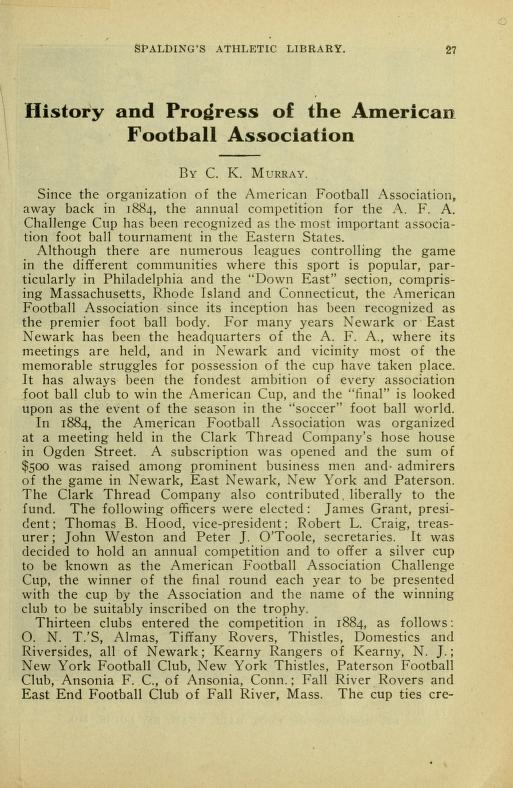
In the three pages in which he addresses the early history of the AFA, Murray incorrectly names where the association was founded and has Fall River clubs entering the American Cup three editions before they did. He fantastically turns ONT’s humbling 1885 five-match tour of Ontario that ended with one win, one draw, and three losses into a triumph of “winning nine games, losing one and drawing one.” While actually played in East Newark in November 1885 and won 1-0 by the WFA, Murray describes the first ever AFA-WFA match as a 3-2 victory for the AFA and places it three hundred and sixty-four miles away in Galt, attributing to the game the score of the second ever AFA-WFA match, the AFA home victory over the WFA in November 1886. He then reports “the second international game with Canada,” which was played in East Newark, as “a splendid victory for the Americans by 5 goals to 1.” Although Murray only mentions one, two AFA-WFA matches were played in East Newark that November, and both were won by the AFA. But neither match ended with the score Murray reports; indeed, no AFA win over the WFA ended with a 5-1 scoreline; the only thing close is the AFA’s crushing 5-0 defeat to the WFA in the last match played in Newark in November 1887. Murray mentions no other international events. Less than twenty-five years after the last AFA-WFA game was played in Ontario in May 1888, an official history of the AFA followed Roberts in getting the history wrong, acknowledging only two of the nine matches played, and incorrectly reporting the details of both. Because the Murray’s account was published in the Spalding Guide, a prime source of information for soccer historians, his errors were repeated in subsequent works. The diverse sources needed to compile reports that enabled historians to detail the actual records of these matches would not be widely, affordably, and remotely accessible until the appearance of online newspaper archives.[39]
Roberts, Watts, and Murray meant no harm; the accounts they left us were probably based on newspaper clippings saved in scrapbooks—clippings of reports which themselves might be inaccurate and without publication dates noted–and other random sources, mixed with a healthy dose of old timers’ decades-old recollections. It is doubtful that the writers spent time doing research in their local library’s newspaper archive. It is unknown if the AFA annually published official records and if it did how widely distributed such records were.
Unofficial or official: Making a judgement
Being better acquainted with the facts thanks to our online access to diverse newspapers, census records, and other sources, we can make an honest judgement of what qualifies as an “official” international. The nationality of the players involved may be one criterion by which the issue is decided. As described above, England and Scotland judged that five matches played before the first “official” international played in November 1872 were unofficial because they were not nationally representative of Scotland. As Andy Mitchell explains, this is because selection for the teams was limited “to those who lived in and around London,” which is akin to the AFA facing a Canadian team of players who lived in and around Newark, New Jersey.[40]
Looking at another international example, ten early Belgium national team international matches played between 1904 and 1909 are considered unofficial by the Royal Belgian Football Association because British nationals were part of the team’s lineup.[41] The AFA-WFA matches were played long before the formation of FIFA and defining nationality in relation to eligibility for national team selection has been an evolving process. Available records indicate the WFA players who competed against the WFAA and the AFA and participated in the 1888 tour to Great Britain were native-born Canadian citizens. With the exception of New Jersey-born goalkeeper Patrick Hughes, available records also indicate the New Jersey- and New York-based players who represented the AFA were recently arrived British immigrants, and almost certainly not yet American citizens. The same is true of the WFAA side in St. Louis. In the 1880s. US immigration law required an immigrant to file a declaration of their intention to obtain US citizenship and then reside in the US for five years before citizenship was granted. That would mean that, at a minimum, the AFA players on the roster for the first AFA-WFA match in 1885 must have arrived in the US in 1880 to be naturalized citizens when they played. It was only after New England clubs joined the AFA that US-born players like Robert Bell, Joseph W. Buckley, Henry Waring, and Abraham Pilling joined Patrick Hughes in appearing on representative AFA teams.[42]
What available records can’t tell us is what immigrant players thought about their nationality and what they were representing on the field of play. The fluidity of nationality is evident in the case of Neil Munro. Munro was a recently arrived immigrant from Scotland playing for Pawtucket Free Wanderers when he was one of the “Americans” who joined the 1891 Canadian American team. Before immigrating to the US, Munro had made two appearances for Scotland, scoring against Wales in 1888 and against England in 1889. Midway through the tour Munro abandoned the Canadian American team to re-sign with his old club in Scotland, Abercorn FC.[43]
The ambiguity of nationality can also be seen in how AFA-WFA games were reported in newspapers. Recall the shifting descriptions of the match between Buffalo FC and the picked WFA team. With the AFA-WFA games, this uncertainty of naming extended over four years. The Newark Sunday Call previewed the first AFA-WFA match in East Newark as one between “a representative Canadian team” and “a representative American team,” which sounds like “Canada” and “the USA.” A week later, the newspaper referred to the AFA team merely as one “selected from the various clubs in the neighborhood.” The Toronto World’s match report on the game was more precise and described the teams as “a picked eleven from the Western association of Canada and a picked team from the American association.” Meanwhile, the New York Times reported the game as one between “the champion elevens of Canada and the United States,” which to be something close to true would’ve been a match between Berlin Rangers and ONT. The next year when the WFA returned for its second match against the AFA, the Paterson Morning Call described the opponents as “the Canadians” and “the team selected from the clubs of the American Association,” also described as “the home association,” but not as the USA team. Forsyth echoed this a year later when he referred to the WFA’s series of games against the AFA as “the matches with the American Association,” not the United States, also describing “Canadian associations” selecting players for “their representative teams” rather than claiming the WFA as the singularly nationally representative association in Canada. By the time of the November 1887 game in Newark, the New York Times was referring to it as “The international football match between Canada and the United States,” while the Toronto Globe said it was “Americans versus Canadians.” But in its brief match report, the New York Times unambiguously reported, “The teams were those of the American Football Association and the Western Football Association of Ontario.”[44]
The variety of names and descriptions in newspaper reports is understandable. Journalists and editors were keeping things simple for uninformed readers: these teams are from the United States and Canada, therefore they are the United States and Canada teams. Sometimes it’s local boosterism or hype getting in the way of accurate reporting. Sometimes it’s clear that an uninformed copy writer simply got things wrong. Credit too must go to the American Football Association for inspired branding. The name infers the reputational weight of the English FA and the Scottish FA: it sounds like a national organization. “American Football Association” can also be correctly shortened both as “the American association” and as “American Association,” although each contraction has different contextual meanings which uninformed journalists and newspaper readers might be unable to distinguish. Mindful of all of that, in recognizing all nine of the AFA-WFA games now, our job looking back is to be clear about who organized the games, how the organizers themselves described the games, and who played in the games. In doing so, why the games are “unofficial” becomes clearer.
The founding texts of US and Canadian soccer history agree that the AFA and WFA were not nationally representative associations. In U.S. Soccer vs the World (1983), Tony Cirino is clear that the “U.S. team”–the AFA team– “was by no means a selection of the best players in the country” because “there was no national association.” Colin Jose explains in Keeping Score: The Canadian Encyclopedia of Soccer (1998) that the AFA-WFA matches are “unofficial” because “they were played before the governing bodies of soccer in the two countries were formed, and also because they represented only a small part of the country.” Roger Allaway agrees in Rangers, Rovers & Spindles (2005). While not discussing the AFA-WFA games in America’s Soccer Heritage (1979), even Sam Foulds and Paul Harris describe the AFA as “a loosely knit organization,” one that “laid the groundwork for an eventual national governing structure,” not one that was. The WFA may have been the largest soccer association in Canada for much of its existence until the founding of what is now called the Canadian Soccer Federation in 1912, but it ceased to exist in 1940. Similarly, the AFA (AFA I) ceased to exist by 1899. Eight years elapsed before it was re-formed in 1906 (AFA II), surviving until 1924 through its American Cup tournament after it was supplanted by the USFA, founded in 1913.[45]
FIFA defines a representative match as “a team representing a Member,” and an international match as “a match between two teams belonging to different Members or a match involving a Scratch Team,” a scratch team being “a team brought together on a one-off basis.” The requirement of FIFA membership is also reflected in the bylaws of the US Soccer Federation, which define an “International Game” as one involving “FIFA national association members.” The AFA and WFA weren’t national associations when the 1885-1888 games were played, and they weren’t FIFA members because FIFA didn’t yet exist. The USFA didn’t exist either when the games were played but it has continuously existed since 1913. A year after applying, the AFA II gained membership in England’s FA in February 1909. But only months after its founding, the USFA won the duel of bids with AFA II for FIFA affiliation, obtaining provisional status on August 15, 1913. Accepting its claim of national representation was now over, AFA II affiliated with the USFA. FIFA granted full membership on June 28, 1914, exactly one month before Archduke Franz Ferdinand of Austria was assassinated and the start of the First World War. Before the USFA was “unanimously admitted to membership” in FIFA, England FA secretary Frederick Wall “pointed out that the U.S.F.A established themselves as a National Association,” and that England’s opposition—on behalf of the AFA II—to granting the USFA FIFA membership “was only a matter of principle,” whatever that means. Thus, the simplest explanation for why the AFA-WFA matches are “unofficial” is because FIFA regulations and US Soccer’s bylaws say they are. Even without such legalistic reasoning, an honest assessment can only conclude there are plenty of other legitimate reasons why the matches are unofficial.[46]
Is unofficial bad?
Defining the AFA-WFA matches as unofficial in no way diminishes their historical importance. AFA and WFA officials acknowledged their associations were not nationally representative even as they aspired, more explicitly in the case of the AFA, to make national representation a reality. It also does not diminish the place of the AFA and the WFA as the most important organizations in the foundational years of soccer in the United States and Canada. Both associations recognized the international events they organized helped to publicize and expand awareness and interest in the game, that the rules they published and the cup tournaments they staged encouraged existing clubs to make interregional and international connections while also encouraging new clubs and leagues to be formed. All of this was part of the process toward realizing “Ned Duncan’s Dream” of regular international competition supported by a mass public. We need to recognize that, too.
Andy Mitchell has pointed out that the five matches played in London before the first official international in Glasgow in 1872 “are often referred to as ‘pseudo-internationals.’” With its connotations of “fake,” the term has a disparaging feel to it, and Mitchell rightly argues the “more accurate description is that of unofficial internationals.”[47] Describing the AFA-WFA matches as “pseudo-internationals” denigrates their importance. Defining them as unofficial simply recognizes that the nine matches do not meet reasonable standards of what currently constitutes national representation.
In accepting them as unofficial, even symbolic internationals, we can move past questions about how geographically diverse select team rosters were, citizenship status, and how nationally representative associations were. Instead, we can celebrate the matches, the associations that organized them, and the players who played in them. We can then unreservedly applaud their significance as part of the first steps in the global history of soccer toward making real the vision of truly nationally representative international competitions that continue to fuel the game’s growth today both in the United States and Canada and throughout the world.
Canada Soccer includes three of the nine unofficial USA-Canada matches on its website. On the US Soccer website, a rather questionable historical timeline mentions the November 1885 AFA-WFA game as the first involving “a team representing the United States.” But, shamefully, US Soccer’s listings of past US Men’s National Team results begins with 2010, omitting ninety-four years of team history, not to mention the first attempts in North America to organize nationally representative international soccer. Fully acknowledging all nine AFA-WFA matches in the beginning of a full list of official US international matches while clearly labeling them as unofficial does no harm to either soccer federation. Rather, doing so affirms the federations stewardship of their respective country’s soccer heritage, a heritage that reaches further into the past than most soccer fans in both countries and the rest of the world realize, while underscoring each country’s contributions to the global development of representative international soccer. That’s why the unofficial AFA-WFA internationals are listed on the Society for American Soccer History website (along with the complete records of both the US Men’s and Women’s national teams).[48]
More interesting than the question of why the AFA-WFA matches aren’t official is why thirty-seven years passed from the last AFA-WFA matches in 1888 until the first official international was played between the US and Canada in 1925. Why aren’t further examples of unofficial internationals present in that thirty-seven-year span?
It’s not that there was a lack of institutional will in the AFA. After the addition of New England teams, AFA I was marked by an ongoing administrative tug of war and power plays between the association’s Newark home base and emergent Fall River. Constant discord within the association was then overshadowed by an enormous external economic challenge: surviving the economic depression that resulted from the Panic of 1893. On top of that AFA I had to contend with rising professionalism, particularly in Fall River and Pawtucket, and then the fallout from the brief appearance in 1894 of the first regional professional leagues in the US, the American Association of Professional Soccer and the American League of Professional Soccer, both of which were formed on the AFA’s turf and drew personnel from AFA-affiliated teams.[49]
AFA II faced the immediate concerns of restarting, expanding, and managing its American Cup tournament and affiliating with the England’s FA. Embracing professionalism saw new challenges as did responding to the tours by English amateur teams the Pilgrims in 1909 and the Corinthians in 1911. AFA II made steps as early as 1910 to extend its authority beyond its traditional base when it named St. Louis soccer organizer Winton E. Barker as honorary president. In 1911 the Michigan State League affiliated. In 1912, the St. Louis Association Football League of which Barker was president did the same. But that good news was undercut by the Michigan State League jumping ship to the American Amateur Football Association (AAFA) and a raft of other leagues affiliating with the New York-based amateur soccer governing body including leagues in Baltimore, Buffalo, Rochester, Erie, Pittsburgh, Cleveland, Louisville, Chicago, and Salt Lake City. Fundamental to the AAFA’s opposition to the AFA II was it’s affiliation with England’s FA: the goal of national governance of the game should be “the entire Americanization of the game” with “complete autonomy” from the FA so that the national governing body could join FIFA as an independent body rather than “a mere off shoot of the English association.” Noting that the AFA’s leadership was made up of immigrants from Britain, one observer testily declared, “As for the American Football Association, it is American only in name, and in the fact that its members live in this country.” Rival applications for FIFA membership from the AFA and AAFA ultimately led to the creation of the USFA with the new national body taking over the AAFA’s bid and eventually winning recognition, signaling the AFA II’s eventual demise.[50] In the face of challenges like these, for AFA I and AFA II, the nexus of moneyed sponsors and quality players able to leave work for representative international matches and tours was simply too difficult to achieve again.
Fortunately for the recently formed USFA, the Swedish Football Association cabled four thousand dollars to cover expenses for the tour that made possible the first official US internationals against Sweden and Norway in 1916.[51] The next official US internationals weren’t against its northern neighbor but against Estonia, Uruguay, Poland, and Ireland as part of the US team’s trip to Europe for the 1924 Olympics. Meanwhile, Canada traveled more than six thousand miles to Australia to play its first official international, one of six official internationals it played in Australia in 1924.
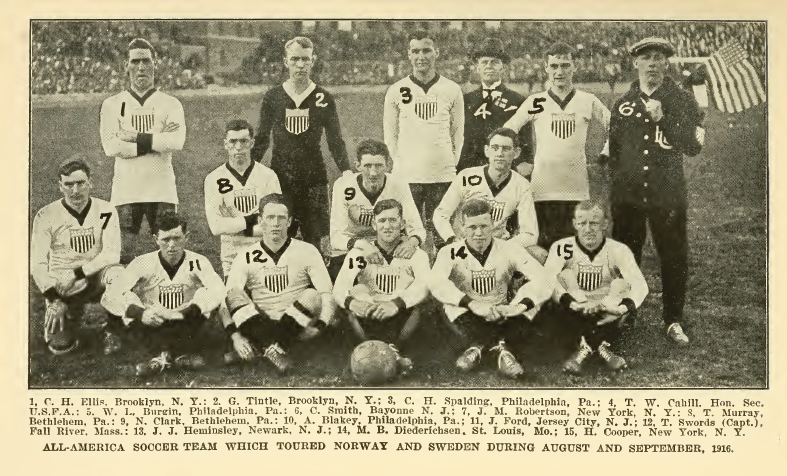
The USA and Canada make it official
The US didn’t officially play Canada until it visited Montreal in June 1925. After that, two further official USA-Canada matches were played in New York City, first in November 1925 (match footage is available on the SASH YouTube channel) and then November 1926, echoing the November visits by Canada to New Jersey nearly forty years before. But the series was not continued, and the countries did not face off again until thirty-one years later in 1957 for two World Cup qualifiers. Another eleven years passed before the countries next met for two more qualifiers in 1968.
In its defense, the then always cash-strapped USFA was domestically focused. The immediate challenge after its founding linking the growing number of soccer centers dispersed across the country to make the US Open Cup a truly national competition. The US is a big country; the distance between New York City and Los Angeles is only about eight hundred miles less than the distance between New York City and Glasgow. Before the USFA’s founding in April 1913, clubs affiliated with AFA II began to trailblaze this path through tours to St. Louis beginning with Philadelphia’s Tacony team in December 1911 followed by the West Hudsons in December 1912 and Rhode Island’s Howard & Bullough team in January 1913. Reciprocal tours to the East by St. Louis sides the St. Leos in March 1912 and Innisfails in March 1913 against AFA-affiliated club followed. All of this activity was implicitly or explicitly supported by AFA II.[52] The US Open Cup’s field of entrants expanded to include clubs beyond the AFA’s American Cup tournament’s footprint in its second edition with the entrance of clubs from western Pennsylvania, Cleveland, and Detroit. Illinois-based clubs from Chicago and Joilet followed with St. Louis clubs entering the tournament in 1919. The East Coast and the Midwest were finally connected but the West Coast would not begin to be linked until the 1950s.
As was the case with the AFA in the 1880s, USFA did not maintain a standing representative team. Aside from the occasional tour by a visiting national team, representative sides were organized largely for specific competitions like the World Cup, the Olympics, and the North American Football Confederation Championship, the precursor to today’s Concacaf Gold Cup. Raising money to pay the expenses associated with participation in these tournaments was a recurring challenge. Nevertheless, it is remarkable that the social networks that facilitated the organization of the unofficial USA-Canada matches in the 1880s did not persist after Canada Soccer and US Soccer were founded, even as advances in communication and transportation technology would have made the organization of further representative matches between them easier. We can only speculate how annual meetings between the US and Canada would have aided soccer’s development in both countries but surely, they wouldn’t have hurt.
“Duncan’s Dream” of “The Great International” between Scotland and the US in Glasgow was finally realized in 1952. In the twenty-six years between the last official match with Canada in 1926 and the match with Scotland in Glasgow in 1952, the US played only twenty-seven official internationals. In seventeen of those twenty-six years, zero official internationals were played. While there were occasional bright spots like the 1930 World Cup and the win over England in 1950, the results generally were not good. Scoring forty-eight goals while conceding one hundred fourteen, the US record during this period was eight wins, three draws, and sixteen losses. Scotland teams toured the US in 1935, 1939, and 1949, but the USFA didn’t organize a representative team for any of those visits. Instead, local and regional all-star teams were the opponents.
On April 30, 1952, more than one hundred and seven thousand fans packed Hampden Park in Glasgow to see the team that had defeated England two years before at the 1950 World Cup. Road traffic was so affected by the massive attendance that it became a news item in itself. But only six of the US players who defeated England faced off against Scotland and the other US players weren’t members of the 1950 World Cup team. Indeed, this was the first match for the US since the 1950 World Cup and that showed in the result. Under a headline blaring, “Scots Win Farcical Match Against U.S.A.,” the Glasgow Herald described the game as “Hampden Park’s most irritating match in all the great history of the famous ground.” Scotland romped to a 6-0 win, turning Duncan’s Dream into a nightmare for the USA.[53]
The inspiration to organize representative intercontinental soccer competition, with participating teams accompanied and cheered on by travelling supporters, provided by Ned Duncan’s Dream to the AFA and WFA echoes in the present with the United States, Canada, and Mexico co-hosting of the 2026 World Cup. Also reflected is the vision of those who organized the 1888 Canada and 1891 Canadian American tours of the UK, and soccer at the 1901 Pan American Games, 1904 Olympics, and the 1905 Lewis Clark Exposition, not to mention those ambitious though unrealized plans for the 1893 World’s Fair in Chicago. While representative international soccer began in the UK, the next international events in the global history of the game were in the US and Canada. Canada then led the way in representative intercontinental soccer, soon enlisting the help of the US.
Even if those first representative international events organized by Canada and the US were unofficial.
Endnotes
[1] “Football in Newark,” Newark Sunday Call, Oct. 12, 1884, 4 P.J. O’Toole, “The American Football Association,” in Scottish Football Association Annual, 1885-86, ed. John M’Dowall (H. Nisbett & Co., 1885), 112-113.
[2] Glenavon, “Ned Duncan’s Dream; or, the Great International of 1901,” in Scottish Football Association Annual, 1884-85, ed. John M’Dowall (H. Nisbett & Co., 1884), 115-121. The story was later republished in a collection of writings by its author: D.D. Bone, “Ned Duncan’s Dream; or, the Great International of 1901,” in Football Reminiscences and Sketches (John Menzies & Co., 1890), 73-79.
[3] Glenavon, 120-121.
[4] O’Toole, 113; David Forsyth, “Western Canada Football Association,” in Scottish Football Association Annual, 1885-86, ed. John M’Dowall (H. Nisbett & Co., 1885), 115.
[5] David Forsyth, “Western Football Association of Ontario,” in Scottish Football Association Annual, 1886-87, ed. John M’Dowall (H. Nisbett & Co., 1886), 110; John West, “Football in America,” The Athletic News (UK), May 26, 1885, 27; Les Jones, Soccer: Canada’s National Sport (Covershots, 2013), 43.
[6] Forsyth, “Western Football Association of Ontario,” 110; “Football in Prospect Park,” Brooklyn Union, Apr. 25, 1886, 3; “New York State Football Association,” New York Times, March 26, 1886, 3; “Sporting Notes,” New York Times, Mar. 22, 1886, 8.
[7] “Football Challenge,” International Gazette, Jan. 9, 1886, 4; “Sporting Notes,” Buffalo Post, Apr. 27, 1886, 3; “Sporting News,” Buffalo Times, May 26, 1886, 5.
[8] Forsyth, “Western Football Association of Ontario,” 110; “Football: Two Scottish Evens to Visit America—The Programme–Our Governor General a Patron of the Game,” Montreal Star, Nov. 28, 1878, 1.
[9] “Football,” Paterson Daily Guardian, May 26, 1884, 3; “Football at the Manhattan Grounds,“ The Sun (New York), May 31, 1884, 4; “East End Football Games, Fall River Daily Herald, Oct. 22, 1884, 4; “Foot-ball in the Rain,“ St. Louis Globe Democrat, Dec. 29, 1884, 10.
[10] Ed Farnsworth, “Sailor lads, jolly tars, and rovers of the briny deep: International ship-crew soccer matches in the US, 1890-1905, part 1,” Society for American Soccer History, https://www.ussoccerhistory.org/sailor-lads-jolly-tars-and-rovers-of-the-briny-deep-international-ship-crew-soccer-matches-in-the-us-1890-1905-part-1/; “Sailor lads, jolly tars, and rovers of the briny deep: International ship-crew soccer matches in the US, 1890-1905, part 2,” Society for American Soccer History, https://www.ussoccerhistory.org/sailor-lads-jolly-tars-and-rovers-of-the-briny-deep-international-ship-crew-soccer-matches-in-the-us-1890-1905-part-2/; “Sailor lads, jolly tars, and rovers of the briny deep: International ship-crew soccer matches in the US, 1890-1905, part 3,” Society for American Soccer History, https://www.ussoccerhistory.org/sailor-lads-jolly-tars-and-rovers-of-the-briny-deep-international-ship-crew-soccer-matches-in-the-us-1890-1905-part-3/.
[11] “Football in Canada,” Newark Sunday Call, Jun. 28, 1885, 2; “Football,” Newark Sunday Call, Nov. 29, 1885, 1; “Canadians the Victors,” New York Times, Nov. 29, 1885, 7; “A Variety of Gossip,” Fall River Daily Herald, Jun. 2, 1893, 7.
[12] Kevin E. Boller, “The History of Cricket Canada,” Cricket Canada, https://www.cricketcanada.org/about/history; Jon Harris, “Cricket in Canada: a historical review,” ESPNCricInfo, https://www.espncricinfo.com/story/cricket-in-canada-a-historical-review-106282; Joyce Hisey, “Historical Information: Toronto Cricket Club,” https://sahratoronto.com/sahra2017/wp-content/uploads/2019/08/Toronto-Cricket-Club-May-2019.pdf; “19th Century Cricket,” International Cricket Council, https://www.icc-cricket.com/about/cricket/history-of-cricket/19th-century; “The International Curling Match,“ Buffalo Morning Express, Jan. 6, 1865, 3; “This Date in History: First football game was May 14, 1874,” McGill University Channels, https://www.mcgill.ca/channels/news/date-history-first-football-game-was-may-14-1874-106694; Woody Eckard, “The International Association of 1877-80,” Baseball Research Journal (Spring 2024), https://sabr.org/journal/article/the-international-association-of-1877-80/; “International Association,” Baseball Reference, https://www.baseball-reference.com/bullpen/International_Association.
[13] Colin Jose, Keeping Score: The Encyclopedia of Canadian Soccer (The Soccer Hall of Fame and Museum, 1998), 3-5; Jones, Soccer: Canada’s National Sport, 24-25.
[14] Jones, Soccer: Canada’s National Sport, 22-23; “Football,” Fall River Daily Herald, Nov. 23, 1887, 4; Colin Jose, “Ontario: The Early Years,” Canadian Soccer History: The Colin Jose Project, http://www.canadiansoccerhistory.com/Ontario/Ontario-%20The%20Early%20Years.html.
[15] OToole, “The American Football Association,” 112; “List of Clubs,” in Constitution, By-Laws and Laws of the Game of the American Football Association (Peck & Snyder, 1887), 29-31; David Forsyth, “Western Canada Football Association,” Scottish Football Association Annual, 1884-85 (HN& Co, 1884), 110; David Forsyth, “Association Foot-Ball in Canada,” in Constitution, By-Laws and Laws of the Game of the American Football Association (Peck & Snyder, 1887), 27.
[16] Forsyth, “Western Football Association of Ontario,” 110; “Bright Outlook for Foot-Ball,” St. Louis Post-Dispatch, Oct. 22, 1884, 7; “A Draw at Fall River,” Toronto Daily Mail, Nov. 28, 1887, 2; “New England vs. Canada,” Fall River Daily Herald, Nov. 28, 1887, 4.
[17] Jose and Rennie referenced as a source by Cirino. Tony Cirino, U.S. Soccer vs the World (Damon Press, 1983), 1-6. For more recent examples see, Colin Jose, Keeping Score: Canadian Encyclopedia of Soccer (The Soccer Hall of Fame and Museum, 1998), 25-29; Roger Allaway, Rangers, Rovers & Spindles: Soccer, Immigration and Textiles in New England and New Jersey (St. Johann Press, 2005), 37-38; Les Jones, Soccer: Canada’s National Sport, 150 Years of the Memorable, Unexpected & Controversial (Covershots, 2013), 43; Thomas A. McCabe, “The New Jersey Soccerscape: A Cradle of Early American Soccer,” in Soccer Frontiers: The Global Game in the United States, 1863-1913, eds. Chris Bolsmann and George N. Kioussis (University of Tennessee Press, 2021), 95; James Walden, ”American Football Association,“ in Scottish Football Association Annual, 1886-87, ed. James M’Dowall (Hay Nisbet & Co.,1886), 111; Canada Soccer Statshub,” Canada Soccer, https://canadasoccer.com/stats/national-team/2068/mens-national-team/; see Ed Farnsworth, Les Jones, and Neil Morrison, ”Representative matches of the Western FA (Canada) and the American FA (United States),” Rec. Sport Soccer Statistics Foundation, https://www.rsssf.org/tablesw/wfa-afa.html.
[18] “Football Matters,” Paterson Morning Call, Nov. 25, 1886, 7; “International Football,” Brooklyn Union, Nov. 28, 1886, 1.
[19] Thomas B. Hood, “American Football Association,” in Scottish Football Association Annual, 1887-88, ed. John M’Dowall (H. Nisbett & Co., 1887), 103; “A Draw at Fall River,” Toronto Daily Mail, Nov. 28, 1887, 2; “New England vs. Canada,” Fall River Daily Herald, Nov. 28, 1887, 4.
[20] Andy Mitchell, First Elevens: The birth of international football (Andy Mitchell Media, 2012), 47-48; Forsyth, “Western Canada Football Association,” 115.
[21] Colin Jose, “Overseas Tours by Canadian Teams: Great Britain Tour, 1888,” Canadian Soccer History: The Colin Jose Project, http://www.canadiansoccerhistory.com/Canadiantoursabroad/Gt%20Britain%201888.html; Colin Jose, “Canadian-American Great Britain Tour, 1891–92,” Canadian Soccer History: The Colin Jose Project, http://www.canadiansoccerhistory.com/Canadiantoursabroad/Gt%20Britain%201891.html.
[22] Jose, “Overseas Tours by Canadian Teams: Great Britain Tour, 1888.”
[23] “Our Boys Were Beaten,” Buffalo Evening News, July 2, 1890, 1; “Canada V. United States,” Toronto Daily Mail, July 4, 1890, 2; Colin Jose, “Overseas Tours by Canadian Teams: Great Britain Tour, 1888.”
[24] “The Rovers’ Canadian Trip,” Fall River Globe, Jun. 3, 1889, 1; “All Canada,” Fall River Daily Herald, Nov. 28, 1890, 4; “A Canadian Trip,” Fall River Globe, Apr. 17, 1891, 7; “Unprofitable,” Fall River Daily Herald, Jun. 17, 1891, 1; Massachusetts Bureau of Statistics of Labor, Massachusetts Labor Bulletin. No. 5, January 1898, 13.
[25] Michael Kielty, “The American Footballers of 1891: When soccer football from North America came to Ireland,” https://express.adobe.com/page/nXXbhmjLfz6IW/.
[26] Jose, “Canadian-American Great Britain Tour, 1891–92.”
[27] Kielty, “The American Footballers of 1891.”
[28] Ed Farnsworth, “The rise and fall: Fall River and Pawtucket soccer, 1883-1896,” Society for American Soccer History, https://www.ussoccerhistory.org/the-rise-and-fall-of-organized-soccer-in-fall-river-and-pawtucket-1883-1896/; Ed Farnsworth and Kurt Rausch, “‘Talented but Tainted’: Henry ‘Harry’ Boyd in the US, 1891-92,” Society for American Soccer History, https://www.ussoccerhistory.org/talented-but-tainted-henry-harry-boyd-in-the-us-1891-92/; Ed Farnsworth, “The AAPF and the ALPF: The beginnings of professional league soccer in the United States,” Society for American Soccer History, https://www.ussoccerhistory.org/the-aapf-and-the-alpf-the-beginnings-of-professional-league-soccer-in-the-united-states/; Brian D. Bunk, From Football to Soccer: The Early History of the Beautiful Game in the United States (University of Illinois Press, 2021), 110-111.
[29] “The Chicago-Canada Football Game,” Chicago Tribune, Jun 17, 1893, p 7; “Beaten at Football,” Chicago Tribune, Jun. 18, 1893; Jose, “Overseas Tours by Canadian Teams: Great Britain Tour, 1888”; Gabe Logan, The Early Years of Chicago Soccer, 1887-1939 (Lexington Books, 2019), 19-20.
[30] Logan, The Early Years of Chicago Soccer, 35.
[31] “Too Much for the Yankees,” Montreal Gazette, July 5, 1894, 8; “Won by the Montreal Team,” Inter Ocean, July 5, 1897, 9.
[32] “Champs are Home,” Fall River Daily Globe, Sep. 9, 1901, 6; “Ladysmith Wins the Game,” The Oregonian, Sep. 29, 1905, 7.
[33] Brian D. Bunk, Beyond the Field: How Soccer Built Community in the United States (University of Illinois Press, 2025), 149-154.
[34]Forsyth, “Western Canada Football Association,” 115; O’Toole, “The American Football Association,” 112.
[35] “Constitution and By-laws,” in Constitution, By-laws and Laws of the Game of the American Football Association, (Peck & Snyder, 1887), 4; “Men Who Have Played Against Canada,” in Constitution, By-Laws and Laws of the Game of the American Football Association (Peck & Snyder, 1887), 26. From the collection of Kurt Rausch.
[36] Farnsworth, “Sailor lads, jolly tars, and rovers of the briny deep, part 1.”
[37] S.H. Roberts, “Association Football,” Outing 17, no. 6 (March 1891), 439-440.
[38] Roberts, “Association Football,” 436; S.J. Watts, “A Plea for Association Football,” Outing 24, no. 2 (May 1894), 112-116; “Football,” San Francisco Call, April 1, 1894, 18.
[39] C.K. Murray, “History and Progress of the American Football Association,” in Spalding’s Official Association “Soccer” Foot Ball Guide 1910 (American Sports Publishing Company, 1910), 27-31. See for example the reference to information from Sam Foulds in Cirino, U.S. Soccer vs the World, 5, and Allaway, Rangers and Rovers, 37.
[40] Mitchell, First Elevens, 47.
[41] Karel Stokkermans, “Belgium – List of International Matches,” Rec.Sport.Soccer Statistics Foundation, https://rsssf.org/tablesb/belg-intres.html.
[42] “Some Strong Kickers,” Newark Evening News, Nov. 23, 1886, 1; Patrick Hughes, 1880 U.S. Census, Newark, Essex County, New Jersey, Population Schedule 1, Page 1, Supervisor District Number 7, Enumeration District 32, Canal Street, House Number 156, Dwelling Number 139; “Major United States Laws Relating to Immigration and Naturalization: 1790-2005,” National Archives, https://www.archives.gov/files/research/naturalization/420-major-immigration-laws.pdf
[43] Robert W. Bell, 1900 U.S. Census, Bristol County, Massachusetts, Population Schedule No. 1, Ward 6, Fall River City, Sheet 11, House 79, Dwelling 73, Family 192; Joseph W. Buckley (father), Births Registered in the City of Fall River for the Year eighteen hundred and ninety-three, No. 49; Henry Waring, 1910 U.S. Census, Bristol County, Massachusetts, Population Schedule 14. Ward 6, Fall River City, Sheet 14, House 56, Dwelling 117, Family 237; Abraham L. Pilling, 1900 U.S. Census, Bristol County, Massachusetts, Population Schedule No. 1, Ward 1, Fall River City, Sheet 2, House 478, Dwelling 20, Family 32; Jose, Keeping Score, 43; “Three Drawn Games,” Fall River Daily Globe, December 21, 1891, 7.
[44] “Football,” Newark Sunday Call, Nov. 22, 1885, 1; “Football,” Newark Sunday Call, Nov. 29, 1885, 1; “The Canadians Win Again,” Toronto World, Nov. 30, 1885, 4; “Canadians the Victors,” New York Times, Nov. 29, 1885, 7; “Football Matters,” Paterson Morning Call, Nov. 25, 1886, 7; Forsyth, “Association Foot-Ball in Canada,” 28; “For Football Supremacy,” New York Times, Nov. 24, 1887, 2; “Football,” Toronto Globe, Nov. 25, 1887, 2; “Sports of the Day,” New York Times, Nov. 25, 1887, 2.
[45] Cirino, U.S. Soccer vs the World, 2; Jose, Keeping Score, 25; Allaway, Rangers, Rovers & Spindles, 37; Sam Foulds and Paul Harris, America’s Soccer Heritage: A History of the Game (Soccer for Americans, 1979), 24.
[46] Fédération Internationale de Football Association, “Regulations Governing International Matches,” 4. Accessed at https://digitalhub.fifa.com/m/428d57940518eef/original/p0ppt4a5mrbb0zmvbl1g-pdf.pdf. ”Bylaws of the United States Soccer Federation, Inc. As revised and amended, Effective May 1, 2026,” 9. Accessed at https://ussoccer.app.box.com/s/ummpm6cykczn0qcl1zolp32j5yj6qole; “Outdoor Work at Columbia,” Buffalo News, Mar. 8, 1908, 11; “Football,” Manchester Guardian, Feb. 23, 1909, 10. “National Soccer Body Admitted to Federation,” Philadelphia Inquirer, Aug. 16, 1913, 10; “A.F.A. Affiliates with National,” Philadelphia Inquirer, Aug. 18, 1913, 12; “America in Soccer Body,” Philadelphia Inquirer, Jun. 29, 1914, 11; “Eleventh Annual Congress of Federation Internationale de Foot Ball Association,” in Spalding’s Official “Soccer Foot Ball Guide 1914-15, ed. Thomas Cahill (American Sports Publishing Company, 1914), 44.
[47] Mitchell, First Elevens, 1.
[48] Mitchell, First Elevens, 1; CanadaSoccer Statshub, https://canadasoccer.com/stats/national-team/2068/mens-national-team/; ”U.S. Soccer History,” https://www.ussoccer.com/history; ”Results, U.S. Men’s National Team, All Years,” https://www.ussoccer.com/all-matches?tab=recent-matches; ”USMNT Results: 1885-1950,” Society for American Soccer History, https://www.ussoccerhistory.org/usnt-results/usmnt-results/1255-2/.
[49] Farnsworth, “The rise and fall: Fall River and Pawtucket soccer, 1883-1896”; Farnsworth, “The AAPF and the ALPF”; Ed Farnsworth, “After the collapse: ALPF vs. ALPF in Baltimore and Fall River, 1894-96,” Society for American Soccer History, https://www.ussoccerhistory.org/after-the-collapse-alpf-vs-alpf-in-baltimore-and-fall-river-1894-96/; Bunk, From Football to Soccer, 103, 108-109.
[50] “Barker Named Honorary Head of Soccer Move,” St. Louis Post Dispatch, Jun. 18, 1910, 8; “Barker to Head Soccer League,” St. Louis Post-Dispatch, Jun. 19, 1910, 37; “Will Join Big Association,” Detroit Times, Jan. 28, 1911, 6; “St. Louis League Begins To-Day,” St. Louis Globe-Democrat, Nov. 3, 1912, b3; E.L. Mockler, “Government of Soccer Football in This Country Badly Muddled,” St. Louis Globe-Democrat, Mar. 17, 1912, 2b; “Kinks in St. Leo Football Plans are Ironed Out,” St. Louis Post-Dispatch, Mar. 9, 1912 8; E.L. Mockler, “National Soccer Football Body Looks Assured Before Very Long,” St. Louis Globe-Democrat, Feb. 25, 1912, 12.
[51] “Soccer Invited to Play in Sweden,” Philadelphia Inquirer, Jun. 9, 1916, 14.
[52] Ed Farnsworth, “1911’s ‘soccer championship of America’: Philadelphia’s Tacony FC in St. Louis, Society for American Soccer History, https://www.ussoccerhistory.org/1911-soccer-championship-of-america-philadelphias-tacony-fc-in-st-louis/; Ed Farnsworth, “The ‘champions of the Middle West’ come to Philly, 1912,” Society for American Soccer History, https://www.ussoccerhistory.org/the-champions-of-the-middle-west-come-to-philly-1912/; Ed Farnsworth, “1913: Innisfails of St. Louis comes East,” Society for American Soccer History, https://www.ussoccerhistory.org/1913-innisfails-of-st-louis-comes-east/.
[53] “Big Match Traffic Congestion,” Glasgow Herald, May 1, 1952, 5; “Scots Win Farcical Match Against U.S.A.,” Glasgow Herald, May 1, 1952, 7.
Appendix A: AFA, WFA, WFAA representative and related international matches, 1884-1893
| Date | Home Team | Score | Visiting Team | Venue | Attendance | City | Country |
| 1884-12-25 | St. Louis Thistle | 0-9 | WFA | Union Grounds | “many” | St. Louis, MO | USA |
| 1884-12-28 | WFAA | 0-5 | WFA | Sportsman’s Park | 300 | St. Louis, MO | USA |
| 1885-06-18 | All Toronto | 2-1 | ONT | Jarvis Street Grounds | 3000 | Toronto, ON | CAN |
| 1885-06-19 | WFA | 2-0 | ONT | Unknown | 8000 | Galt, ON | CAN |
| 1885-11-26 | ONT | 1-5 | WFA | ONT Grounds | 2000 | East Newark, NJ | USA |
| 1885-11-28 | AFA | 0-1 | WFA | ONT Grounds | 3000-4000 | East Newark, NJ | USA |
| 1885-11-30 | Alma | 1-3 | WFA | Frelinghuysen Avenue Grounds | Unknown | Newark, NJ | USA |
| 1885-12-02 | ONT | 0-1 | WFA | Newark Rink | “goodly number of spectators” | Newark, NJ | USA |
| 1885-12-03 | ONT | 1-1 | WFA | Newark Rink | Unknown | Newark, NJ | USA |
| 1885-12-04 | ONT | 0-6 | WFA | Newark Rink | Unknown | Newark, NJ | USA |
| 1885-12-05 | Kearny Rangers | 0-1 | WFA | Emmet Street Baseball Grounds | 500 | Kearny, NJ | USA |
| 1886-11-25 | AFA | 3-2 | WFA | ONT Grounds | 2000 | East Newark, NJ | USA |
| 1886-11-27 | AFA (NJ) | 2-1 | WFA | ONT Grounds | 2000 | East Newark, NJ | USA |
| 1887-05-21 | WFA | 1-1 | AFA | Unknown | Unknown | Berlin, ON | CAN |
| 1887-05-23 | Galt | 2-1 | AFA | Unknown | Unknown | Galt, ON | CAN |
| 1887-05-24 | WFA | 4-1 | AFA | Unknown | 2000 | Berlin, ON | CAN |
| 1887-11-24 | AFA | 0-5 | Wright Street Grounds | 3000 | Newark, NJ | USA | |
| 1887-11-26 | AFA (NE) | 0-0 | Rovers Grounds | 1000-“over 3,000” | Fall River, MA | USA | |
| 1888-05-22 | WFA | 0-0 | AFA | Unknown | 2000 | Aylmer, ON | CAN |
| 1888-05-24 | WFA | 3-3 | AFA | Unknown | Unknown | Berlin, ON | CAN |
| 1888-05-26 | Galt | 1-5 | AFA | Unknown | Unknown | Galt, ON | CAN |
| 1890-07-01 | Picked Galt/Berlin | 7-1 | Buffalo | Unknown | Unknown | Preston, ON | CAN |
| 1890-11-27 | All Fall River | 3-1 | WFA | Rovers Grounds | 3000-4000 | Fall River, MA | USA |
| 1890-11-29 | Pawtucket Free Wanderers | 2-0 | WFA | Dexter Street Grounds | 1800-2500 | Pawtucket, RI | USA |
| 1891-06-09 | WFA | 1-4 | NEFA | Unknown | 700 | Seaforth, ON | CAN |
| 1891-06-11 | Berlin Rangers | 1-2 | NEFA | Unknown | 400-500/1200-1300 | Berlin, ON | CAN |
| 1891-06-12 | Galt | 0-0 | NEFA | Unknown | Unknown | Galt, ON | CAN |
| 1891-06-13 | All Toronto | 1-2 | NEFA | Rosedale Grounds | 1000-3000 | Toronto, ON | CAN |
| 1891-11-26 | Detroit 4-0 | 4-0 | WFA/CFA | Michigan Athletic Association Grounds | 1500-2000 | Detroit, MI | USA |
| 1892-07-04 | MAA | 4-1 | WFA/CFA | Michigan Athletic Association Grounds | 800 | Detroit, MI | USA |
| 1893-05-30 | MAA | 1-3 | WFA | Unknown | Unknown | Detroit, MI | USA |
| 1893-06-17 | All Chicago | 0-1 | WFA | 37th Street and Indiana Avenue Grounds | Unknown | Chicago, IL | USA |
| 1893-06-20 | Braidwood | 4-1 | WFA | Unknown | Unknown | Braidwood, IL | USA |
| 1893-06-21 | All Chicago | 1-1 | WFA | 37th Street and Indiana Avenue Grounds | Unknown | Chicago, IL | USA |
Appendix B: AFA, WFA, WFAA matches, 1884-1888 (player’s 1884-1888 representative match appearances noted)
Game A – Dec. 28, 1884: WFAA 3-5 WFA (Sportsman’s Park in St. Louis, att. 300)
| WFAA | Club | Position | WFA | Club |
| Fulford | St. Louis Thistle | GK | A Beddoe | Torontos |
| S. Kane | St. Louis Hibernians | FB | F. Smith | ? |
| T. Kane | St. Louis Hibernians | FB | Solomon BrubacherA,1, 4,5,6,7,9,UK1 | Berlin Rangers |
| J. Dennehy | St. Louis Hibernians | HB | Frederick KillerA,6,7,8,9,UK1 | Berlin Rangers |
| Wm. Gillanders | St. Louis Thistle | HB | J. SchantzA,4,9 | Berlin Rangers |
| D. O’Keefe | St. Louis Hibernians | LW | A Meuller | Berlin Rangers |
| McGuffle | St. Louis Thistle | LW | Thomas GibsonA,1,7,UK1 | Berlin Rangers |
| Wynne | St. Louis Thistle | CF | David Forsyth (c)A,1,2,3,6,7,UK1 | Berlin Rangers |
| Browning | St. Louis Olympic | CF | Walter P. ThomsonA,1,5,6,7,8,9,UK1,UK2 | Galt |
| Burton | St. Louis Thistle | RW | W.W. Aylen | Toronto Varsity |
| Keating | St. Louis Hibernians | RW | H.P. BinghamA,9,UK1 | Berlin Rangers |
Game 1 – Nov. 28, 1885: AFA 0-1 WFA (ONT Grounds in East Newark, att. 3000-4000)
| AFA | Club | Position | WFA | WFA |
| Patrick Hughes1,2 | ONT | GK | J.N. McKendrick1,2,3,5 | Toronto Varsity |
| Harry Holden1,2,3 | ONT | FB | A.F. Bowman | Berlin Rangers |
| A. Lennox | Kearny Rangers | FB | Solomon BrubacherA,1, 4,5,6,7,9,UK1 | Berlin Rangers |
| J. Hood1,6 | Kearny Rangers | HB | H.B. Fraser | Toronto Varsity |
| Joseph Swithenby1,2,3 | ONT | HB | W. Malcolm | Toronto Varsity |
| James McGuirck1,2,3 | ONT | LW | J.M. Palmer | Toronto Varsity |
| William Turner1,3,4,5,6 | Paterson Thistle | LW | W.A. Lamporte | Toronto Varsity |
| A. Turner | Paterson Thistle | CF | David Forsyth (c)A,1,2,3,6,7,UK1 | Berlin Rangers |
| Joseph Lucas1,3 | Alma | CF | Thomas GibsonA,1,7,UK1 | Berlin Rangers |
| Jack Swithenby (c)1,3 | ONT | RW | Walter P. ThomsonA,1,5,6,7,8,9,UK1,UK2 | Toronto Varsity |
| H. Young | Kearny Rangers | RW | Alex Gibson1,2,3,4,5,6,7,9,UK1 | Berlin Rangers |
Game 2 – Nov. 25, 1886: AFA 3-2 WFA (ONT Grounds in East Newark, att. 2000)
| AFA | Club | Position | WFA | Club |
| Patrick Hughes1,2 | ONT | GK | J.N. McKendrick1,2,3,5 | Galt |
| Harry Holden (c)1,2,3 | ONT | FB | Oliver Schantz2,3,4,6,9 | Berlin Rangers |
| James Chapman | Kearny Rangers | FB | W. Wood2,3,5 | Torontos |
| George Wright | Alma | HB | Henry H. Pirie2,3,4,5,UK1 | Dundas |
| James Howarth | ONT | HB | Harry Bewell2,3,4,5,6,7,UK1 | Galt |
| Joseph Swarbrick2,3 | ONT | LW | F. Doll2,3,4 | Galt |
| John Gray2,4,5 | Alma | LW | E.W. Webster2,3,5,6,7,UK1 | Galt |
| T. Bright | Pilgrims | CF | David Forsyth (c)A,1,2,3,6,7,UK1 | Berlin Rangers |
| James McGuirck1,2,3 | ONT | CF | F.W. Sheppard2,3,5,9 | Berlin Rangers |
| Frank Cornell2,8,9 | Pilgrims | RW | Alex Gibson1,2,3,4,5,6,7,9,UK1 | Berlin Rangers |
| Joseph Swithenby1,2,3 | ONT | RW | Walter W. Bowman2,3,4,5,6,7,9,UK1,UK2 | Berlin Rangers |
Game 3 – Nov. 27, 1886: AFA (NJ) 2-1 WFA (ONT Grounds in East Newark, att. 2000)
| AFA | Club | Position | WFA | Club |
| Frank Farrow3,4,5 | Alma | GK | J.N. McKendrick1,2,3,5 | Galt |
| Harry Holden1,2,3 | ONT | FB | Oliver Schantz2,3,4,6,9 | Berlin Rangers |
| T. Crann3,4,5 | Tiffany Rovers | FB | W. Wood2,3,5 | Toronto Varsity |
| William Allsopp3,4,5,6 | Kearny Rangers | HB | Henry H. Pirie2,3,4,5,UK1 | Dundas |
| Joseph Swithenby (c)1,2,3 | ONT | HB | Harry Bewell2,3,4,5,6,7,UK1 | Galt |
| William Turner1,3,4,5,6 | Paterson | LW | F. Doll2,3,4 | Berlin Rangers |
| Joseph Swarbrick2,3 | ONT | LW | E.W. Webster2,3,5,6,7,UK1 | Galt |
| Jack Swithenby1,3 | ONT | CF | David Forsyth (c)A,1,2,3,6,7,UK1 | Berlin Rangers |
| James McGuirck1,2,3 | ONT | CF | F.W. Sheppard2,3,5,9 | Berlin Rangers |
| Joseph Lucas1,3 | Alma | RW | Alex Gibson1,2,3,4,5,6,7,9,UK1 | Berlin Rangers |
| George Curtin3,4,5 | Alma | RW | Walter W. Bowman2,3,4,5,6,7,9,UK1,UK2 | Berlin Rangers |
Game 4 – May 21, 1887: WFA 1-1 AFA (in Berlin, att. unknown)
| WFA | Club | Position | AFA | Club |
| A.J.J. Thibadau | Berlin Rangers | GK | Frank Farrow3,4,5 | Alma |
| Oliver Schantz2,3,4,6,9 | Berlin Rangers | FB | William Lines4,5,6 | Kearny Rangers |
| Solomon BrubacherA,1, 4,5,6,7,9,UK1 | Berlin Rangers | FB | T. Crann3,4,5 | Tiffany Rovers |
| Harry Bewell2,3,4,5,6,7,UK1 | Norwood | HB | William Allsopp (c)3,4,5,6 | Kearny Rangers |
| J. SchantzA,4,9 | Berlin Rangers | HB | Roderic McDonald4,5,6 | Kearny Rangers |
| Walter W. Bowman2,3,4,5,6,7,9,UK1,UK2 | Berlin Rangers | LW | L. Lockray4,5 | ONT |
| Alex Gibson1,2,3,4,5,6,7,9,UK1 | Berlin Rangers | LW | John Gray2,4,5 | Alma |
| Henry H. Pirie2,3,4,5,UK1 | Dundas | CF | William Turner1,3,4,5,6 | Paterson |
| William Anderson | Hamilton | CF | George Sargeant4,5 | Kearny Rangers |
| R.D. Kay | Galt | RW | George Curtin3,4,5 | Alma |
| F. Doll2,3,4 | Berlin Rangers | RW | Harry Fisher4,5 | ONT |
Game 5 – May 24, 1887: WFA 4-1 AFA (in Berlin, att. 2000)
| WFA | Club | Position | AFA | Club |
| J.N. McKendrick1,2,3,5 | Galt | GK | Frank Farrow3,4,5 | Alma |
| Solomon BrubacherA,1, 4,5,6,7,9,UK1 | Berlin Rangers | FB | William Lines4,5,6 | Kearny Rangers |
| W. Wood2,3,5 | Toronto Victorias | FB | T. Crann3,4,5 | Tiffany Rovers |
| Harry Bewell2,3,4,5,6,7,UK1 | Norwood | HB | William Allsopp (c)3,4,5,6 | Kearny Rangers |
| Henry H. Pirie2,3,4,5,UK1 | Dundas | HB | Roderic McDonald4,5,6 | Kearny Rangers |
| Alex Gibson1,2,3,4,5,6,7,9,UK1 | Berlin Rangers | HB | L. Lockray4,5 | ONT |
| Walter W. Bowman2,3,4,5,6,7,9,UK1,UK2 | Berlin Rangers | LW | John Gray2,4,5 | Alma |
| F.W. Sheppard2,3,5,9 | Berlin Rangers | LW | William Turner1,3,4,5,6 | Paterson |
| Walter P. ThomsonA,1,5,6,7,8,9,UK1,UK2 | Toronto Varsity | CF | George Sargeant4,5 | Kearny Rangers |
| P. Parker | Galt | RW | George Curtin3,4,5 | Alma |
| E.W. Webster2,3,5,6,7,UK1 | Galt | RW | Harry Fisher4,5 | ONT |
Game 6 – Nov. 24, 1887: AFA 0-5 WFA (Wright Street Grounds in Newark, att. 2000)
| Name (AFA) | Club (AFA) | Position | Name (WFA) | Club (WFA) |
| H. Eddy | Newark Caledonians | GK | A.N. Garrett6,7,8,UK1,UK2 | Toronto Varsity |
| J. Hood1,6 | Newark Caledonians | FB | Oliver Schantz2,3,4,6,9 | Berlin Rangers |
| William Lines4,5,6 | Kearny Rangers | FB | Frederick KillerA,6,7,8,9,UK1 | Berlin Rangers |
| William Allsopp (c)3,4,5,6 | Kearny Rangers | HB | Harry Bewell2,3,4,5,6,7,UK1 | Norwood |
| Roderic McDonald4,5,6 | Kearny Rangers | HB | T.W. Murray6,7,UK1 | Galt |
| T. Spencer | Kearny Rangers | LW | E.W. Webster2,3,5,6,7,UK1 | Galt |
| W. Downs | Tiffany Rovers | LW | David Forsyth (c)A,1,2,3,6,7,UK1 | Berlin Rangers |
| William Turner1,3,4,5,6 | Kearny Rangers | CF | Walter P. ThomsonA,1,5,6,7,8,9,UK1,UK2 | Toronto Varsity |
| Alex Campbell | Kearny Rangers | CF | Solomon BrubacherA,1, 4,5,6,7,9,UK1 | Berlin Rangers |
| James Wood | Kearny Rangers | RW | Alex Gibson1,2,3,4,5,6,7,9,UK1 | Berlin Rangers |
| J. Cornell | Alma | RW | Walter W. Bowman2,3,4,5,6,7,9,UK1,UK2 | Berlin Rangers |
Game 7 – Nov. 26, 1887: AFA NE 0-0 WFA (Rovers Grounds in Fall River, att. 1000)
| AFA | Club | Position | WFA | Club |
| Crone | Providence | GK | A.N. Garrett6,7,8,UK1,UK2 | Toronto Varsity |
| Whittle | Fall River East End | FB | Solomon BrubacherA,1, 4,5,6,7,9,UK1 | Berlin Rangers |
| Korzenski | Fall River East End | FB | Frederick KillerA,6,7,8,9,UK1 | Berlin Rangers |
| Bradley | Fall River Rovers | HB | Harry Bewell2,3,4,5,6,7,UK1 | Norwood |
| J. Stuart | Pawtucket Free Wanderers | HB | T.W. Murray6,7,UK1 | Galt |
| Abraham Pilling | Pawtucket Free Wanderers | LW | Walter W. Bowman2,3,4,5,6,7,9,UK1,UK2 | Berlin Rangers |
| Duff | Fall River Rovers | LW | E.W. Webster2,3,5,6,7,UK1 | Galt |
| Joseph W. Buckley7,UK2 | Fall River Rovers | CF | Walter P. ThomsonA,1,5,6,7,8,9,UK1,UK2 | Toronto Varsity |
| E. Lennox | Pawtucket Free Wanderers | CF | Thomas GibsonA,1,7,UK1 | Berlin Rangers |
| R. Sandilands | Pawtucket Free Wanderers | RW | Alex Gibson1,2,3,4,5,6,7,9,UK1 | Berlin Rangers |
| Robert Bell7,8,9,UK2 | Fall River Rovers | RW | David Forsyth (c)A,1,2,3,6,7,UK1 | Berlin Rangers |
Game 8 – May 22, 1888: WFA 0-0 AFA (in Aylmer, att. 2000)
| WFA | Club | Position | AFA | Club |
| A.N. Garrett6,7,8,UK1,UK2 | Toronto Varsity | GK | Sutton8,9 | Paterson |
| J. Leary | Aylmer | FB | Barney Fagan8,9 | Newark |
| Frederick KillerA,6,7,8,9,UK1 | Berlin Rangers | FB | R. Rhodes8,9 | Trenton |
| S.B. Arnold | Chatham | HB | Bridgeford8,9 | Newark |
| B. McLeish | Aylmer | HB | Harry Waring8,9,UK2 | Fall River Rovers |
| J. Lockart | Woodstock | LW | Harry Adams8,9 | Fall River Rovers |
| G. Clark | Aylmer | LW | Henry Wilde8,9 | Fall River Rovers |
| W. White | Aylmer | CF | McAuley8,9 | Paterson |
| Walter P. ThomsonA,1,5,6,7,8,9,UK1,UK2 | Toronto Varsity | CF | Cooper8,9 | Trenton |
| G.A. Dewar | Seaforth | RW | Frank Cornell8,9 | Newark |
| F. McLeary | Woodstock | RW | Robert Bell7,8,9,UK2 | FR Rovers |
Game 9 – May 24, 1888: WFA 3-3 AFA (in Berlin, att. unknown)
| WFA | Club | Position | AFA | Club |
| F.W. Sheppard2,3,5,9 | Berlin Rangers | GK | Sutton8,9 | Paterson |
| Oliver Schantz2,3,4,6,9 | Berlin Rangers | FB | Barney Fagan8,9 | Newark |
| Frederick KillerA,6,7,8,9,UK1 | Berlin Rangers | FB | R. Rhodes8,9 | Trenton |
| J. SchantzA,4,9 | Berlin Rangers | HB | Bridgeford8,9 | Newark |
| J.W. Livingstone | Seaforth | HB | Harry Waring8,9,UK2 | Fall River Rovers |
| Walter W. Bowman2,3,4,5,6,7,9,UK1,UK2 | Berlin Rangers | LW | Harry Adams8,9 | Fall River Rovers |
| Alex Gibson1,2,3,4,5,6,7,9,UK1 | Berlin Rangers | LW | Henry Wilde8,9 | Fall River Rovers |
| Solomon BrubacherA,1, 4,5,6,7,9,UK1 | Berlin Rangers | CF | McAuley8,9 | Paterson |
| Walter P. ThomsonA,1,5,6,7,8,9,UK1,UK2 | Toronto Varsity | CF | Cooper8,9 | Trenton |
| H.P. BinghamA,9,UK1 | Berlin Rangers | RW | Frank Cornell8,9 | Newark |
| E.C. Senkler9,UK2 | Toronto Varsity | RW | Robert Bell7,8,9,UK2 | Fall River Rovers |
Appendix C: Representative team records
| Team | GP (W-D-L) | Home W-D-L | Away W-D-L | GF | GA |
| WFA | 14 (5-5-4) | 1-3-2 | 4-2-2003 | 26 | 20 |
| All Toronto | 1 (0-0-1) | 0-0-1 | 0-0-0 | 1 | 2 |
| AFA/AFA (NJ)/AFA (NE) | 9 (2-4-3) | 2-1-2 | 0-3-1 | 10 | 18 |
| NEFA | 2 (2-0-0) | 0-0-0 | 2-0-0 | 6 | 2 |
| Fall Rivers | 1 (1-0-0) | 1-0-0 | 0-0-0 | 3 | 1 |
| All Chicago | 2 (0-1-1) | 0-1-1 | 0-0-0 | 1 | 2 |
| WFAA | 1 (0-0-1) | 0-0-1 | 0-0-0 | 0 | 5 |
| CAN Combined | 15 (5-5-5) | 1-3-2 | 4-2-3 | 26 | 20 |
| USA Combined | 15 (6-5-4) | 3-2-4 | 3-3-0 | 17 | 26 |
Appendix D: Appearances by club
AFA-WFAA / WFA Appearances by Club. 1884-1888
| USA Club | Player Appearances | CAN Club | Player Appearances | |
| Kearny Rangers | 20 | Berlin Rangers | 55 | |
| ONT | 20 | Toronto Varsity | 17 | |
| Fall River Rovers | 12 | Galt | 16 | |
| Alma | 13 | Aylmer | 4 | |
| Paterson | 7 | Dundas | 4 | |
| Newark | 6 | Norwood | 4 | |
| St. Louis Hibernians | 5 | Seaforth | 2 | |
| St. Louis THistle | 5 | Torontos | 2 | |
| Pawtucket Free Wanderers | 4 | Woodstock | 2 | |
| Tiffany Rovers | 4 | Chatham | 1 | |
| Trenton | 4 | Hamilton | 1 | |
| Fall River East End | 2 | Toronto Victorias | 1 | |
| Newark Caledonians | 2 | Unnamed Club | 1 | |
| Paterson Thistle | 2 | |||
| Pilgrims | 2 | |||
| Providence | 1 | |||
| St. Louis Olympics | 1 |
Appendix E: Appearances by player
AFA/WFAA Appearances by Player, 1884-1888
| Appearances | Player (Club) |
| 5 Appearances | William Turner (Kearny Rangers) |
| 4 Appearances | William Allsopp (Kearny Rangers) |
| 3 Appearances + 1891 UK Tour | Robert Bell (Fall River Rovers) |
| 3 Appearances | Frank Cornell (Pilgrims, Newark), T. Crann (Tiffany Rovers), George Curtin (Alma), Frank Farrow (Alma), John Gray (Alma), Harry Holden (ONT), William Lines (Kearny Rangers), Roderic McDonald (Kearny Rangers), Joseph McGuirk (ONT), Joseph Swithenby (ONT) |
| 2 Appearances + 1891 UK Tour | Harry Waring (Fall River Rovers) |
| 2 Appearances | Harry Adams (Fall River Rovers), Bridgeford (Newark), James Chapman (Kearny Rangers), Cooper (Trenton), Barney Fagan (Newark), Harry Fisher (ONT), J Hood (Kearny Rangers, Newark Caledonian), Patick Hughes (ONT), L. Lockray (ONT, Joseph Lucas (Alma) McAuley (Paterson), R. Rhodes (Trenton), George Sargeant (Kearny Rangers), Sutton (Paterson), Joseph Swarbrick (ONT), Jack Swithenby (ONT), Henry Wilde (Fall River Rovers), H. Young (Kearny Rangers) |
| 1 Appearance + 1891 UK Tour | Joseph W. Buckley (Fall River Rovers) |
| 1 Appearance | Bradley (Fall River Rovers), T. Bright (Pilgrims), Browning (St. Louis Hibernian), Burton (St. Louis Thistle), Alex Campbell (Kearny Rangers), J. Cornell (Alma), Crone (Providence), J. Dennehy (St. Louis Hibernians), W Downs (Tiffany Rovers), Charles Duff (Fall River Rovers), H. Eddy (Newark Caledonians), Fulford (St. Louis Thistle), William Gillanders (St. Louis Thistle), James Howarth (ONT), S. Kane (St. Louis Hibernians), T. Kane (St. Louis Hibernians), Keating (St. Louis Hibernians), Edwin Korzenski (Fall River Rovers), A. Lennox (Kearny Rangers), E. Lennox (Pawtucket Free Wanderers), McGuffle (St. Louis Thistle), D. O’Keefe (St. Louis Hibernians), Abraham Pilling (Pawtucket Free Wanderers), R. Sandilands (Pawtucket Free Wanderers), T. Spencer (Kearny Rangers), J. Stuart (Pawtucket Free Wanderers), A. Turner (Paterson Thistle), William Whittle (Fall River East End), James Wood (Kearny Rangers), George Wright (Alma), Wynne (St. Louis Thistle) |
WFA Appearances by Player, 1884-1888
| Appearances | Player (Club) |
| 8 Appearances + 1888 UK Tour | Alex Gibson (Berlin Rangers) |
| 7 Appearances + 1888 UK Tour and 1891 UK Tour | William Proudfoot Thomson (Galt, Toronto Varsity), William Wells Bowman (Berlin Rangers) |
| 7 Appearances + 1888 UK Tour | Solomon Brubacher (Berlin Rangers) |
| 6 Appearances + 1888 UK Tour | David Forsyth (Berlin Rangers), Harry Bewell (Galt, Norwood) |
| 5 Appearances + 1888 UK Tour | E.W. Webster (Galt), Frederick Killer (Berlin Rangers) |
| 4 Appearances + 1888 UK Tour | Henry Hempton Pirie (Dundas) |
| 4 Appearances | F.W. Sheppard (Berlin Rangers), J.N. McKendrick (Galt, Toronto Varsity), Oliver Schantz (Berlin Rangers) |
| 3 Appearances + 1888 UK Tour | Thomas Gibson (Berlin Rangers) |
| 3 Appearances | F. Doll (Berlin Rangers, Galt), J. Schantz (Berlin Rangers), W. Wood (Toronto Victorias) |
| 2 Appearances + 1888 UK Tour + 1891 UK Tour | A.N. Garrett (Toronto Varsity) |
| 2 Appearances + 1888 UK Tour | H.P. Bingham (Berlin Rangers), T.W. Murray (Galt) |
| 1 Appearance + 1891 UK Tour | E.C. Senkler (Toronto Varsity) |
| 1 Appearance | A. Beddoe (Torontos), A. Meuller (Berlin Rangers), A.F. Bowman (Berlin Rangers), A.J.J. Thibadau (Berlin Rangers), B. McLeish (Aylmer), F. Smith (?), G. Clark (Aylmer), G.A. Dewar (Seaforth), H.B. Fraser (Toronto Varsity), J. Leary (Aylmer), J.M. Palmer (Toronto Varsity), J.W. Livingstone (Seaforth), P. Parker (Galt), R.D. Kay (Galt), S.B. Arnold (Chatham), W. Malcolm (Toronto Varsity), W. White (Aylmer), W.A. Lamporte (Toronto Varsity), W.W. Aylen (Toronto Varsity), William Anderson (Hamilton), F. McLeary (Woodstock), J. Lockart (Woodstock) |
Ed Excellent work Let’s connect My WhatsApp number is +1-214-603-9600